How do I protect my stakes when using a heavy hammer?

For most campers, the “heavy hammer” is a double-edged sword. You bring it because you know that in places like the baked clay of Texas or the rocky granite of the California Sierra, a gentle tap with a boot just won’t cut it. However, the sheer force of a steel hammer is the primary reason for bent, mushroomed, and ruined tent stakes.
At besttentstakes.com, we see the aftermath of “hammer-heavy” setups all the time. The good news? You don’t have to choose between a secure tent and your gear’s lifespan. By mastering a few simple impact-management techniques, you can use your heavy tools while keeping your stakes in pristine condition.
The Physics of Impact: Why Stakes Fail
When you strike a tent stake with a heavy hammer, the energy of the blow doesn’t just push the stake down—it creates a shockwave. If the stake is made of a softer material (like standard aluminum), that energy is absorbed as permanent deformation.
The goal of protection is to increase the contact area and dampen the shock. Here is how to achieve that.
5 Essential Methods to Protect Your Stakes
1. The “Buffer” Technique (The Most Effective)
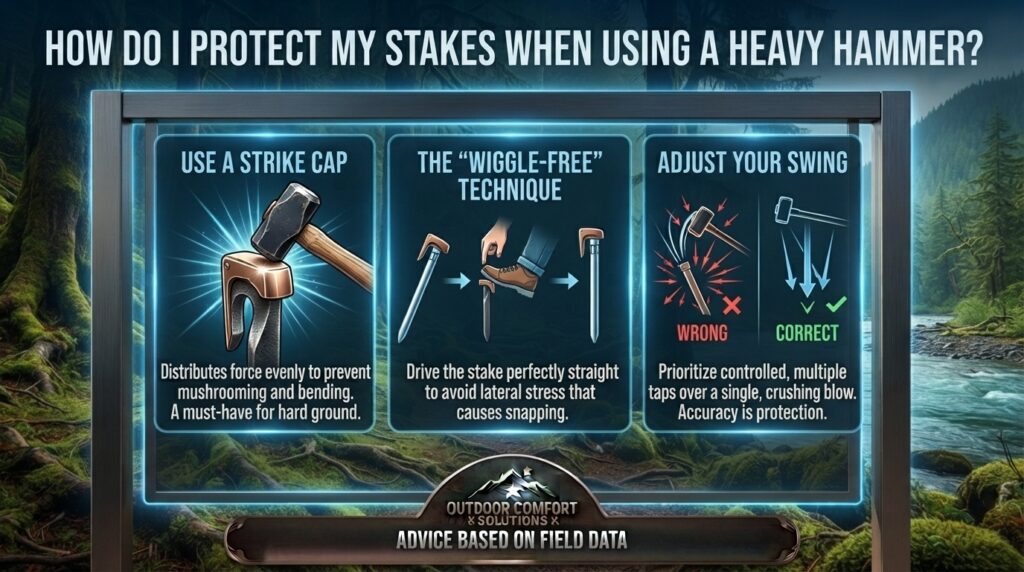
Never let the raw steel face of your hammer make direct contact with the head of your stake. Place a flat, smooth, dense object between them.
- Best Buffer: A folded, thick piece of cotton cloth or a small leather patch.
- Why it works: The fabric absorbs the high-frequency vibration of the steel, spreading the force across the entire surface of the stake head instead of a single impact point.
2. Utilize a “Sacrificial” Stake
If you are worried about the head of your primary tent stake deforming, drive a sacrificial rock peg (a heavy-duty steel peg) into the ground first to create a pilot hole. Once you remove that steel peg, you can slide your lighter-weight aluminum or titanium stake into the hole. You essentially bypass the need for hammering altogether.
3. The “Soft Face” Conversion
If you are car camping and your heavy hammer is a steel claw hammer, consider wrapping the head in layers of duct tape or rubber tubing. Creating a “soft face” creates a dampening effect that is much kinder to aluminum and titanium heads while still retaining the weight needed to punch through hardpan.
4. The 90-Degree Precision Strike
Most stakes bend because the hammer strike was off-axis. A blow that hits the side of the stake head creates a bending moment, which snaps even high-quality metal. Focus on vertical precision. If you cannot strike perfectly vertically, do not swing.
5. Adjust Your Force, Not Your Tool
In regions like Washington or New York, where the soil is loamy, you don’t need a “nails-into-wood” swing. Use the weight of the hammer head to your advantage. Let the hammer drop, rather than driving it with your full bicep power.
Regional Soil Considerations
| Region | Soil Challenge | Protection Strategy |
| Texas | Baked, hard clay | Use a Buffer: The clay is unyielding; you need the hammer, but protect the stake head. |
| New York | Roots/Stones | Stop and Relocate: If you hit a root, hammering will only destroy the stake. |
| California | Granite | Use Rock Pegs: Don’t use light stakes here; use hardened steel. |
| Washington | Damp Loam | Manual Pressure: Forget the hammer; use your foot. |
| San Francisco | Sand/Loose | Long-Stakes: Hammering doesn’t help here; use wide-body anchors. |
10 Frequently Asked Questions (FAQ)
1. Can I use a rubber mallet instead of a heavy hammer?
Absolutely. A rubber mallet is the best tool for protecting your stakes. It is heavy enough to drive the stake but soft enough that it will never “mushroom” the metal.
2. Does titanium need protection?
Titanium is much stronger than aluminum, but it is not immune to deformation. If you are hammering into frozen or extremely hard ground, a buffer is still recommended to keep the head pristine.
3. What is “mushrooming”?
Mushrooming occurs when the top of the stake spreads out and deforms due to repeated heavy strikes, making it impossible to pull out or pack away.
4. Why does my stake bend when I hit it?
You are likely hitting it off-axis (not perfectly centered) or forcing it into a hidden rock. Stop and relocate.
5. Can I use a flat stone to protect my stake?
Yes, a flat, smooth stone acts as a perfect buffer. Just ensure the stone is thick enough that it won’t shatter on the first swing.
6. Are there stakes designed to be hammered?
Yes, look for “Rock Pegs” or “Nail Pegs” which have hardened heads designed to withstand direct steel-on-steel impact.
7. How do I protect the cord loops?
The cord loops are the most fragile part. If you have to hammer, remove the cord/loop first, drive the stake, and re-attach the cord.
8. Is the claw end of the hammer useful?
No, never use the claw end to pry. It applies extreme point-pressure that will snap your stake instantly.
9. Will duct tape on my hammer head leave a residue?
Yes, but it is a small price to pay to keep your gear in good shape. You can easily clean it off with an alcohol wipe.
10. Does soil type affect how hard I can swing?
Yes. In soft soil, you need almost zero force. In hard clay, you need force, but you must use a buffer to distribute that force.
Conclusion: The Expert’s Takeaway
Protecting your stakes is about understanding the balance between kinetic energy and material limits. A heavy hammer is a tool of convenience, but it requires a “soft touch” and the right buffers to keep your gear intact.
By using a buffer (like cloth or leather), converting your hammer face, and—most importantly—knowing when to stop hammering and move to a new spot, you ensure that your stakes remain straight, functional, and ready for your next adventure.
At besttentstakes.com, we advocate for gear that lasts. If you find that your current stakes are constantly being damaged, it may be time to upgrade to a set of hardened rock pegs or titanium nails. They are designed for the hammer, so you don’t have to worry about the protection.