

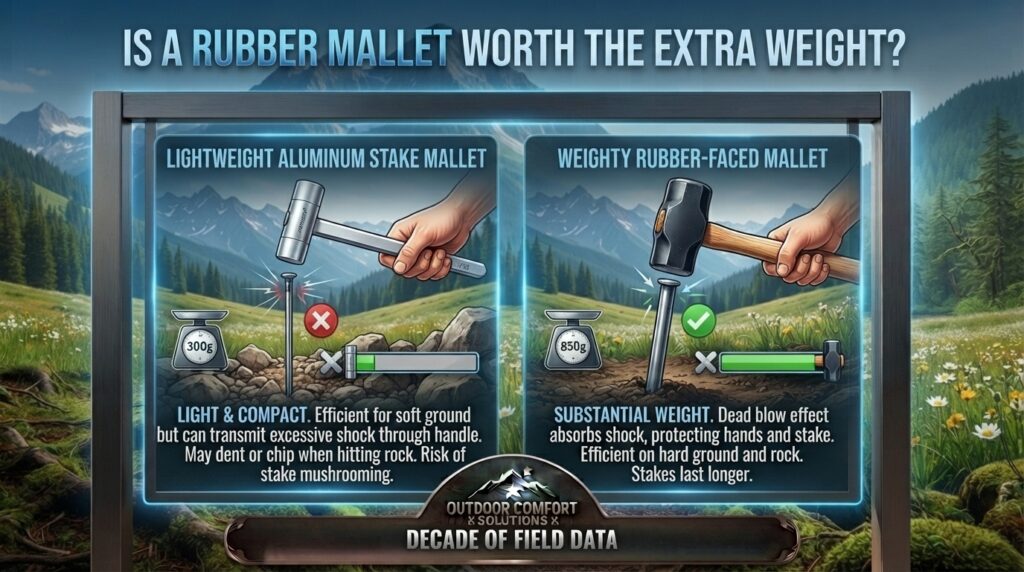
If you have ever spent thirty minutes fruitlessly battling a stubborn tent stake in hard, baked ground, you have probably wondered if carrying a rubber mallet is worth the extra weight in your pack. The short answer: It depends entirely on your style of camping.
For family car campers and glampers, a rubber mallet is an essential, reliable tool. For ultralight backpackers trekking through the backcountry, it is almost always unnecessary “dead weight” that can be replaced by more versatile, natural solutions.
The Rubber Mallet: When It’s Worth It
A rubber mallet is designed to provide significant impact force while protecting your gear.
The Pros
- Gear Protection: The soft rubber head prevents “mushrooming”—the deformation of the stake head that happens when you strike soft aluminum or titanium with a hard steel hammer.
- Ease of Use: It makes driving stakes into firm or compacted campsites significantly easier and faster, turning a potential struggle into a quick setup.
- Dual Functionality: Many camping-specific rubber mallets include a built-in hook at the base of the handle, designed specifically to help pull stubborn stakes out of the ground when it’s time to leave.
The Cons
- Weight & Bulk: A typical rubber mallet weighs between 290g to 450g (10–16 oz). In the world of backpacking, where every gram counts, this is a significant penalty.
- Limited Power: If you are camping on true rocky ground or dense, frozen terrain, a lightweight rubber mallet may lack the striking power needed to penetrate the surface .
The “Backpacker’s Alternative”: Why Most Hikers Skip It
If you are hiking into the wilderness, the “extra weight” of a mallet is usually not justified [1.4.1]. Most experienced backpackers have developed techniques to avoid carrying one altogether:
- The Foot-Press Method: For 90% of soil types, a sturdy hiking boot is all you need [1.3.1]. By placing your toe on the stake and applying firm, steady pressure with your heel, you can drive most stakes into place without any tools at all [1.3.1].
- Nature’s Hammer: Almost any campground or trail has a fist-sized rock nearby [1.3.1, 1.4.2]. Using a rock to tap your stakes is free, weighs nothing, and is widely accepted as the standard “backpacker’s hammer” [1.3.1].
- Correct Stake Selection: Often, the need for a hammer is a sign that you are using the wrong stakes for the terrain [1.3.2]. Switching to high-quality titanium nail pegs or reinforced rock pegs can allow you to use a rock or your boot, eliminating the need for a mallet entirely [1.5.1].
Quick Decision Guide: Should You Pack It?
| Camping Style | Verdict | Why? |
| Family/Car Camping | Yes | You have the space; it makes setup efficient and saves your gear [1.2.2]. |
| Weekend Backpacking | No | Use a rock or your boot; save your legs from the extra weight [1.3.1]. |
| High-Altitude/Rocky | No | A mallet often lacks the power for granite; use “rock pegs” and a heavy stone [1.1.1, 1.5.1]. |
| Sand/Soft Sediment | No | You shouldn’t be hammering here at all; use longer sand anchors [1.5.2]. |
10 Frequently Asked Questions (FAQ)
1. Will a rubber mallet work on frozen ground?
It can, but rubber can become brittle in extreme cold. If you are winter camping, a metal-headed hammer or a dedicated steel rock peg is more effective [1.2.1].
2. Is there a lightweight alternative to a rubber mallet?
Yes, there are small, minimalist camping hammers made of lightweight aluminum that have a much smaller profile than a traditional rubber-headed mallet [1.2.2].
3. Does using a rubber mallet prevent my stakes from bending?
It helps significantly by dampening the shock of the strike, but it won’t stop a stake from bending if you hit a buried rock [1.1.2].
4. Can I use a hammer drill instead of a mallet?
Only for heavy-duty, long-term setups on extremely hard rock ground. It is completely impractical for standard camping [1.3.2].
5. What is the best way to pull a stake if my mallet doesn’t have a hook?
Use another stake! Hook the loop of the spare stake onto the head of the stuck one and pull upward [1.5.1].
6. Do I need to worry about the mallet’s handle material?
Yes. Wooden handles can eventually rot if left wet, while fiberglass or metal-shaft mallets offer better long-term durability for outdoor use [1.2.1, 1.2.2].
7. Why do my stakes bounce when I use a rubber mallet?
If the mallet is bouncing, the ground is likely too hard. Stop hammering and find a new spot, or switch to a thinner “nail” style stake [1.2.2].
8. Can I use my rubber mallet for other tasks?
They are great for general campsite utility, such as securing tent poles or grounding footprint stakes [1.5.2].
9. Are plastic mallets better?
Plastic mallets are often lighter but can crack under repeated heavy strikes. Rubber remains the better choice for longevity [1.2.2].
10. What if I lose my mallet on the trail?
Don’t worry—nature provides! A solid, fist-sized rock will perform exactly the same function in an emergency [1.3.1].
Conclusion
For most campers, the rubber mallet is a “nice-to-have” luxury, not a necessity. If your primary goal is convenience at a drive-in campsite, it’s a worthy addition that saves your stakes and speeds up your setup [1.2.2]. However, if you are counting ounces on the trail, leave it at home. Your boots, a local rock, and the right choice of stakes for the region will serve you far better than any mallet ever could.