Are titanium tent stakes worth the extra money for long distance backpacking hiking trips

When you are planning a long-distance backpacking or thru-hiking trip—whether you are tackling the grueling elevation changes of California’s Pacific Crest Trail, navigating the dense roots and mud of New York’s Appalachian Trail, or enduring the wet, wind-swept wilderness of Washington’s Pacific Northwest—every single gram in your pack undergoes an unwritten trial by fire.
You quickly learn to scrutinize every piece of gear. You swap heavy stoves for ultralight setups, trim excess straps off your pack, and cut your toothbrush in half. Then you look at your shelter system.
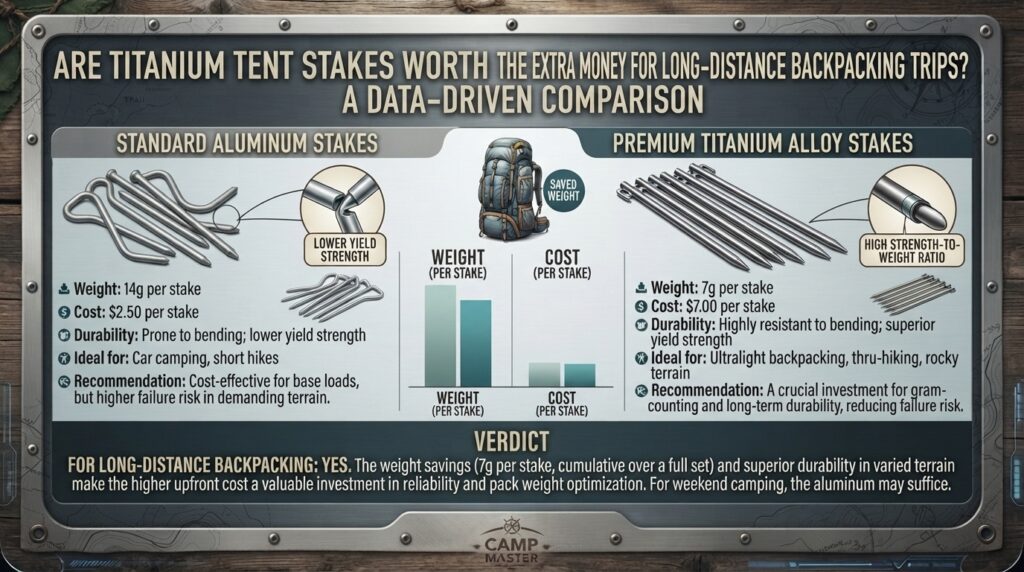
Standard aluminum tent stakes usually cost around $1.50 to $2.50 each. Upgrading to a full set of premium titanium stakes can easily cost three to four times that amount. On paper, spending $30 to $50 on a tiny handful of metal pegs sounds absurd to the uninitiated.
But on a long-distance trek spanning hundreds or thousands of miles, are titanium tent stakes actually worth the extra money?
To give you the short answer: Yes, but only if you choose the right profile for the specific terrain you are hiking. Titanium is not a magic, one-size-fits-all solution, but its metallurgical properties offer unparalleled field advantages that can save your shelter—and your sanity—when things go sideways.
Let’s dive deep into the math, the physics, and the real-world performance of titanium stakes to see if they belong in your backcountry kit.
The Core Debate: Weight vs. Durability vs. Cost
To understand if titanium is worth the investment, we need to look closely at how it stacks up against its main competitor: high-grade aircraft aluminum (typically 7075-T6 or 6061-T6 alloys).
[ Titanium Core Benefits ]
  ├── Yield Strength: Higher resistance to permanent bending under stress.
  ├── Elasticity: "Springy" memory allows it to deflect and return to straight.
  └── Hardness: Resists scoring, denting, and friction-wear from rocky soils.
1. The Weight Dynamic
A common misconception is that titanium is inherently lighter than aluminum. On a purely atomic level, aluminum is actually less dense than titanium. However, because titanium possesses a significantly higher tensile and yield strength, manufacturers can forge titanium into incredibly thin profiles (like 0.12-inch diameter wire shepherd’s hooks) that remain structural.
An ultralight titanium shepherd’s hook stake weighs a mere 0.19 to 0.30 ounces (approx. 5.4 to 8.5 grams). By comparison, a standard heavy-duty aluminum Y-stake weighs roughly 0.50 to 0.60 ounces (14 to 17 grams). Saving 0.3 ounces per stake might seem trivial, but multiplied across a shelter requiring 8 to 10 staking points, you instantly shed nearly a quarter-pound off your base weight.
2. The Fatigue and “Spring” Factor
The real magic of titanium lies in its modulus of elasticity. If you drive an aluminum stake into hard ground and hit a buried rock, the aluminum will hit its yield point and permanently bend or snap.
Titanium behaves like a spring. When it hits an underground obstruction, it yields slightly, flexing out of the way. If you back off the pressure, it snaps right back into its perfectly straight, original form. For a long-distance hiker who relies on the same stakes for 40 to 150+ consecutive nights, this resistance to structural fatigue is invaluable.
Technical Comparison: Titanium vs. Premium Aluminum
| Evaluation Metric | Ultralight Titanium (Wire/Pin) | Heavy-Duty Aluminum (Y-Beam) | Titanium V/Y-Shape |
| Average Weight Per Stake | 0.19 – 0.30 oz (5 – 8g) | 0.50 – 0.60 oz (14 – 17g) | 0.40 – 0.45 oz (11 – 13g) |
| Average Cost Per Stake | $3.00 – $4.50 | $1.50 – $2.50 | $4.00 – $5.50 |
| Penetration in Hard Soil | Excellent (Slim profile slips past rocks) | Poor (Thick cross-section resists entry) | Good (Balances shape with thin edges) |
| Holding Power (Soft/Loose Soil) | Low (Prone to spinning or twisting) | Excellent (High surface area creates friction) | Exceptional (Combines material strength with surface area) |
| Lifespan / Field Durability | Infinite (Virtually immune to snapping) | Limited (Prone to work-hardening and breaking) | Extreme (Maximum structural rigidity) |
Regional Breakdown: How Ground Conditions Affect Value
A gear choice that works flawlessly in the soft, pine-needle loam of Washington state can completely fail in the unforgiving, hard-baked earth of Central Texas. Where you hike determines the economic value of titanium stakes.
1. California & San Francisco (The Sierra Nevada & Coastal Ranges)
- The Terrain: Highly compacted granite soils, scree fields, decomposing bedrock, and shifting coastal sand.
- The Performance: In the High Sierra, finding a clear path to drive a wide aluminum Y-stake is incredibly frustrating. The slim profile of a titanium shepherd’s hook shines here. It can slip neatly between small, buried granite pebbles where thicker stakes get completely blocked.
- The Verdict: Highly Worth It. The ability to easily wedge your stakes into rocky alpine ground saves hours of camp setup stress.
2. Texas (Hill Country to West Texas)
- The Terrain: Brittle topsoil resting over solid shelves of limestone and highly compressed caliche clay.
- The Performance: Forcing aluminum stakes into Texas caliche often results in ruined, twisted metal. Titanium pins act like structural nails. They can withstand repeated impacts from heavy camp rocks without losing their tip sharpness or structural integrity.
- The Verdict: Indispensable. Standard aluminum stakes are essentially disposable gear in West Texas; titanium pays for itself by surviving the harsh ground.
3. Washington & The Pacific Northwest (The Cascades & Olympics)
- The Terrain: Thick organic forest duff, wet loam, mud, and roots.
- The Performance: Here is the catch: thin titanium wire stakes have very low surface area. In soft, rain-soaked Washington mud, a thin wire stake can pull loose under heavy wind loads.
- The Verdict: Conditional. If you hike in the muddy PNW, thin wire hooks aren’t enough. You must upgrade to a titanium V-profile or Y-profile stake (like TOAKS Titanium V-shapes) to get the required surface area and holding power without carrying heavy weight.
4. New York (The Adirondacks & Catskills)
- The Terrain: Dense, tangled hardwood root networks, wet clay, and glacial cobble boulders.
- The Performance: Setting up a shelter in the Northeast is a constant battle against tree roots. Trying to smash a wide aluminum stake through a root will either split the root or ruin your stake. A thin, rigid titanium nail can easily bypass or wedge between dense root structures.
- The Verdict: Worth It. The high corrosion resistance of titanium also protects your gear from pitting and degrading in the perennially wet, acidic soils of the Northeast.
5 Field-Tested Tips for Maximizing Titanium Stakes
If you decide to invest the extra cash into a set of titanium stakes, use these five rules to ensure they last a lifetime:
- Adopt the “Mixed Pot” Strategy: You do not need an all-or-nothing kit. Most experienced thru-hikers carry a mixed collection. Use 4 heavy-duty Y-profile stakes (aluminum or titanium) for the primary structural corner guylines of your tent, and use 4 to 6 ultra-lightweight titanium shepherd’s hooks for low-tension tie-outs, vestibules, and groundsheets.
- Never Stomp with Your Boot: Even though titanium is exceptionally strong, stomping down vertically with full body weight on a thin wire stake will leverage it against a buried stone and bend it past its elastic memory point. Always press them in using your hand, or tap them progressively with a flat wooden block or a smooth rock acting as a buffer.
- Paint the Heads: Titanium wire stakes have a very low profile and can easily disappear into the forest leaf duff. Buy stakes with pre-dipped high-visibility orange or red heads, or wrap a tiny piece of reflective paracord or neon tape through the top loop so you don’t accidentally leave a $4 stake behind when breaking camp at dawn.
- Use the “Big Stone, Little Stone” Anchor: If you encounter solid rock shelves where no stake can penetrate, lay your titanium stake flat on the ground, tie your guyline to it, place a large heavy stone directly over the stake, and wedge a second stone behind it to create an immovable anchor.
- Clean After Muddy Trips: While titanium will not rust or oxidize like steel or aluminum, packed wet mud left on your stakes can corrode your tent fabric or storage sack over time. Wipe them down with a handful of dry grass or a camp towel before packing them away.
10 Frequently Asked Questions (FAQs)
1. Do titanium tent stakes really save a meaningful amount of weight?
Yes, for a long-distance backpacker. A standard set of eight high-quality aluminum Y-stakes weighs around 4.8 ounces. A set of eight ultralight titanium wire stakes weighs around 1.5 ounces. Saving over 3 ounces directly out of your pack’s base weight is one of the cheapest ways to shed weight when optimizing an ultralight setup.
2. Can titanium tent stakes bend?
Yes. Titanium is highly resistant to bending and possesses excellent elastic memory, but it is not entirely indestructible. If you strike it with high-impact force using a heavy rock against solid bedrock, it will bend permanently or warp.
3. Is it easier to straighten a bent titanium stake compared to aluminum?
Significantly easier. Aluminum work-hardens when bent, meaning it becomes extremely brittle and often snaps when you try to force it straight. Titanium retains its ductility well, allowing you to carefully leverage it back into a functional shape without the metal cracking.
4. Why do my titanium shepherd’s hook stakes keep spinning in the ground?
Because round wire stakes have a completely smooth, narrow profile, they lack rotational surface area. In loose soil or high winds, the tension from your tent’s guyline can cause the hook to rotate sideways, letting the line slip off. To fix this, drive the stake in at a deep 45-degree angle, or place a stone over the hook to lock it down.
5. What is the best titanium stake for soft, sandy, or muddy ground?
For soft or shifting ground, avoid thin wire stakes. Instead, choose a titanium V-shaped or Y-shaped stake (such as options from TOAKS or Vargo). These profiles feature significantly wider surface faces that catch the dirt, providing excellent holding power in loose conditions.
6. Are titanium stakes safe to use with a freestanding tent?
They are excellent for freestanding tents. Since a freestanding tent holds its own shape, the stakes are primarily preventing the shelter from shifting or blowing away in unexpected wind gusts. Light titanium wire pins provide more than enough security for these configurations.
7. Do I need titanium stakes if I only do weekend camping trips?
Probably not. If your trips only last 2 to 3 days and you aren’t logging serious daily mileage, the extra cost of titanium yields diminishing returns. Standard aluminum stakes work perfectly fine for casual use, provided you carry a couple of spares in case one bends.
8. Will titanium stakes rust or corrode over time?
No. Titanium forms a passive oxide coating almost instantly when exposed to air, making it completely immune to rust, galvanic corrosion, and degradation from acidic forest soils, rain, or saltwater environments.
9. Why are titanium tent stakes so much more expensive than aluminum?
Titanium is exceptionally difficult to extract, refine, and machine. Processing the raw metal requires specialized vacuum environments, and forging it into precise outdoor gear inflicts extreme wear on manufacturing tools, driving up the retail price.
10. If I can only buy four titanium stakes, where should I use them on my tent?
Always place your highest-performing, strongest stakes at the primary windward corners of your shelter. These spots endure the brunt of structural stress when a storm rolls in. Lower-tier or older stakes can be relegated to minor areas like vestibule doors or peak pull-outs.
Conclusion
If you are a casual weekend warrior who camps primarily at developed state parks, titanium tent stakes are a luxury you can comfortably skip.
However, if you are a long-distance backpacker, thru-hiker, or weight-conscious alpinist, titanium stakes are unequivocally worth the investment. The premium price tag buys you structural reliability across thousands of miles of varied terrain. By freeing up pack weight, enduring brutal rock strikes, and adapting to challenging backcountry soils, a solid set of titanium stakes proves to be one of the smartest upgrades you can make to your shelter system.