
How to choose the right tent stake shape for different types of soil conditions

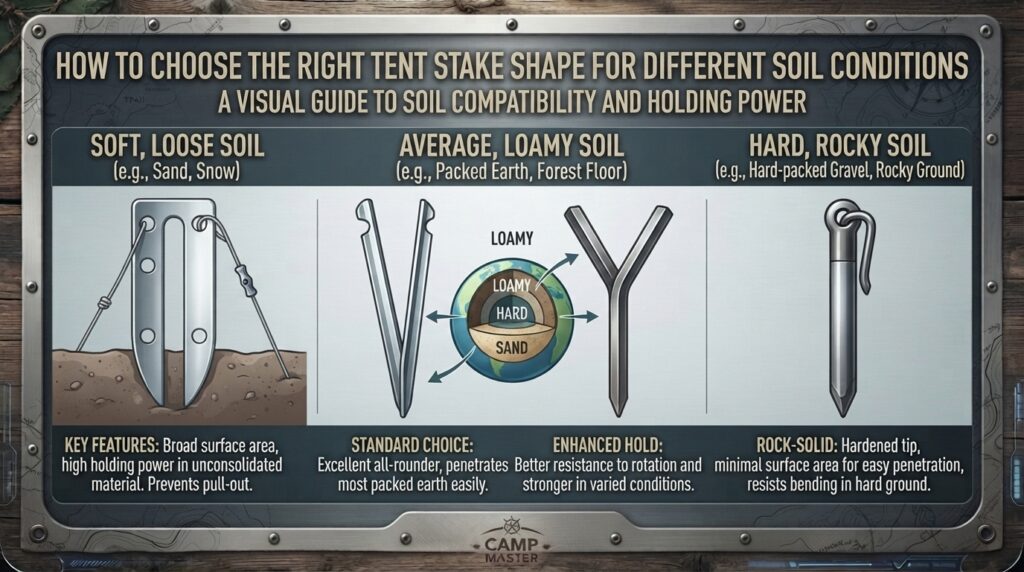
Every experienced backpacker knows the feeling of relief when arriving at a campsite after an exhaustive, high-mileage day. Whether you are pitching your shelter along the rocky ridges of California’s Sierra Nevada, amid the dense root networks of New York’s Adirondacks, on a windy bluff in Washington’s Pacific Northwest, or across the hard-baked caliche plains of Central Texas, the final step to a secure night of sleep is driving in your tent stakes.
Yet, all too often, this final step turns into a frustrating battle. You hit an obstruction, a stake spins uselessly in loose soil, or a premium peg folds completely in half.
The mistake isn’t necessarily the material of your stake—it’s almost always the shape.
Tent stakes are engineered with distinct geometric cross-sections, and each profile is tailored to interact with a specific type of ground anatomy. If you try to use a thin wire pin in loose coastal sand near San Francisco, your tent will blow away with the first gust of wind. If you try to force a wide, high-surface-area sand canopy stake into rocky glacial till, you will destroy your gear before it even gets an inch into the ground.
This definitive guide will break down the science of soil mechanics, analyze every tent stake shape available on the market, match them to regional environments across the United States, and teach you exactly how to choose the perfect stake setup for your next long-distance hiking trip.
1. The Mechanics of Soil and Anchor Holding Power
To understand why stake geometric profiles matter, we must first look at how soil behaves when placed under load. When wind hits your tent rainfly, that kinetic energy travels down the guyline and exerts pulling force on your tent stake. The stake stays in the ground by leveraging two primary physical forces: friction and soil shear resistance.
                           [ Guyline Pulling Force ↗ ]
                                       │
                                       ▼
    [ Soil Compression Zone ]  ◄─── █▒▒▒█ ───►  [ Surface Area Friction ]
                                    █▒▒▒█
                                    █▒▒▒█
- Friction: The physical contact between the outer surface of the stake material and the surrounding earth. Tight, highly compressed soils exert high friction.
- Soil Shear Resistance: The ability of the soil particles to lock together and resist being displaced or pushed aside when the stake is pulled against them. Loose soils (like sand or dry snow) have incredibly low shear resistance, while damp loam or dense clay has high shear resistance.
A stake with a wide, structural cross-section (like a Y-profile or a V-angle) displaces a larger volume of soil and forces the earth to pack tightly into its grooves. This creates a massive wedge of resistance. Conversely, a ultra-slim wire stake relies almost purely on friction; if the soil is loose, it slips out like a needle through fabric.
2. Comprehensive Deep Dive into Tent Stake Shapes
Manufacturers shape stakes into various geometric cross-sections to balance weight, packability, and holding dynamics. Let’s look at the four primary shapes you will encounter in the outdoor gear market.
Y-Profile / Tri-Beam Stakes
The Y-profile (pioneered globally by designs like the MSR Groundhog) features three distinct fins radiating from a central structural spine at 120-degree angles.
- How it Works: As the Y-shape enters the dirt, soil packs tightly into the three open channels between the fins. When a guyline pulls against the stake, it has to lift or displace the entire wedge of packed dirt captured within those fins, giving it unparalleled holding power.
- Pros: Exceptional structural rigidity; highly resistant to bending; holds well in a massive variety of soil profiles from loose dirt to dense forest soil.
- Cons: Can be difficult to clean when caked in wet clay; has a bulkier pack profile; requires more striking force to drive down.
V-Angle / Stamped V-Stakes
V-stakes are created by taking a flat strip of metal or composite material and stamping a clean 90-degree bend down its longitudinal axis.
- How it Works: When driven into the ground with the open interior of the “V” facing directly toward your tent, it acts like a miniature underground parachute or shovel blade. The soil piles up inside the trough of the V-shape, resisting pulling forces.
- Pros: Extremely stackable (multiple V-stakes nest together perfectly in a gear sack, saving massive pack volume); fantastic holding capacity in medium-to-soft soils.
- Cons: If driven in sideways or backward (with the point of the V facing the tent), its holding power drops by more than 50%; thinner stamped aluminum variants can warp along the spine if hit incorrectly.
Shepherd’s Hook / Round Pin Stakes
The classic hook stake is a simple cylindrical wire rod with a curved, crook neck at the top to catch a tent loop or guyline cord.
- How it Works: This profile relies almost exclusively on its ultra-thin cross-section to slice cleanly past underground stones, tree roots, and small pebbles.
- Pros: Incredibly lightweight; effortless to slip into tight crevices; occupies minimal space.
- Cons: Miserable holding capacity in loose or wet earth; highly prone to “spinning” (twisting sideways under load, allowing the guyline to slip off the hook); easily bent if forced.
Nail / Peg Stakes
Nail stakes are perfectly straight cylindrical or square shafts featuring a reinforced flat head at the top and a sharp, tapered point at the driving end. They are often built from heavy-duty steel, solid titanium, or thick carbon fiber.
- How it Works: Actuation is simple: they function precisely like a structural construction nail, piercing tough, stubborn layers of earth via raw vertical force.
- Pros: The undisputed king of penetrating hard-packed, frozen, or rocky soils; handles heavy rock mallet impacts without shattering.
- Cons: Very poor surface area retention; if the ground becomes waterlogged or soft, nail stakes will pull loose under moderate wind loads.
3. The Cross-Section Reference Matrix
To quickly visualize how these shapes compare across core performance metrics, consult the master reference matrix below.
| Stake Geometric Shape | Relative Surface Area | Penetration Ability | Resistance to Bending | Packability / Nesting | Primary Failure Mode |
| Y-Profile / Tri-Beam | Very High | Medium | Exceptional | Poor (Bulky) | Twisting / Fin warping |
| V-Angle / Stamped | High | Medium-Low | Good | Excellent (Nests) | Longitudinal creasing |
| Shepherd’s Hook | Extremely Low | High | Poor | Good | Right-angle folding |
| Nail / Peg Profile | Low | Exceptional | High | Fair | Head separation |
4. Matching Stake Shapes to Regional U.S. Soil Profiles
To ensure your shelter stays anchored, you must match your stake geometric shapes to the soil geography of your specific hiking destination.
California & San Francisco (The High Sierra, Coastal Ranges, & Bay Bluffs)
- Soil Ecosystem: High alpine regions like the Sierra Nevada feature highly compacted granite soils, scree fields, and decomposing bedrock fragments. Meanwhile, the coastal bluffs surrounding San Francisco offer loose, shifting maritime sand mixed with wind-swept topsoils.
- The Shape Solution:
- For the Mountains: Bring Shepherd’s Hooks or Nail Stakes. You need a narrow, needle-like shape that can navigate the microscopic gaps between subterranean granite rocks.
- For the Coast: Switch completely to wide, high-surface-area V-Angle Stakes driven deeply at a sharp angle to catch the loose sand particles.
Texas (Hill Country, Central Clay, & West Texas Desert)
- Soil Ecosystem: Central and West Texas are infamous for caliche—a bone-dry, cement-like sedimentary layer of calcium carbonate—as well as jagged, shallow limestone shelves.
- The Shape Solution: Avoid thin wire hooks and soft aluminum Y-stakes here, as they will twist and deform instantly. Choose heavy-duty Nail Stakes made of titanium or hardened steel. Treat the ground like concrete; tap the nail stake steadily into the caliche to punch a clean pilot hole.
Washington & The Pacific Northwest (Cascades & Coastal Rainforests)
- Soil Ecosystem: The PNW features exceptionally deep, wet organic duff, decomposition loam, mud, and shallow, hyper-dense evergreen root mats.
- The Shape Solution: Thin pin stakes are useless in wet, spongy mud. You require maximum surface area to combat low shear resistance. Choose large Y-Profile Stakes or wide V-Angle Stakes. The deep fins will bite into the soft forest loam and lock your shelter down against heavy, rain-laden coastal storms.
New York & The Northeast (The Adirondacks & Catskills)
- Soil Ecosystem: Glacial cobble (smooth, rounded boulders buried at random depths) combined with dense, subterranean networks of ancient hardwood tree roots and slick glacial clay.
- The Shape Solution: This terrain requires a strategic mix. A Y-Profile Stake is ideal if you can find a clear patch of forest soil. However, if you are constantly striking thick roots, deploy a Nail Stake or a rigid Shepherd’s Hook to wedge directly between the root joints or slip past the round edges of buried river stones.
5. Pro-Tips for Perfect Field Staking and Care
Regardless of which shape you deploy, your field technique determines whether that shape succeeds or fails. Implement these five industry-standard tips on your next trek:
- The Master 45-Degree Rule: Never drive a tent stake straight down vertically into the ground at a 90-degree angle. Instead, tilt the top of the stake 45 degrees away from the tent, with the point aiming directly toward the shelter. This positioning forces the pull of the guyline to cut perpendicular to the stake’s shaft, multiplying its mechanical advantage and holding power up to three times over.
- Clear a Visual Micro-Site: Before blindly hitting a stake, scrape away the top two inches of loose leaves, pine needles, or decomposing organic mulch with your boot or a trowel. Seeing the true surface of the raw earth allows you to identify hidden root lines or rock edges before you damage your gear.
- The “Big Stone, Little Stone” Bypass: If you encounter solid rock shelves where no stake can penetrate, lay your stake flat on the ground, tie your guyline to it, place a large heavy stone directly over the stake, and wedge a second stone behind it to create an immovable anchor.
- Rotate for Security: If you are using V-stakes in high-wind conditions, ensure the open trough of the “V” faces the tent structure. If the wind shifts permanently, go outside and rotate the stakes so they continue to act as miniature parachutes relative to the directional pull of the guylines.
- Maintain Your Gear Fleet: Once you return home from a muddy or wet backpacking trip, pull your stakes out, wash off all caked-on dirt and grit, and inspect the structural spines for stress fractures. Storing stakes coated in acidic forest mud can cause pitting and micro-corrosion over time.
6. 10 Frequently Asked Questions (FAQs)
1. What is the single best all-around tent stake shape for a beginner backpacker?
The Y-Profile (Tri-Beam) stake is universally considered the best all-around choice. It delivers an excellent balance of high holding power in soft earth, outstanding structural stiffness against bending, and reliable performance across roughly 80% of typical campsite soil variations.
2. Why do my tent stakes keep pulling out of the ground when it rains heavily?
When heavy rain saturates the earth, it turns the soil into a liquid slurry, causing its shear resistance to plummet to near zero. Slim profiles like shepherd’s hooks lose all friction in these conditions. To fix this, you need to switch to high-surface-area shapes like wide V-Stakes or large Y-Stakes, which grab more physical earth.
3. Can I use my boot to stomp Y-profile stakes into hard ground?
No. While Y-stakes are exceptionally rigid along their longitudinal axis, stomping them with a heavy boot applies unguided, uneven downward force. If the tip hits a buried stone while you are applying full body weight, the stake will bend or warp. Always push them in gently by hand or tap them with a smooth rock.
4. What should I do if my shepherd’s hook stakes keep spinning sideways?
Round wire stakes frequently rotate under guyline tension, causing the cord to slip off the hook. To stop this, ensure the stake is driven completely flush with the ground so the hook is practically touching the dirt, or place a medium-sized stone over the head of the hook to mechanically lock it in place.
5. Are plastic tent stakes worth carrying on a long-distance backpacking hike?
Generally, no. Heavy-duty plastic or polycarbonate stakes provide decent surface area for car camping or sand, but they are far too heavy, bulky, and prone to snapping at the head when struck by camp stones. For long-distance backpacking, stick to ultralight aluminum or titanium alloys.
6. How do I choose a stake shape specifically for camping in deep snow or sand?
Deep snow and beach sand possess incredibly low structural density. Standard backpacking stakes will pull out instantly. You need specialized Sand/Snow Stakes, which are extra-long, wide V-shaped or U-shaped scoops perforated with holes along the center spine. The holes allow snow or sand to pack through and freeze or settle, locking the anchor in place.
7. Why do some V-stakes have holes drilled through their sides?
The holes in premium stamped V-stakes serve a dual purpose: they shed unnecessary weight without compromising structural integrity, and they allow soft soil, mud, or snow to press through the metal face, creating an interconnected mechanical bond that increases overall holding power.
8. What stake profile works best for an ultralight, non-freestanding trekking pole tent?
Non-freestanding shelters rely 100% on stake tension to keep the structure upright. A single failed stake can cause the entire tent to collapse. Therefore, you should carry ultra-secure Y-Profile or deep V-Stakes for the primary corner anchors, as they provide maximum insurance against wind load failures.
9. Can I mix and match different stake shapes in the same gear kit?
Yes, and you absolutely should. Most experienced thru-hikers carry a hybrid gear kit. For example, a smart configuration consists of four robust Y-stakes for the primary high-tension structural corners of the tent, combined with four lightweight shepherd’s hooks or nail pins for the minor vestibule pull-outs and groundsheets.
10. How long can I expect a high-quality set of aluminum Y-stakes to last?
If driven correctly without excessive rock impacts or boot-stomping, a premium set of 7075-T6 aluminum Y-stakes can easily last for several multi-month thru-hikes. They only need replacement if the central spine develops a noticeable permanent curve or if the metal shows visible micro-cracking.
Conclusion
Choosing the right tent stake is not a matter of guessing; it is an exercise in analyzing the ground conditions beneath your feet. By matching the structural integrity of Y-profiles to unpredictable terrains, the stackable ease of V-shapes to soft loams, and the surgical precision of nails and shepherd’s hooks to rocky or root-dense forests, you protect your shelter from unexpected failures.
Treat your stakes as the foundation of your entire sleep system. Keep your kit varied, respect the soil mechanics of the regions you explore, and sleep soundly knowing your tent is anchored by the perfect shape for the job.