How do I remove a steel stake that is jammed tightly between underground rocks?

Setting up camp or securing a canopy on rocky terrain often comes with a frustrating side effect: a heavy-duty steel stake driven straight into a subterranean “rock trap.” When two underground boulders wedge around the shaft or notch of a steel stake, pulling upward by hand is virtually impossible.
In fact, tugging blindly at a jammed steel stake can strain your lower back, tear guyline loops, or snap the stake’s head off entirely.
The secret to removing a jammed steel stake is breaking the mechanical friction bond rather than relying on raw vertical lifting power. By using targeted lateral rotational tapping, hydraulic soil lubrication, or simple physical leverage principles (like fulcrum levers and claw mechanics), you can extract even the most stubbornly wedged steel stake without destroying your gear or your back.
The Physics of Underground Rock Traps
Understanding why your stake is stuck helps you choose the correct extraction method. When a heavy steel stake enters rocky soil, it encounters three distinct types of subterranean resistance:
    SURFACE SOIL
  ═════════════════════════════════════════
      │             │
      │   STAKE     │  <-- Downward Force
      ▼             ▼
   ┌──────┐     ┌──────┐
   │ ROCK │ ==> │ ROCK │  <-- Pinching Force (Lateral Compression)
   │  A   │     │  B   │
   └──────┘     └──────┘
      │   WEDGED    │
      │   POINT     │
- The Scissors Pinch (Mechanical Interference): The stake passed between two adjacent rocks that shifted under impact. The weight of the surrounding soil presses these rocks against the steel shaft like a vise.
- Friction Lock (Surface Tension): Smooth or ribbed steel stakes (like rebar or hook stakes) create massive surface friction against stone faces under soil pressure.
- Vacuum & Soil Compaction: In dense clay or wet silty soil intermixed with gravel, pulling a stake creates a localized vacuum at the tip, requiring dozens of extra pounds of pull force to break free.
7 Step-by-Step Methods to Free a Jammed Steel Stake
Use these proven field techniques, ordered from simplest to most advanced, depending on what tools and natural elements you have available at your site.
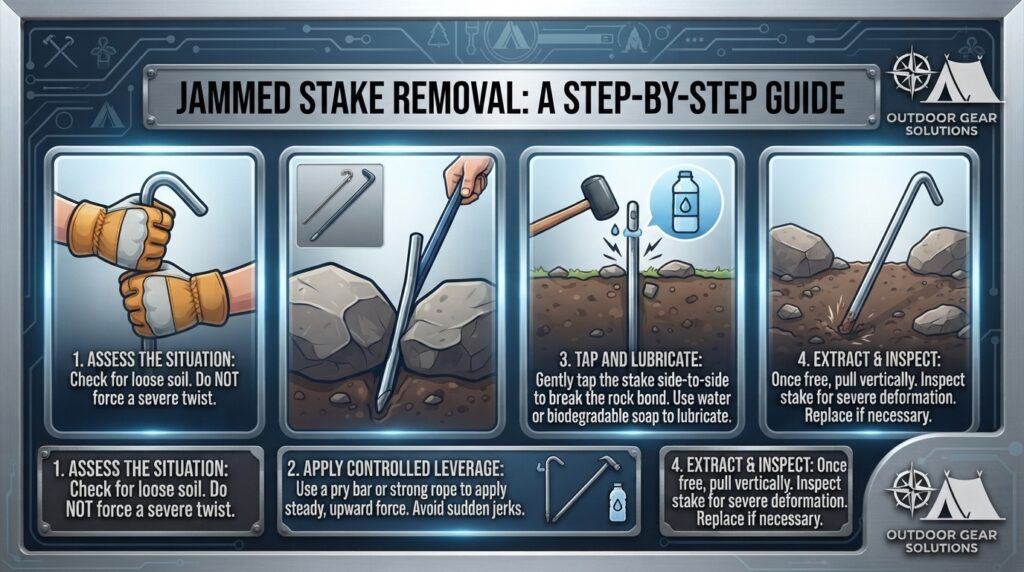
1.Method 1: The 360-Degree Rotational Tap (Break the Friction Bond):Required Tools: 3 lb Hammer / Heavy Rock.
Before pulling upward, you must break the static friction holding the steel against the rock faces.
- Take your 3 lb hand sledge hammer or a flat, dense rock.
- Tap the exposed head of the steel stake side-to-side in a 360-degree circle.
- Do not hit it hard enough to bend the shaft—you are aiming to create micro-clearance between the steel and the pinched rocks.
- Once you hear a slight change in impact tone (from a dull thud to a hollow ring), the bond is broken.
- Twist the stake clockwise and counter-clockwise using a second stake or pliers before pulling up.
2.Method 2: The Rock & Lever Claw System (Class-1 Lever):Required Tools: Camp Axe / Claw Hammer + Fulcrum Rock.
Lifting vertically with your back puts all the strain on your body. Using a natural fulcrum multiplies your pulling force exponentially.
- Place a sturdy 4-to-6-inch thick rock or log segment 2 inches away from the stuck stake.
- Hook the claw of a hammer or the notch of a camp axe under the head or hole of the steel stake.
- Rest the neck of the tool on your fulcrum rock.
- Press downward on the handle of your tool. The leverage multiplies your downward force into massive upward lifting power, popping the stake out of the rock pinch.
3.Method 3: Hydraulic Soil Lubrication (The Water Flush):Required Tools: Water Bottle or Canteen + 5 Minutes.
If dry clay, silt, or crushed rock dust has compacted around the wedged boulders, water acts as a natural pressure release.
- Pour approximately 8 to 16 ounces of water directly around the base where the stake enters the ground.
- Tap the stake lightly side-to-side to allow water to trickle down the shaft into the subterranean gap.
- Wait 3 to 5 minutes for the water to soften compacted dust and lubricate the rock contact points.
- Twist and pull upward—the reduced friction coefficient allows the stake to slide out smoothly.
4.Method 4: The T-Handle Twist Leverage:Required Tools: Spare Steel Stake or Heavy Screwdriver.
If the stake has an eyelet hole or hook top, linear pulling often fails where rotational torque succeeds.
- Slide a secondary sturdy steel stake (or heavy screwdriver/carabiner) horizontally through the eyelet or under the hook of the jammed stake.
- Grasp both sides of the horizontal crossbar with both hands to form a “T-handle.”
- Rotate the jammed stake 360 degrees repeatedly while pulling upward smoothly.
- The rotational force shifts the orientation of the stake tip, slipping it out from between the pinching rock edges.
5.Method 5: The High-Leverage Wooden Pole Lift:Required Tools: 4-Foot Sturdy Fallen Log or Board.
When dealing with deep commercial canopy anchors or rebar driven 18+ inches into rock-heavy soil, hand tools may not offer enough leverage.
- Wrap a low-stretch guyline, webbing strap, or chain tightly around the base of the stake using a clove hitch or pipe-hitch knot.
- Tie the other end of the cord to a thick, 4-to-5-foot log or timber branch.
- Place a large boulder near the stake to act as your fulcrum point.
- Rest the middle of the log on the boulder and push down on the far end of the log lever.
6.Method 6: Pressure-Relief Trenching:Required Tools: Hand Trowel or Entrenching Tool.
If the stake is wedged under a large flat granite shelf, pulling up will only wedge it tighter.
- Use a sturdy trowel or shovel to dig away soil on one side of the stake down 4 to 6 inches.
- Expose the subterranean rock that is trapping the steel shaft.
- Use a flathead tool or secondary stake to pry the obstructing stone away from the shaft.
- Once the lateral compression is released, pull the stake out toward the excavated trench side.
7.Method 7: The Vise-Grip Spiral Extraction:Required Tools: Locking Pliers (Vise-Grip).
For smooth steel stakes or headless rebar driven flush with the ground line:
- Clamp a pair of heavy-duty locking vise-grip pliers tightly to the exposed steel shaft just above ground level.
- Tap the underside of the vise-grip jaw upward with a 3 lb hammer.
- Alternate between tapping upward and rotating the pliers in full circles to screw the stake upward out of the subterranean grip.
Comparison of Extraction Methods
Choosing the right method depends on the gear you carry and the site conditions:
| Method | Best For | Required Tools | Success Rate in Hard Soil | Physical Effort Level |
| 360-Degree Tap | Lightly wedged stakes, steel pins | 3 lb Hammer or Rock | 85% | Very Low |
| Rock & Lever Claw | Hooked stakes, eyelet stakes | Hammer/Axe + Fulcrum Rock | 95% | Low |
| Hydraulic Flush | Dry clay mixed with rock, compacted silt | Water (8–16 oz) | 75% | Minimal |
| T-Handle Twist | Eyelet stakes, rebar with loops | Second stake, thick screwdriver | 90% | Moderate |
| Log Lever System | Commercial 18″+ rebar, heavy anchors | 4 ft Log + Webbing strap | 98% | Low (Leverage-driven) |
| Pressure Relief | Embedded under large rock shelves | Camp Trowel / Shovel | 90% | High (Requires digging) |
Regional Soil & Subterranean Conditions
Terrain varies dramatically across North America. Knowing what lies beneath the surface helps you anticipate jams before driving stakes:
California & San Francisco Bay Area
- Subterranean Landscape: Volcanic rock, granite gravel, and dense clay shelves (Sierra Nevada, Coastal Ranges).
- Common Jam Cause: Stakes wedged into fissured granite or pinched under tight root-and-rock combinations.
- Pro Strategy: Always carry a dedicated 3 lb drilling hammer and use the 360-degree tap technique first to break granite friction.
Texas (Hill Country, West Texas & North Texas)
- Subterranean Landscape: Hardened caliche (calcium carbonate layers), limestone rock, and expansive clay.
- Common Jam Cause: Caliche acts like natural concrete, binding around steel stakes when dry.
- Pro Strategy: Use the Hydraulic Flush method. Water quickly softens the binding surface tension of Texas caliche and dry clay.
Washington State (Cascades & Columbia Basin)
- Subterranean Landscape: River cobble, dense glacial till, and basalt bedrock.
- Common Jam Cause: Round basalt cobble rolling into the stake channel during driving, creating an underground wedge.
- Pro Strategy: The Rock & Lever Claw system works best here to lift straight up against loose glacial cobble.
New York (Adirondacks, Catskills & Hudson Valley)
- Subterranean Landscape: Dense glacial till, slate flakes, and intermixed tree root systems.
- Common Jam Cause: Stakes passing through slate fissures that pinch the metal shaft tightly.
- Pro Strategy: Use T-Handle Twisting to realign the stake shaft with the slate fissure direction before extraction.
Gear Maintenance: What to Do After Extraction
Once you have successfully pulled your jammed steel stake from the ground, take a minute to inspect and service your gear:
[Inspect Shaft for Bends] ──► [File Down Mushroomed Head] ──► [Wipe Moisture/Mud] ──► [Store Clean & Dry]
- Check for Bends: Roll the stake across a flat rock or picnic table. If bent slightly, tap it straight using your 3 lb hammer against a flat boulder.
- Inspect the Head for Mushrooming: Striking steel stakes with heavy hammers can mushroom the top edges over time. File sharp burrs flat to prevent hand cuts or glove snags.
- Clean Off Moisture and Clay: Wipe down steel stakes to prevent rust formation during storage, especially if you used water during extraction.
10 Frequently Asked Questions (FAQ)
1. Can pulling too hard on a jammed stake damage my tent guylines?
Yes. Never pull on guyline ropes or webbing loops to free a stuck stake. Nylon and polyester cords can snap under high tension, or the friction can slice through the stake loop. Always attach pull tools directly to the steel stake itself.
2. What should I do if the top hook or head snaps off while the stake is still stuck?
If the top breaks off below ground level, use a trowel to excavate 2 to 3 inches of soil around the remaining shaft. Clamp locking vise-grip pliers tightly to the exposed metal and use a lever or hammer tap on the pliers to extract it.
3. Will pouring water on the stake make the ground messier to pack up?
Pouring 8 to 16 ounces of water targets only the immediate stake entry hole. It absorbs into the localized soil in 2 to 3 minutes without creating a muddy mess around your tent site.
4. Is a dedicated steel stake puller tool worth carrying?
If you frequently camp in rocky regions (like the Sierra Nevada, Texas Hill Country, or Adirondacks) or set up heavy commercial event canopies, a lightweight steel stake puller or claw tool is well worth the minor weight penalty.
5. Why shouldn’t I just pull the stake out at an angle?
Pulling sideways against a wedged rock increases lateral friction and will usually bend the steel shaft permanently. Always break the bond first, then pull straight up along the angle of entry.
6. Can I use my tent pole to pry out a stuck stake?
Never use tent poles as levers. Tent pole walls are made of thin-walled aluminum or carbon fiber engineered for structural arching, not point-leverage. Prying with a tent pole will bend or snap the pole segment instantly.
7. How can I prevent stakes from getting jammed in rocks in the first place?
If you feel solid rock resistance after driving a stake 2 to 3 inches, stop pounding. Shift the stake location or angle slightly rather than forcing it between underground boulders.
8. Are rebar stakes harder to pull out than smooth steel stakes?
Yes. Rebar features ridged exterior walls that offer superior ground holding power, but those same ridges catch easily against underground rock edges. Rotational twisting is essential to free stuck rebar.
9. What is a fulcrum, and why does it make pulling stakes easier?
A fulcrum is a pivot point (like a rock or log) used by a lever. Placing a fulcrum close to the jammed stake converts downward arm force into powerful upward lifting force, multiplying your effort several times over.
10. What if the stake is completely unmovable despite all methods?
If a stake is permanently pinned in deep bedrock and cannot be freed without destructive digging, knock the exposed head flat against the ground using your hammer so it does not pose a hazard to future campers or wildlife, or cut it flush with heavy wire/bolt cutters.
Conclusion
Getting a steel stake jammed between underground rocks can slow down your camp teardown, but it doesn’t have to mean abandoning your gear or injuring your back.
By applying smart leverage—tapping 360 degrees around the head, using a rock fulcrum with your axe or claw hammer, or applying a splash of water to lubricate dry soil—you can break subterranean friction traps quickly. Keep these techniques in mind on your next trip to the rocky trails of California, Washington, Texas, New York, or beyond!