
What is the best knot to use for tent guylines if I don’t have plastic tensioners?

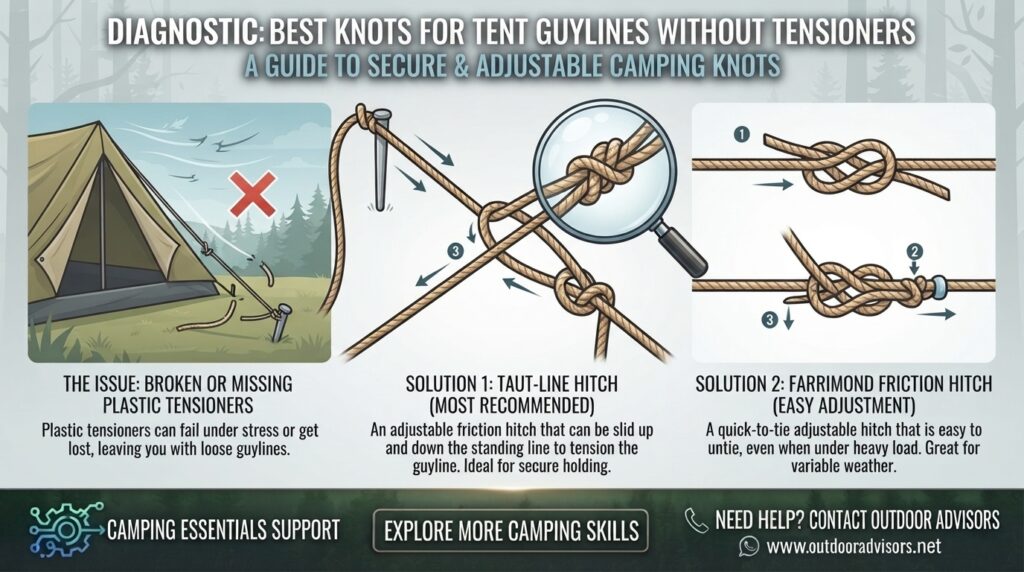
Plastic guyline tensioners (runners or linelocs) are convenient—until one snaps under high wind in the High Sierra, melts near a campfire, or gets lost in the dirt. Whether you are backpacking through the Sierra Nevada, camping along the windy coast of Northern California, pitching a tent in the high-humidity pine forests of East Texas, or setting up camp on the damp soil of Washington state, knowing how to pitch your shelter without plastic hardware is an essential outdoor skill.
The Taut-Line Hitch is widely considered the best overall knot for securing tent guylines without plastic tensioners. It forms an adjustable friction loop that slides along the standing line to tighten or loosen tension, but grips securely under load.
This comprehensive guide covers the essential friction knots every camper should know, detailed step-by-step instructions, regional pitch considerations across the United States, gear reviews, and a troubleshooting FAQ to help keep your tent taut in any weather.
1. The Core Solution: The Taut-Line Hitch vs. The Midshipman’s Hitch
When plastic tensioners are missing, you need an adjustable friction knot (also known as a slide-and-grip hitch). The knot must slide easily when pushed by hand, yet bite down firm when the guyline pulls under wind pressure.
Why the Taut-Line Hitch Wins
- Friction-Based Adjustability: Works exactly like a plastic runner.
- Single Line Simplicity: Requires no extra cordage or carabiners.
- Easy Tensioning: Slide the hitch toward the tent to tighten; slide it toward the stake to loosen.
The Superior Alternative: The Midshipman’s Hitch
While the Taut-Line Hitch is the classic Scout choice, many seasoned backcountry guides prefer the Midshipman’s Hitch (also called the Awning Hitch). It uses an “awash” turn (an internal loop that bites into the standing line), making it significantly less prone to slipping on slick, modern Dyneema, UHMWPE, or silicone-coated guylines.
2. Top 4 Knots for Tent Guylines (Ranked & Compared)
Different weather conditions and guyline materials call for different knots. The table below breaks down the top four choices for tensioning guyline cordage.
| Knot Name | Ease of Tying | Holding Power on Slick Lines | Best Use Case | Primary Advantage |
| Taut-Line Hitch | Moderate | Fair | General camping, standard nylon/poly cord | Easy to remember and adjust |
| Midshipman’s Hitch | Moderate | Excellent | Slick Dyneema/reflective lines, high wind | Forms an internal grip; won’t slip |
| Farrimond Friction Hitch | Moderate | Good | Quick breakdown, rainy conditions | Tied on a bight; quick-release slip tail |
| Trucker’s Hitch | Advanced | Maximum (3:1 Mechanical Advantage) | Ultra-windy ridges, tarp ridge lines | Extreme mechanical tensioning |
3. Step-by-Step Knot Tying Guide
How to Tie the Taut-Line Hitch
- Pass the working end of your guyline around the tent stake from front to back.
- Wrap the working end inside the loop (between the stake and your tent), crossing around the standing line twice. Keep these wraps neat and side-by-side.
- Bring the working end outside the loop, moving past your two initial wraps away from the stake.
- Wrap the working end once around the standing line outside the loop to form a half-hitch.
- Pull the working end tight while holding the standing line. Slide the knot up or down to adjust tension.
How to Tie the Farrimond Friction Hitch (Quick-Release)
The Farrimond hitch is an excellent choice in rainy environments like the Pacific Northwest (Washington/Oregon), where cold, wet hands make untying tight knots difficult.
- Form a loop around your ground stake.
- Wrap a bight (a folded bend of rope) around the standing line inside the loop twice.
- Finish with a final half-hitch around the standing line using a second bight.
- To release, pull the loose tail—the entire knot unzips instantly.
4. Regional Guyline & Stake Strategies Across the US
Pitching a tent securely without tensioners requires adapting to local soils and weather profiles.
Texas & Desert Southwest
- Soil Profile: Hard-packed clay, caliche, or loose dry sand.
- Challenge: High wind gusts and baked ground that makes driving stakes straight down difficult.
- Technique: Angle stakes at 45 degrees away from the tent. Use a Midshipman’s Hitch to prevent slippage during sudden desert wind squalls. In soft sand, bury the stake horizontally as a “deadman anchor” and tie a Clove Hitch around its center.
California & Alpine Sierra
- Soil Profile: High-elevation granite, decomposed granite (DG), and thin alpine topsoil.
- Challenge: Inability to push stakes into solid rock.
- Technique: Use the “Little Big Rock” method. Wrap your guyline around a small rock using a Clove Hitch or Bowline, place it behind a heavy anchor rock, and tension the line using a Taut-Line Hitch.
Washington State & Pacific Northwest
- Soil Profile: Deep forest duff, saturated clay, and wet topsoil.
- Challenge: Wet rope expands and loses friction; soft ground allows stakes to pull out under heavy rain loading.
- Technique: Use the Farrimond Friction Hitch or add a third wrap inside your Taut-Line Hitch (making a Magnus Hitch). The quick-release feature lets you pack up quickly in freezing rain without picking at jammed knots.
5. Gear Review: Top 3 Guyline Cordage Options for Knot Holding
Without plastic runners, the grip of your knots depends directly on your cordage texture and core structure.
1. Lawson Equipment Ironwire (2mm)
- Sheath: Textured polyester braided over Dyneema core.
- Knot Retention: Exceptional. The textured polyester outer sheath bites firmly into itself.
- Best For: Use with Taut-Line and Midshipman’s hitches in windy regions like Texas or coastal California.
2. MSR Reflective Guyline Cord (1.8mm – 2.5mm)
- Sheath: High-visibility reflective weave with smooth nylon braid.
- Knot Retention: Good. Slightly slicker than Ironwire, but holds well if an extra wrap is added to the hitch.
- Best For: Nighttime visibility in dense campsites around Washington state parks.
3. Sterling Rope 2.7mm Reflective Accessory Cord
- Sheath: Heavy-duty nylon construction.
- Knot Retention: Outstanding. Thick enough to hold standard Taut-Line Hitches effortlessly without slipping under heavy loads.
- Best For: Winter camping, heavy tents, and maximum longevity.
6. Expert Tips for Keeping Guylines Taut All Night
- Account for Cord Stretch: Nylon stretches up to 10–15% when wet from night dew or rain. Check and re-tension your friction hitches right before going to bed.
- Double Wrap for Slick Lines: If using ultra-light, smooth Dyneema cordage, add a 3rd internal wrap to your Taut-Line Hitch (effectively creating a Magnus/Taut-line hybrid).
- Set the Angle Right: Anchor your guylines at a 45-degree angle relative to both the ground and the tent wall to balance downward pressure and lateral wind resistance.
7. Frequently Asked Questions (FAQ)
Q1: What is the single best knot if I need to tie a guyline in the dark?
The Taut-Line Hitch is the easiest to tie by touch alone. Its structure consists of two inner loops followed by one outer loop, making it straightforward to memorize and check by feel.
Q2: Why does my Taut-Line Hitch keep slipping?
This usually happens if your guyline cordage is too smooth (such as slick Dyneema or ultralight Spectra), or if the inner wraps were tied loosely. Switch to a Midshipman’s Hitch or add a 3rd inner wrap to increase friction.
Q3: Can I use a Bowline knot for my tent guylines?
A Bowline forms a fixed, non-adjustable loop. It is great for attaching a guyline permanently to the tent’s webbing loop, but it cannot be adjusted for tension at the stake end unless paired with a movable stake position or secondary hitch.
Q4: How do I secure a tent in pure sand or snow without tensioners?
Bury your stake or a stout stick horizontally 6–12 inches deep as a “deadman anchor.” Tie your main line around the middle of the stick using a Bowline or Clove Hitch, then use a Taut-Line Hitch closer to the tent body to fine-tune tension.
Q5: What is the difference between a Taut-Line Hitch and a Midshipman’s Hitch?
The difference lies in the position of the second wrap. In a Taut-Line Hitch, the second turn sits parallel to the first. In a Midshipman’s Hitch, the second turn crosses back over the first turn inside the loop, creating an awash grip that prevents slipping on slick lines.
Q6: How do I tension a guyline if the line is too short to double back?
If the cord is too short to form a sliding hitch, anchor the end to the stake using a Two Half-Hitches knot, then use a stick as a toggle to twist and tension the line, driving the stick into the ground to lock it.
Q7: What rope diameter works best for knot-only guyline setups?
Cordage between 2.0mm and 3.0mm strikes the best balance between weight savings and knot-holding friction. Thinner cordage (under 1.5mm) can jam under tension and become difficult to untie when wet.
Q8: Should I tie the tensioning knot at the tent end or the stake end?
Tie the friction hitch at the stake end. This keeps the adjustment knot within easy reach from the ground and allows you to adjust tension without reaching up toward the fly under heavy rain.
Q9: What knot should I use if winds exceed 40 mph?
Use the Trucker’s Hitch. It acts as a pulley system, allowing you to apply up to three times the manual tensioning force to anchor your shelter rigidly against high wind pressure.
Q10: How do I keep my tension knots from freezing solid in winter?
Use a quick-release knot like the Farrimond Friction Hitch or a Slipped Taut-Line Hitch. The slipped tail lets you collapse the knot by pulling the free end, even if ice has formed over the turns.
Conclusion
Losing or breaking a plastic guyline tensioner does not have to ruin your trip. By mastering the Taut-Line Hitch, the Midshipman’s Hitch, and the Farrimond Friction Hitch, you can maintain a rigid, wind-resistant shelter anywhere from the rocky Sierra wilderness to rainy coastal pine forests. Match your knot choice to your cordage type and weather conditions, check your lines before bed, and your tent will stay taut and secure all night long.