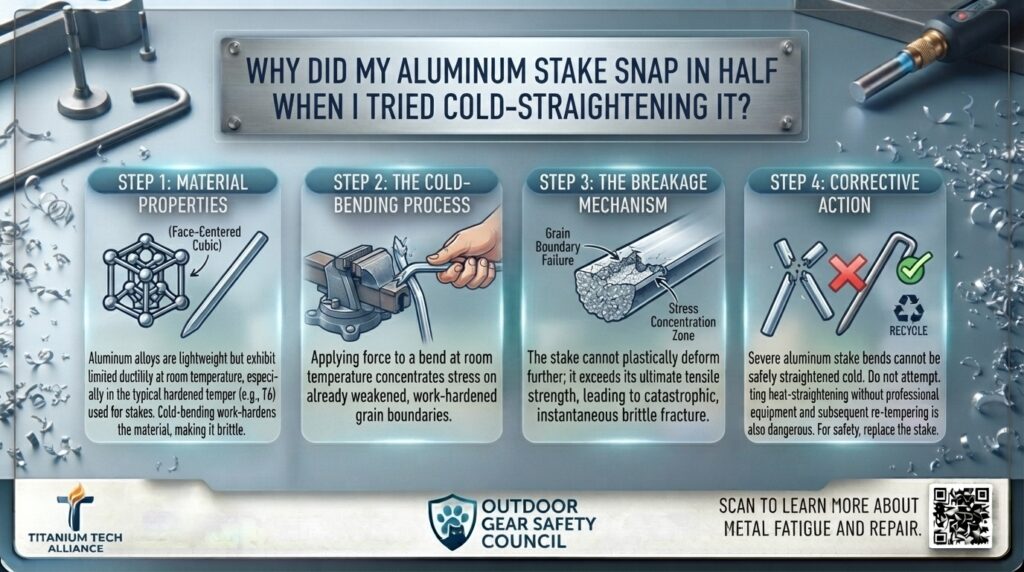
Why did my aluminum stake snap in half when I tried cold-straightening it?

Picture this scenario: You have just wrapped up a breathtaking weekend of camping—perhaps navigating the rocky granite of California’s Sierra Nevada, exploring the damp, root-heavy forest floors of Washington State, pitching your tent on the shale-strewn earth of upstate New York, or driving pegs into the unforgiving, sun-baked clay of Texas. As you pull your gear from the ground, you notice one of your lightweight aluminum tent stakes has taken a frustrating curve after hitting a hidden subsurface obstacle.
Thinking nothing of it, you decide to employ a classic camp-hack: you place the bent stake on a flat rock, press down or tap it gently with a mallet to straighten it out, and—snap—it shatters cleanly in two right before your eyes.
If you have ever stared down at two useless pieces of metal wondering what went wrong, you are not alone. Your aluminum stake snapped because of a metallurgical phenomenon called work hardening (or strain hardening), combined with the limited ductility of high-strength aluminum alloys.
The Metallurgy: Why Cold-Straightening Breaks Aluminum
To understand why a seemingly simple fix turns into a broken piece of gear, we have to look beneath the surface at how structural aluminum behaves under physical stress.
1. The Crystal Lattice and Dislocation Movement
High-end backpacking and camping stakes are rarely made of pure, soft aluminum. Instead, they are crafted from performance-driven aerospace alloys like 7075-T6 or 6061-T6. At a microscopic level, these metals consist of orderly rows of crystal grains.
When your stake hits a rock and bends during setup, those crystal rows slide past one another. In metallurgy, these shifts are called dislocations. As the metal bends, these dislocations multiply and tangle up, making that specific area harder and stiffer than the surrounding metal.
2. What Happens When You Bend It Back?
When you take that bent stake and try to cold-straighten it (bending it in the opposite direction), you force those tangled dislocations to move again.
- Loss of Ductility: Each movement strips away the metal’s remaining flexibility, a process known as exhaustion of ductility.
- Micro-Fissures: Instead of flowing smoothly back into a straight line, the tightly packed crystal structure locks up. Internal micro-fissures open along the bend axis.
- The Snap: The moment you apply pressure to force it straight, those microscopic fractures propagate instantly, resulting in a sudden, clean snap.
3. Alloy Differences: Why Some Stakes Tolerate It Better Than Others
Not all aluminum stakes react the same way. Cheap, soft aluminum utility stakes (often found in bargain multi-packs) have high ductility and low tensile strength; you can bend them back and forth multiple times before they break, but they also bend under the slightest wind load. High-end structural stakes prioritize rigidity and strength-to-weight ratios, meaning they sacrifice ductility—making them much less forgiving when cold-worked.
Material Comparison: Cold-Working and Resilience Across US Terrains
When dealing with challenging regional soils across the US, choosing a stake with the right balance of flexibility and strength prevents unexpected field failures.
| Material | Tensile Strength | Cold-Working Tolerance | Reaction to Bending | Best Regional Terrain Application |
| Aluminum (7075/6061) | High | Very Low | Work-hardens rapidly; snaps easily when straightened. | General backpacking, alpine trails, forest loam |
| Titanium (Grade 5) | Extremely High | Moderate-to-High | Elastic memory allows minor flexing without snapping. | Rocky terrain, ultralight thru-hiking (Sierra Nevada, Cascades) |
| Forged Steel | Maximum | High | Bends rather than snaps; highly malleable. | Frozen ground, hard clay (Texas caliche, New York winter) |
| Composite / Resin | Low | None | Shatters or cracks under impact. | Sandy coastal dunes, soft beach camping |
Product Reviews: Best Replacement Stakes That Resist Bending
If your aluminum stakes keep failing or snapping when you encounter tough soil conditions, it is time to upgrade your kit with more resilient alternatives.
1. MSR Ground Hog Stakes
- Best For: All-around backpacking and varied soil conditions (California mountain passes, Washington damp forests).
- Material: 7000-series aluminum.
- Why We Love Them: While they are still aluminum and can snap if heavily work-hardened, their Y-beam geometry provides exceptional structural rigidity. They resist initial bending far better than round wire stakes and bite securely into loose or semi-firm earth.
2. Vargo Titanium Nail Stakes
- Best For: Rocky ground, weight-conscious backpackers, and durability.
- Material: Grade 5 Titanium.
- Why We Love Them: Titanium offers superior elasticity compared to aluminum. If a titanium stake takes a slight curve, it tolerates cold-working and minor adjustments much more reliably without instantly snapping in half.
3. Coleman Steel Peg Tent Stakes
- Best For: Car camping, high winds, and hard-packed regional soils (Texas clay, New York state park grounds).
- Material: Forged Steel.
- Why We Love Them: Virtually indestructible. Steel is malleable, meaning if a steel stake bends in rocky or frozen ground, you can hammer it straight multiple times without fear of it snapping. Perfect for car camping where weight is not a constraint.
Expert Tips for Tent Stake Longevity
Preventing bent stakes in the first place means you won’t have to test your luck with cold-straightening in the field. Follow these guidelines:
- Stop hammering immediately upon resistance: If you hit a buried boulder or tree root, do not force the stake down. Forcing an aluminum stake against rock guarantees a warp or structural failure. Reposition the stake at a 45-degree angle away from the tent.
- Use the right striking tool: Avoid using jagged, sharp rocks that can gouge and notch aluminum shafts, creating weak points. Use a rubber mallet, a smooth stone, or the flat base of a camp hatchet.
- Retire severely bent aluminum stakes: If an aluminum stake has a sharp crease or a deep bend, accept that its life is over. Trying to straighten it is a gamble that almost always ends in a snapped stake during a midnight windstorm.
- Pack terrain-specific backups: If you are camping in rocky California canyons or the dense, dry clay of Texas, leave lightweight wire stakes at home. Bring heavy-duty steel or robust Y-beam stakes designed to handle the local geology.
10 Comprehensive FAQs
1. Why do aluminum tent stakes snap instead of bending back?
High-strength aluminum alloys (like 7075-T6) have high rigidity and tensile strength but low ductility. When you bend them, the crystal structure work-hardens. Bending them back creates internal fractures that cause the metal to snap cleanly.
2. Can I prevent an aluminum stake from snapping when I straighten it?
Generally, no. Once an aluminum structural stake is bent significantly, its molecular structure is compromised at the bend point. Trying to cold-work it back into shape almost always causes a fracture.
3. Is it safe to use a tent stake that has been successfully straightened?
It is risky. Even if a straightened aluminum stake does not snap immediately, the micro-fissures created during the bending and straightening process leave it structurally weak, making it prone to failing under wind stress.
4. Do titanium stakes snap when cold-straightened?
Titanium has much higher elasticity and ductility than high-end structural aluminum. While an extreme kink can still break titanium, minor curves can often be hammered straight safely without causing structural failure.
5. Why do high-end backpacking stakes bend so easily in the first place?
To keep base packs ultra-light, manufacturers use thin-walled aluminum tubing. This design optimizes the strength-to-weight ratio for vertical pulling forces, but leaves them vulnerable to lateral shear stress when striking hidden rocks.
6. What is work hardening?
Work hardening (or strain hardening) is the process where metal becomes harder and more brittle as it is plastically deformed (bent or hammered). As dislocations in the crystal lattice pile up, the metal loses its flexibility.
7. How should I pull a stuck aluminum stake out of the ground?
Never pull on the attached guyline or rock the stake back and forth violently, as this introduces lateral torque that bends the shaft. Instead, pull straight up using a stake puller or hook another stake through the eyelet for leverage.
8. What stakes work best in hard Texas clay?
Texas soils—especially dry clay or caliche—require rigid, heavy-duty steel pegs or spiral-fluted stakes. Standard lightweight aluminum backpacking stakes will bend or snap instantly against unyielding Texan earth.
9. Can broken aluminum tent stakes be recycled?
Yes! Aluminum is 100% infinitely recyclable without losing its material properties. Once a stake snaps in half, throw it into a local metal recycling bin rather than leaving fragments in nature.
10. How many spare stakes should I pack on a trip?
Always pack at least two to three extra stakes beyond your tent’s minimum requirement. Stakes can easily get lost in brush, overlooked during teardown, or broken on tough terrain, ensuring your shelter remains secure.
Conclusion
The frustration of watching a lightweight aluminum tent stake snap in half when you attempt to cold-straighten it is a common backcountry lesson in metallurgy. Because high-strength aluminum alloys undergo rapid work-hardening and lose their ductility, forcing a bent stake back into alignment creates internal micro-fractures that inevitably lead to structural failure.
Instead of gambling on compromised gear in the middle of a storm, retire snapped aluminum stakes responsibly, rely on proper non-destructive setup techniques, and equip your kit with terrain-appropriate stakes built to withstand the unique geological challenges of your camping destinations across the US.