

How to Put Tent Stakes in Hard Ground: The Ultimate Camper’s Guide
There is a specific kind of frustration that only campers understand: you arrive at a stunning campsite after a long day of hiking, unroll your tent, and realize the ground beneath you is as hard as concrete. Whether you are dealing with sun-baked desert clay, frozen winter soil, gravel-filled clearings, or highly compacted dirt at a popular campground, trying to force a tent stake into hard ground can feel like an impossible task.
If you swing your hammer too hard, ping—your stake bends. If you don’t drive it deep enough, the first midnight breeze will rip your anchors out of the earth.
So, how do you put tent stakes in hard ground safely and effectively?
The short answer is: You must combine the correct gear (forged steel or Y-beam aluminum stakes) with the correct technique (tapping at a 45-degree angle rather than smashing). If the ground is completely impenetrable, you must pivot to advanced field tactics like drilling a pilot hole with a rock peg, creating a “rock tarp” anchor, or pouring water to soften the earth.
In this ultimate comprehensive guide, we will break down the exact physics of hard-ground staking, step-by-step methods to get your pegs down without breaking them, and what to do when the earth refuses to budge.
1. Material Check: Why Your Current Stakes Are Failing
If your stakes are bending the moment they touch the dirt, the culprit is almost always the material. Most tents come packaged with cheap, ultra-thin galvanized steel skewers. These are designed for pristine backyard lawns—not the rugged outdoors.
When tackling hard ground, you must upgrade your gear to one of these two profiles:
- Forged Steel “Rock Pegs”: These look like massive, heavy-duty nails. They are thick, incredibly dense, and designed to be driven straight through gravel, clay, and even thin layers of rock with a heavy mallet.
- 7000-Series Aluminum Y-Beams: If you are a backpacker and cannot afford the heavy weight of steel, Y-beam stakes (like the MSR Groundhog) use a three-sided geometric design that distributes structural stress. They cut through hard dirt like a wedge rather than buckling under pressure.
2. Step-by-Step: The Correct Way to Hammer into Dense Earth
When the ground resists, most campers make the mistake of swinging harder. This instantly ruins the stake. Follow this professional, controlled approach instead:
Step 1: The 45-Degree Angle Check
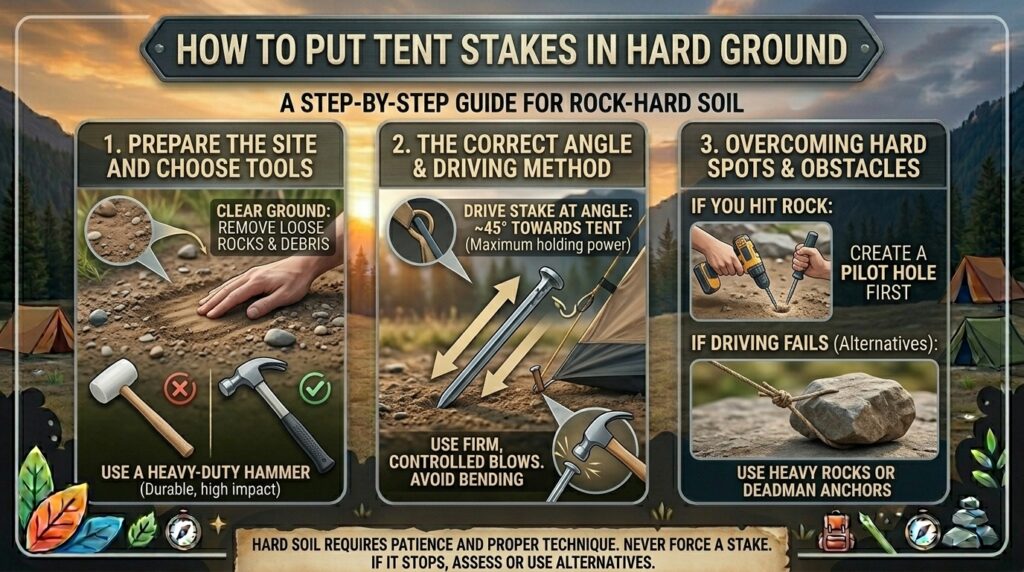
Never drive your stake straight down (90 degrees) into hard ground. Angle the tip of the stake at 45 degrees pointing directly away from the tent. This allows the stake to glide across subterranean rock shelves rather than hitting them dead-on, while maximizing horizontal soil resistance.
Step 2: Switch to the “Tap-Tap” Technique
Do not try to drive the stake home with three massive swings. Use a rubber mallet or a dedicated camp hammer to deliver frequent, light, rhythmic taps. This allows the metal point to slowly fracture and wedge its way into the compacted dirt molecules without absorbing a sudden, catastrophic shock.
Step 3: Read the Resistance
Listen to the sound of your hammer hits. If the sound changes from a dull thud to a sharp, high-pitched metallic ping, stop striking immediately. This means your stake has hit an immovable underground rock or root. If you strike it again, it will bend or shatter. Pull it out, move it two inches to the left or right, and try again.
3. 4 Genius Field Hacks for Impermeable Ground
What happens if you have used the correct technique, but the ground is simply too dense to accept a stake? Use these advanced backcountry workarounds:
Method 1: The “Pilot Hole” Technique
If you only have a few heavy-duty steel rock pegs but a whole tent full of lightweight aluminum pegs, use the steel stake as a drill bit.
- Take your single strongest steel stake and hammer it 4 to 5 inches into the hard ground.
- Wasp it back and forth slightly to loosen it, then pull it straight out.
- You have now created a perfect, pre-carved pilot hole. Slide your softer aluminum or plastic stake smoothly into this hole and tap it secure.
Method 2: The Softening Pour
Sun-baked clay holds onto its density because it lacks moisture. You can use physics to your advantage.
- Pour a small cup of camp water directly over the spot where you want to place your stake.
- Let it sit for 2 to 3 minutes to saturate and loosen the tightly bound dirt molecules.
- The earth will soften significantly, allowing you to easily tap your stake down flush with the surface.
Method 3: The “Big Rock” Anchor (The No-Stake Solution)
If the ground is solid sheet rock (like an alpine ridge), stop trying to use stakes entirely. Pivot to the Big Rock Wrap method.
                  [Tent Guy Line]
                        /
                       /
              _______/______ [Solid Rock Ground]
             (  Weight Rock )
             (==============)
             [ Anchor Rock  ]
- Find a medium-sized “anchor rock” and tie your tent’s guy line securely around it.
- Find a massive, heavy “weight rock” (15–20 lbs) and stack it directly on top of the anchor rock and the guy line.
- The friction between the heavy rocks and the hard ground will easily hold your tent secure against high winds without a single inch of metal entering the earth.
Method 4: The V-Peg Cross Rig
If you can only get your V-shaped or Y-beam stakes an inch or two into the ground before they stop, do not leave them protruding. They will act as levers and pull out.
- Drive the stake in as far as it will comfortably go.
- Lay a heavy, flat log or boulder directly over the exposed portion of the stake flush against the earth. This structural weight keeps the shallow anchor from tilting or sliding out under wind load.
4. Frequently Asked Questions (FAQ)
Can I use a standard construction hammer for tent stakes in hard ground?
You can use a steel claw hammer on forged steel stakes, but never use a steel hammer on aluminum or plastic stakes. The steel-on-aluminum impact delivers an intense kinetic shock that will instantly flatten the head, shear off the guy line notches, or snap the shaft of your lightweight stakes. Use a rubber mallet or a brass-headed camp hammer.
Is frozen ground considered hard ground?
Yes, and it is often the hardest ground you will ever encounter. Frozen earth acts like concrete because the moisture between the dirt particles turns to solid ice. For winter camping, you must use specialized threaded ice screws or heavy-duty steel rock pegs.
What should I do if a stake gets permanently stuck in hard ground?
Do not try to yank it out by the plastic loop. Loop a piece of spare paracord or the hook of another tent stake underneath the head of the stuck peg. Pull straight upward while twisting the stake clockwise and counter-clockwise. The twisting action breaks the friction seal of the compacted dirt, allowing it to slide out.
Summary: Your Hard-Ground Success Checklist
Pitching a tent on dense earth doesn’t have to result in a pile of ruined, bent gear. For your next trip into tough terrain, memorize this checklist:
- Upgrade Your Kit: Leave thin wire skewers at home; bring forged steel or Y-beams.
- Watch the Angle: Maintain a crisp 45-degree angle pointing away from the tent.
- Tap, Don’t Smash: Use light, rapid strokes with a rubber mallet.
- Use Nature: If the ground refuses to break, clear the dirt and use heavy rocks as your primary weights.
Keywords: how to put tent stakes in hard ground, hammering tent pegs into clay, best stakes for rocky ground, how to drive stakes into compacted dirt, camp gear tips, tent anchor hacks, rubber mallet camping.