

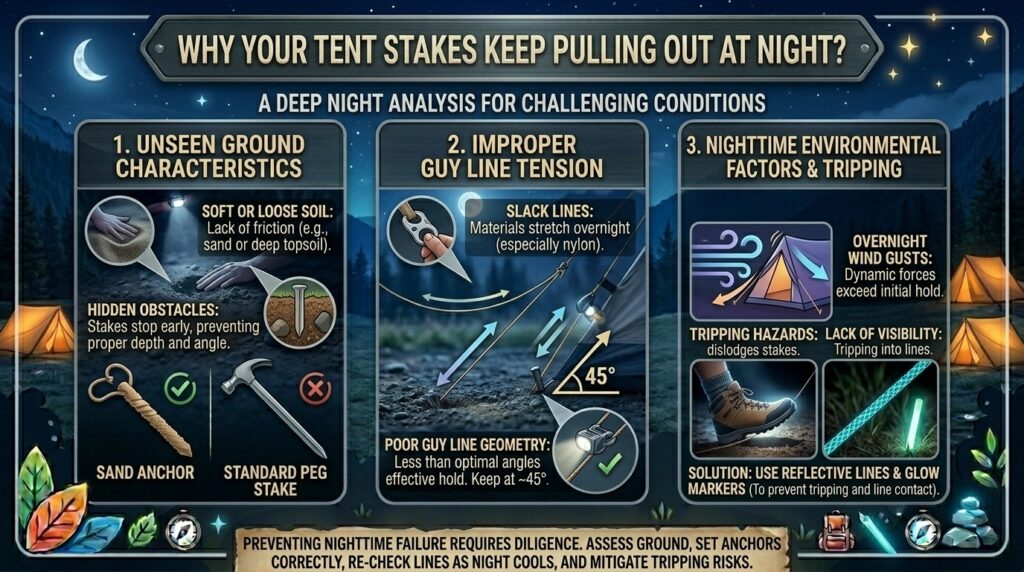
Why Your Tent Stakes Keep Pulling Out at Night? The Hidden Science of Overnight Anchor Failure
There is a universal nightmare shared by backpackers and car campers alike: You spend your evening setting up a beautiful campsite, crawl into your sleeping bag, and drift off to sleep. Then, at 2:00 AM, you are violently awoken by the sound of flapping nylon, a sagging rainfly, and a cold wind whipping through your shelter. You step outside in the dark and the freezing air only to find that your tent stakes—which felt rock-solid when you hammered them in during the afternoon—have pulled completely out of the ground.
Why does this happen so consistently at night? Is it just bad luck, or is there an invisible force working against your campsite security while you sleep?
The short answer is a mix of environmental physics and gear mechanics. Tent stakes pull out at night due to three major nocturnal changes: skyrocketing humidity and dew that turn dry dirt into slippery mud, temperature drops that cause nylon tent fabric to shrink and tighten (exerting massive extra tension on your lines), and predictable late-night thermal winds.
In this ultimate comprehensive guide, we will dive deep into the hidden science of overnight tent failure, explain exactly why the ground changes after the sun goes down, and give you the professional rigging secrets needed to keep your tent anchored until sunrise.
1. The Nocturnal Trifecta: Why the Ground and Gear Shift at Night
To stop your stakes from escaping, you have to understand the science of what happens to a campsite between 6:00 PM and 2:00 AM. Three invisible environmental shifts occur simultaneously:
Factor A: The Dew Point and Soil Saturation
During the day, the sun bakes the top layer of dirt, drying it out and creating high friction against your tent stakes. When the sun sets, the temperature drops toward the dew point. Moisture from the air condenses directly onto the grass and seeps into the top two inches of soil.
The Result: The hard, high-friction dirt that held your stake snugly at 5:00 PM turns into slick, lubricated mud by midnight. The soil’s shear strength plummets, allowing the stake to slide out effortlessly under pressure.
Factor B: Nylon Fabric Contraction (The Tension Spike)
Most standard tents are made of nylon or polyester. Nylon, in particular, is highly susceptible to temperature and moisture changes. As the night air becomes cold and damp, nylon fibers absorb water and contract (shrink). If you pitched your tent incredibly tight during the warm afternoon, this late-night contraction acts like a giant rubber band tightening across your frame. The tension on your guy lines can double overnight, violently jerking and pulling at the stakes with a steady, continuous force.
Factor C: Katabatic and Thermal Winds
As mountain slopes or open plains cool down after dark, the cold air becomes dense and heavy, naturally rushing down into valleys and basins. These are known as katabatic winds or nocturnal cooling breezes. They often peak between midnight and dawn, hitting your tent when you least expect it and putting sudden, rhythmic wind loads on your guy lines.
2. Structural Mistakes That Specifically Cause Night Failures
If your stakes keep pulling out while you sleep, you are likely falling into one of these three structural pitching traps:
INCORRECT (Vertical Leverage)        CORRECT (45-Degree Friction)

          \                                    \
           \ [Guy Line]                         \ [Guy Line]
       _____\___________ [Ground]           _____\___________ [Ground]
      |     |           |                  |    /           |
      |     |           |                  |   /            |
      |     | (90° Angle)                  |  /  (45° Angle)|
      |_____|___________|                  |/_______________|
 (Pulls straight out easily)           (Must plow through pounds
                                        of solid earth to escape)
1. The 90-Degree Vertical Mistake
If you drive your stakes straight down into the earth at a vertical 90-degree angle, you are inviting disaster. When late-night nylon contraction occurs, the line pulls diagonally upward. Because a vertical stake’s exit path aligns closely with that upward pull, the stake acts like a piston, pumping itself straight up out of the damp night soil.
2. High-Notch Rigging
If you hook your tent’s guy line to the very top of a stake that is protruding 3 or 4 inches out of the ground, you have created a classic lever arm. Every time the night wind hits the tent, it pulls the top of the stake, rocking it back and forth. This creates a cone-shaped hole in the damp dirt, completely destroying the soil’s grip until the peg fails.
3. Relying on Smooth Wire Skewers
Thin, smooth metal wire stakes (the ones packaged with cheap tents) provide zero surface area and zero texture. Once the midnight dew lubricates the ground, these smooth needles have nothing to grip, making them completely useless against overnight wind loads.
3. How to Bulletproof Your Tent Anchors Before You Go to Sleep
You don’t have to accept midnight tent collapses as a normal part of camping. Use these advanced backcountry rigging tactics before you crawl into your sleeping bag:
Step 1: Drive Stakes 100% Flush and at 45 Degrees
Always angle your stakes at a 45-degree angle pointing directly away from the tent, and drive them down until the head of the stake is completely flush with the ground. This places the guy line loop right at soil level, completely eliminating leverage and forcing the stake to plow through a massive wall of solid earth before it can ever escape.
Step 2: Compensate for Late-Night Fabric Stretch
When setting up your tent in the afternoon, do not crank your guy line tensioners to 100% tightness. Leave a small amount of play or elasticity in the lines. This gives the nylon fabric room to naturally contract as the temperature drops, preventing a massive midnight tension spike from snapping or pulling your anchors.
Step 3: Implement the “Big Rock” Insurance Policy
If you suspect the soil is loose or sandy, or if the weather forecast predicts overnight storms, never rely on the stake alone. Drive your stake flush, then find a 15-to-20-pound flat boulder and place it directly on top of the buried stake head. Even if the night dew turns the soil to liquid mud, the physical weight of the boulder will pin the anchor to the earth.
Step 4: Upgrade to Y-Beam or Screw-In Stakes
Ditch the smooth wire pegs. Upgrade your gear kit to 7000-series aluminum Y-beam stakes (like the MSR Groundhog) or threaded screw-in pegs. The three-sided fins of a Y-beam physically trap and compact the dirt within their channels, meaning that even if the soil gets damp, the stake resists pulling out from multi-directional wind loads.
4. Emergency Midnight Fixes: What to Do in the Dark
If you are reading this article on your phone inside a collapsing tent right now, do not panic. Grab your headlamp, step outside, and execute these immediate emergency field fixes:
- The Double-Stake “V”: If a single stake won’t hold in the wet night soil, drive two stakes into the ground about 6 inches apart, forming a “V” shape pointing away from the tent. Loop your guy line around both. This instantly splits the wind load across two separate anchors.
- The Log Tarp-Anchor: If the ground has turned completely to liquid mud and won’t hold any stake, stop using the ground. Tie your guy line securely around a large, heavy log or a thick tree branch, and roll it outward until the tent is taut.
- Bypass to Trees and Roots: Look around with your flashlight. If there are trees or exposed, heavy roots nearby, extend your guy lines using extra paracord and tie them directly around the base of the timber. Nature’s root systems will never pull out at night.
5. Frequently Asked Questions (FAQ)
Why does my tent rainfly sag so badly at night?
This is caused by the exact same moisture that loosens your stakes. When nylon fabric absorbs overnight humidity and dew, it relaxes and stretches out slightly before contracting from the cold, causing a sagging effect if the lines aren’t properly angled. Staking your lines further out at a clean 45-degree angle eliminates this sag.
Should I buy longer stakes to prevent overnight failure?
Yes. If you frequently camp in soft forest soil, loam, or coastal areas, standard 6-inch stakes do not go deep enough to reach the dense, dry subsoil beneath the damp top layers. Upgrading to 9-to-12-inch stakes ensures the lower half of the anchor remains securely locked in dry, unlubricated earth all night long.
Does the color of the tent stake matter at night?
While color doesn’t affect holding power, using reflective guy lines and neon orange or glow-in-the-dark stakes is highly recommended. If an anchor does fail at night, trying to locate a dark silver or black peg in the pitch-black grass with a weak flashlight is incredibly difficult and dangerous.
Summary: The Nocturnal Security Checklist
To guarantee a peaceful, uninterrupted night of sleep on your next camping trip, run through this quick checklist right before dark:
- Are all stakes driven at a 45-degree angle pointing away from the shelter?
- Is every single peg hammered down completely flush with the soil level?
- Did you leave a tiny bit of slack in the guy lines to allow for thermal nylon contraction?
- Did you place an insurance boulder on top of your primary windward anchors?
By understanding how the damp night air alters your gear and your campsite’s soil, you can build a bulletproof anchoring system that keeps you safe, dry, and asleep until morning.
Keywords: tent stakes pulling out at night, why does tent sag overnight, securing tent in wind at night, nylon tent contraction, how to stop tent pegs slipping, camping gear troubleshooting, midnight tent repair hacks.