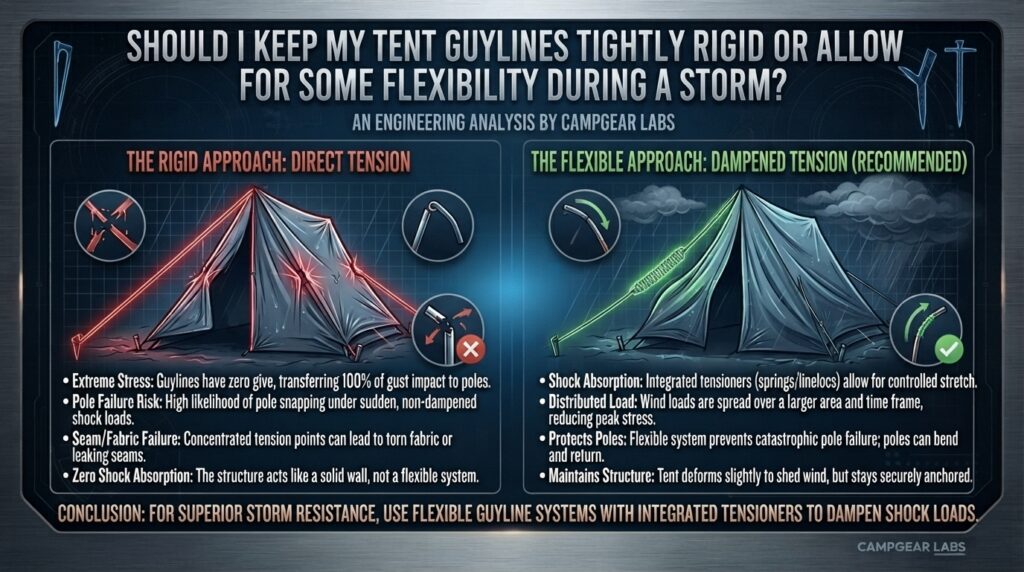
Should I keep my tent guylines tightly rigid or allow for some flexibility during a storm?

When dark weather fronts roll across your campsite—whether you are pitch-camping along the bluffs of San Francisco, braving West Texas wind squalls, riding out a mountain storm in Washington’s Cascades, or facing cold autumn gusts in Upstate New York—the structural sound of a tensioned shelter under strain is enough to keep any camper awake.
At besttentstakes.com, we test anchors, tensioners, and guyline setups across extreme conditions nationwide. One of the most fiercely debated questions among outdoor enthusiasts is: Should your tent guylines be pulled guitar-string tight (rigid), or should you allow for dynamic flex and shock absorption during a storm?
The short answer: Your main static guylines should be kept firmly taut and rigid, but adding shock-absorbing elasticity (via heavy-duty shock cord loops or tensioners) to key anchor points creates the ultimate hybrid system. Pure rigid lines without dynamic shock absorption transfer 100% of severe wind impact forces directly into tent seams and stakes, increasing the risk of torn fabric or pulled stakes.
In this comprehensive guide, we unpack the mechanical physics of guyline tensioning, fabric stretch (silnylon vs. silpoly), regional wind conditions, step-by-step storm-rigging methods, and answer the top 10 questions every camper should know before facing heavy winds.
Rigid vs. Flexible Guylines: The Mechanical Trade-Off
Understanding how wind force interacts with a tent framework requires looking at the difference between static load tension and dynamic impact force.
                             [ WIND GUST FORCE ]
                                      │
                                      ▼
                        ( Tent Rainfly / Frame )
                                      │
             ┌────────────────────────┴────────────────────────┐
             ▼                                                 ▼
   [ 100% RIGID GUYLINE ]                           [ FLEXIBLE / SHOCK-CORDED ]
   • Zero line give                                 • Shock cord absorbs initial shock
   • Max rainfly tension (no flap)                  • Reduces peak shock load by 30-50%
   • Transfers peak force to stake                  • Maintains tension if fabric sags
   • Risk: Stake pulls out or seam tears            • Risk: Over-flex can flatten canopy
1. The Case for Rigid Guylines (Drum-Tight)
Proponents of guitar-string tight guylines point to structural rigidity and aerodynamic stability:
- Eliminates Fabric Flapping: A drum-tight rainfly keeps fabric taut, preventing wind from catching underneath folds or causing loud, sleep-depriving fabric flutter.
- Preserves Internal Air Gap: Tight lines maintain crucial spacing between the outer rainfly and inner mesh tent body, preventing condensation transfer and water leakage.
- Prevents Canopy Deformation: In heavy rain or wet snow, rigid tension prevents water pooling that could collapse the pole structure.
2. The Case for Controlled Flexibility (Dynamic Tensioning)
Proponents of dynamic flexibility argue that static systems fail under extreme, unpredictable shock loads:
- Dampens Peak Shock Loads: Wind gusts do not apply a gentle, steady push; they hit like a hammer. A small inline shock-cord loop stretches dynamically, dampening peak shock force on stakes and seams by 30% to 50%.
- Compensates for Nighttime Fabric Stretch: Many common tent fabrics—especially silnylon—naturally stretch when wet or cold. A rigid static line tied at 8 PM will often become saggy by 2 AM as humidity rises.
- Protects Anchor Points in Loose Soil: When a gust slams a rigid guyline, the sudden force can instantly pop a stake out of soft sand, mud, or snow. A flexible shock element absorbs the energy spike before it reaches the ground anchor.
Detailed Comparison: Rigid, Flexible, and Hybrid Guyline Systems
| Feature / Performance Metric | 100% Rigid Static Line (Dyneema / Polyester) | 100% Elastic Bungee / Shock Cord | Hybrid: Taut Static Line + Shock Absorber Loop |
| Wind Resistance Limit | High (in solid soil) | Low (canopy flattens) | Maximum (Best overall stability) |
| Shock Load Absorption | Zero (transfers full force) | Extreme (over-stretches) | Controlled (Dampens peaks, hits hard stop) |
| Fabric Sag Compensation | Poor (requires manual adjustment) | High | High (Self-adjusting night tension) |
| Seam & Tie-Out Stress | Very High | Very Low | Balanced & Protected |
| Stake Extraction Risk | High in loose/sandy soil | Low | Low (Dampens pull spikes) |
| Best Weather Scenario | Steady breeze / Heavy snow | Light rain / Quiet nights | High-wind storms / Gusty squalls |
Fabric Science: Silnylon vs. Silpoly Tension Needs
Not all tent rainflies respond to storm tension in the same way. The fabric material dictates whether static or dynamic tensioning is required:
1. Silnylon (Silicone-Coated Nylon)
- Property: Nylon is hygroscopic, meaning it absorbs moisture from fog, rain, or night air.
- Behavior: Silnylon can stretch and relax by up to 3% to 5% when wet, causing a drum-tight pitch to go slack overnight.
- Tension Strategy: Hybrid Self-Tensioning Line. Silnylon tents benefit tremendously from shock-cord loops integrated into the guylines to take up slack as the fabric expands.
2. Silpoly (Silicone-Coated Polyester) & DCF (Dyneema Composite)
- Property: Polyester and Dyneema fibers are hydrophobic and have virtually zero stretch when wet or cold.
- Behavior: A silpoly rainfly pitched taut at dusk will remain drum-tight all night long regardless of humidity.
- Tension Strategy: Static Taut Line with Short Shock Limiter. Because the fabric won’t sag, you only need minimal shock absorption to protect tie-out points from sudden wind buffeting.
Regional Storm Demands: Tailoring Your Setup Across Target States
Weather conditions vary drastically across North America. How you rig your guylines should match the environment where you pitch camp:
1. San Francisco & Coastal California
- Weather Profile: Strong afternoon ocean gusts along coastal bluffs (Marin Headlands, Big Sur) combined with dense ocean fog and high salt humidity.
- Tension Recommendation: Hybrid System. Ocean fog saturates tent flys rapidly, while coastal wind shear delivers heavy shock loads. Use non-slip cleat tensioners with 1/8-inch shock cord dampeners.
2. Texas Plains, Deserts & Gulf Coast
- Weather Profile: Sudden, violent thunderstorm downbursts in West Texas (Big Bend, Palo Duro Canyon) and humid Gulf Coast gales.
- Tension Recommendation: Static Taut Lines + Heavy-Duty Ground Anchors. Texas thunderstorm gusts can exceed 50 mph in seconds. Prioritize drum-tight static Dyneema guylines anchored with long Y-beam or spiral stakes from besttentstakes.com.
3. Washington State & Pacific Northwest Cascades
- Weather Profile: Prolonged, heavy rain, damp alpine snow accumulation, and funneling pass winds.
- Tension Recommendation: Self-Tensioning Shock Loops. High humidity causes silnylon shelters to sag, while heavy rainfall adds weight to fly surfaces. Self-tensioning shock loops keep the fly off the inner tent canopy automatically.
4. New York Adirondacks, Catskills & Long Island Shorelines
- Weather Profile: Unpredictable autumn squalls, mountain ridge exposure, and damp coastal conditions.
- Tension Recommendation: Hybrid Setup. Rigid lines for windward poles combined with shock-absorbing tie-outs for rainfly corners to withstand cold mountain gusts.
How to Build the Ultimate Hybrid Storm Guyline (Step-by-Step)
The ultimate storm setup combines the unwavering support of a static cord with the energy-dampening benefits of a shock cord. Follow this step-by-step guide to rig your tent:
1.Select High-Quality Static Cord:High tensile strength, zero stretch.
Use 2mm to 3mm reflective Dyneema or polyester core cord for your main guyline run. Avoid cheap nylon cord that stretches permanently under tension.
2.Attach a 1/8-Inch Shock-Cord Loop to the Tent Tie-Out:Creating the shock absorber loop.
Tie a 6-inch loop of heavy-duty 1/8-inch elastic shock cord directly to the webbing loop on your tent’s rainfly using a girth hitch or fisherman’s knot.
3.Tie the Static Line with a Slack-Bypass Safety Bridge:Incorporating a fail-safe hard stop.
Tie your main static line directly to the fabric tie-out behind the shock loop, leaving a few inches of slack. This ensures that if wind force stretches the shock cord to its absolute limit, the static cord catches the load, acting as a “hard stop” to prevent the shock cord from snapping.
4.Install Line Tensioners or Line-Loks:Quick, precise field adjustments.
Thread a Line-Lok or aluminum tension cleat onto the lower end of the guyline near the stake anchor. This allows you to tighten or loosen the line in seconds without retying knots in cold or wet weather.
7 Pro Tips for Pitching Guylines in Severe Weather
- Pitch the Lowest Profile into the Wind: Always position the narrowest, lowest rear section of your tent directly facing the prevailing wind direction to reduce drag surface.
- Anchor Guylines in Line with Pole Seams: Run your main guylines along the exact path of internal tent pole seams. This transfers wind pressure off the fly fabric directly into the rigid pole structure.
- Double-Stake High-Load Windward Anchors: On the side facing the oncoming storm, drive two stakes in a V-formation 12 inches apart and bridle the guyline between them to double your soil holding area.
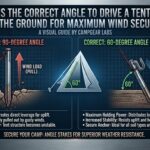
- Maintain 45-Degree Stake Angles: Always drive tent stakes into the ground at a 45-degree angle pointing away from the tent, keeping the guyline pulling at a 90-degree right angle to the stake shaft.
- Clear Chafing Hazards: Ensure guylines do not rub against sharp rocks, tree bark, or exposed pole joints. Continuous wind friction can saw through a 2mm Dyneema cord in hours.
- Re-Tension Before Sleep: Check and snug all guylines 30 minutes after initial setup, especially if rain or temperature drops occur, as both cause initial fabric and knot settling.
- Use High-Visibility Reflective Cord: Storm gusts often force middle-of-the-night adjustments. Reflective tracer threads in your guylines prevent dangerous tripping hazards when navigating around your tent with a headlamp.
10 Frequently Asked Questions (FAQ)
FAQ 1: Will pure shock cords replace standard static guylines?
No. Using 100% shock cord for your entire guyline length is dangerous in a storm. Under heavy wind, pure elastic cords stretch excessively, allowing wind to flatten the tent canopy, bend poles inward, and push rainfly fabric directly against the inner body, causing severe leaks.
FAQ 2: How tight should my tent guylines be during normal weather?
In normal weather, guylines should be snug and drum-taut, eliminating all fly sag without placing excessive lateral pulling strain on the tent poles or stitching seams.
FAQ 3: Why do my guylines go slack during cold or rainy nights?
Guylines go slack overnight primarily because wet or cold nylon fabric (silnylon) naturally stretches and absorbs moisture. Secondary causes include knot slippage and stakes gradually creeping through soft soil under tension.
FAQ 4: What is the best knot to use for tent guylines if I don’t have plastic tensioners?
The Taut-Line Hitch or the Midshipman’s Hitch are the gold-standard adjustable friction knots for tent guylines. They allow you to slide the knot up or down the line to adjust tension while locking securely under load.
FAQ 5: Can overly tight guylines damage my tent?
Yes. Over-tightening guylines with excessive mechanical leverage can rip webbing loops off rainflies, snap lightweight tent poles out of arc symmetry, or tear waterproofing tape along seam stitching.
FAQ 6: What thickness of guyline cord is best for storm protection?
A 2.0mm to 3.0mm Dyneema or UHMWPE core cord offers the ideal balance of high tensile strength (often rated over 400–600 lbs test), minimal weight, low wind drag, and knot-holding friction.
FAQ 7: Should I guy out my tent if there is no wind forecasted?
Yes! Mountain and coastal weather forecasts can shift rapidly overnight. Fully guying out your tent also optimizes ventilation, reduces internal condensation build-up, and prevents morning dew from causing rainfly sag.
FAQ 8: How does guyline angle affect holding power?
Guylines should extend outward at roughly a 30 to 45-degree slope from the tent body down to the ground. If a guyline is pegged too close to the tent (steep angle), it pulls almost straight up on the stake, drastically reducing ground holding capacity.
FAQ 9: What should I do if my tent stakes keep pulling out in high wind?
If stakes pull free, increase your anchor holding power by using the deadman technique (burying the stake or a large stick horizontally in the ground), placing heavy 15+ lb rocks over the stake head, or upgrading to wide Y-beam or spiral stakes from besttentstakes.com.
FAQ 10: What is a “line shock absorber,” and do I need one?
A line shock absorber is a short elastic element (usually a shock-cord loop or heavy spring) placed inline between the tent tie-out and the static guyline. You need them if you camp in high-wind regions or use silnylon shelters, as they dampen shock spikes and compensate for overnight fabric stretch.
Conclusion
When facing a storm, the debate between rigid and flexible guylines is resolved with a hybrid solution: Keep your main static guyline runs firmly taut, but integrate shock-absorbing elastic loops at key tie-out points.
This balanced approach delivers the best of both worlds—it maintains the rigid, aerodynamic canopy shape required to shed wind and rain, while providing dynamic shock absorption that protects your seams, rainfly fabric, and ground anchors from catastrophic wind spikes.
Before heading into your next outdoor adventure in Texas, California, Washington, New York, or anywhere across the country, gear up with high-performance stakes and anchoring accessories at besttentstakes.com to keep your shelter rock-solid through any storm!