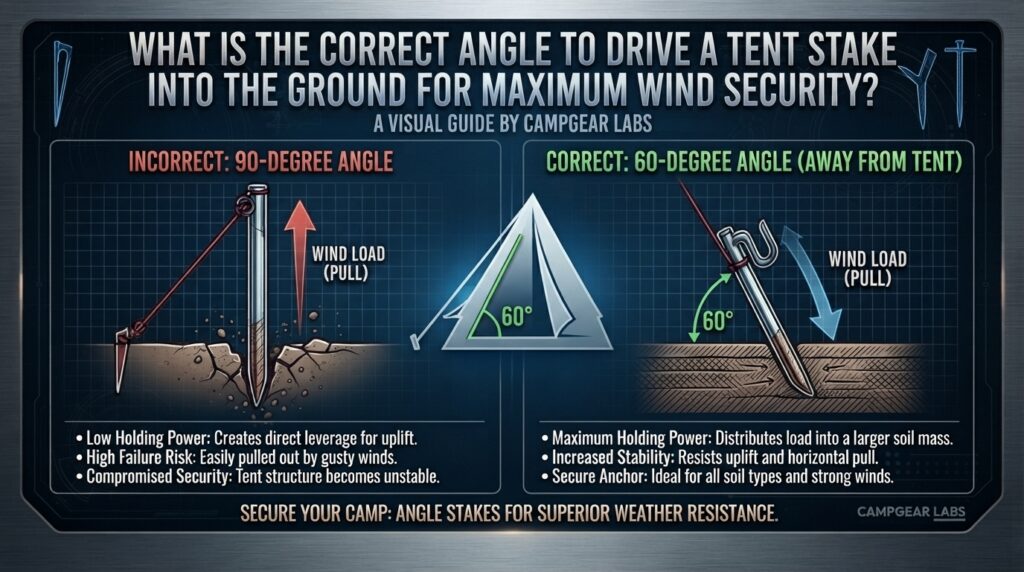
What is the correct angle to drive a tent stake into the ground for maximum wind security?

When a midnight gust sweeps through your campsite—whether you are pitch-camping along the breezy Pacific bluffs in San Francisco, facing dust storms in West Texas, or holding down camp in Washington’s Cascade Range—your tent’s survival depends on a single fundamental anchor point: the humble tent stake.
At besttentstakes.com, we regularly test grounding hardware across every terrain type in North America. The most common mistake we see campers make isn’t using cheap stakes—it is driving them into the ground at the wrong angle.
The definitive answer: The correct angle to drive a tent stake into the ground for maximum wind security is 45 degrees away from the tent (slanted backward from the direction of guyline pull). The guyline itself should form a 90-degree right angle with the stake shaft.
In this comprehensive guide, we examine the underlying soil mechanics, vector physics, soil-specific staking techniques for target regions across the US, step-by-step pitch instructions, and field-tested anchor strategies.
The Physics of Ground Holding Power: Why 45 Degrees Works
To understand why a 45-degree reverse angle provides maximum security, we need to look at how force vector distribution and soil resistance interact under load.
                           [ WIND FORCE DIRECTION ]
                                      │
                                      ▼
                       ( Tent Fabric / Rainfly )
                                      │
                         [ Guyline Tension Line ]
                                      │  (Pulls at ~45° slope)
                                      ▼
        Ground Level ─────────────────┐───────────────────────
                                     /  ▲
                                    /   │
               Stake driven at     /    │  Soil Wedge Resistance
               45° reverse angle  /     │  (Acts perpendicular to shaft)
                                 /      │
                                ▀       └──────────────────────
1. Vector Force Distribution
When wind hits your shelter, it transfers tension down the guyline. Because guy lines extend from the rainfly down to the ground, they pull upward and inward at roughly a 30 to 45-degree angle.
- Driving Vertical (90° to ground): If you drive a stake straight down into the soil, the guyline’s upward pull directly leverages the top of the stake. The stake acts as a lever arm, carving a slot in the topsoil (“soil slicing”) until it loosens and slips free.
- Driving Forward (Angled toward the tent): This is the worst possible pitch angle. The guyline pulls almost inline with the stake shaft, effectively pulling the stake directly out of its hole with minimal resistance.
- Driving Backward (45° away from tent): When the stake is angled 45 degrees away from the shelter, the guyline pulls at a 90-degree perpendicular angle relative to the stake’s shaft. This forces the full length of the stake to pull against a compact wedge of undisturbed soil, maximizing friction and mechanical resistance.
Holding Capacity Loss by Driving Angle
The table below outlines how driving angle directly impacts soil holding power across standard loam soil:
| Stake Driving Angle | Angle Relative to Guyline | Relative Holding Capacity | Primary Failure Mode |
|---|---|---|---|
| 45° Away from Tent | ~90° (Perpendicular) | 100% (Maximum Hold) | Full soil wedge compression required to fail |
| 60° Away from Tent | ~105° (Oblique) | ~85% | Stake bends under extreme tension |
| 90° (Straight Down) | ~135° (Oblique) | ~75% | Soil slicing / levering open the hole |
| 45° Toward Tent | ~180° (Inline) | < 25% (Catastrophic) | Direct slip extraction along insertion path |
Regional Soil Profiles: Adapting Your Staking Strategy
Camping conditions vary dramatically across the US. A staking angle that works in deep forest loam might require specialized adjustments in shifting sand or rocky riverbeds.
Selecting the correct stake geometry—from Y-beam pegs to spiral anchors—is critical for securing your shelter across varied soil types.. Source: Outdoor Gear Lab
1. Texas (Desert Sand, Hardpacked Clay & Coastal Plains)
- Soil Profile: Sun-baked clay in Caprock Canyons, loose sand along the Gulf Coast, and rocky limestone in Hill Country.
- Staking Strategy: In sun-baked clay, drive heavy-duty forged steel or thick Y-beam aluminum stakes at 45 degrees using a rubber mallet. In soft coastal sand, standard 45-degree angles will fail; use long spiral stakes or deadman anchor techniques (burying the stake horizontally 12 inches deep).
2. San Francisco & Coastal California (Dunes, Bluff Topsoil & Salt Air)
- Soil Profile: High wind exposure on bluffs (Big Sur, Marin Headlands) combined with sandy or damp topsoil.
- Staking Strategy: Maintain the 45-degree angle, but increase stake length to 9–12 inches to penetrate through loose top layer sand into denser damp subsoil. Always weight the anchor points with nearby coastal rocks (“deadman weighting”).
3. Washington State (Pacific Northwest Forest Loam, Riverbed Gravel & Alpine Scree)
- Soil Profile: Thick forest duff in rain forests, loose gravel along riverbeds, and frozen scree in the Cascades.
- Staking Strategy: In deep forest duff, brush away organic debris until reaching mineral soil before driving your stake at 45 degrees. In rocky alpine scree, drive slim titanium nail pegs at a 45-degree angle, wedging them between firmly set boulders.
4. New York (Adirondack Granite Soil, Catskill Clay & Coastal Long Island)
- Soil Profile: Dense root networks, shallow rocky soil over granite bedrock, and sandy beach soil on Long Island.
- Staking Strategy: When hitting shallow bedrock, do not force the stake straight through stone. Angle the stake at 45 degrees wedged against a root or rock edge, or transition to a rock-stack anchor method.
Step-by-Step Guide: Pitching Stakes for High Wind Security
Follow this sequence to ensure your ground anchors hold fast in storms:
1
Expose True Mineral Soil
Clear surface debris first
1.Expose True Mineral Soil:Clear surface debris first.
Clear away loose pine needles, leaf litter, or dry surface sand until you reach firm, compacted soil.
2
Align and Angle the Stake Away from the Tent
Maintain the golden 45-degree slope
2.Align and Angle the Stake Away from the Tent:Maintain the golden 45-degree slope.
Position the stake tip at the guyline attachment point. Tilt the head of the stake 45 degrees away from the tent body, so the hook or notch faces directly up and away from the shelter.
3
Drive flush into the ground
Avoid exposed lever arms
3.Drive flush into the ground:Avoid exposed lever arms.
Using a mallet or firm foot pressure over the center axis, drive the stake into the soil until only the hook or attachment loop remains above ground. Leaving several inches of stake exposed creates leverage that allows wind to wiggle the stake free.
4
Attach and Tension the Guyline
Achieve 90-degree perpendicular tension
4.Attach and Tension the Guyline:Achieve 90-degree perpendicular tension.
Loop the guyline under the stake hook or through the tie-out cord. Adjust line tensioners so the cord forms a crisp 90-degree angle with the submerged stake shaft.
5 Expert Tips to Multiply Your Stake Holding Power
- The “Deadman” Technique for Loose Soil: In deep beach sand or soft snow where no stake will hold at an angle, tie your guyline around the center of the stake and bury it horizontally 8 to 12 inches deep, stomping the snow or sand firm above it.
- Rock-Weighting (Big Boy Backup): Place a heavy stone (15+ lbs) directly on top of the ground where the stake enters the soil. This prevents the stake head from lifting and dampens high-wind vibrations.
- Never Drive Stakes with Your Boot Heel on Hard Ground: Stomping on the thin shaft of an aluminum stake over hard ground or hidden rocks will bend the peg before it enters the soil. Use a smooth stone or camp mallet applied directly inline with the shaft angle.
- Utilize Guyline Tensioners correctly: Keep guylines drum-tight. Slack lines allow wind gusts to build momentum, creating shock loads that snap stakes out of position.
- Double-Staking in Storm Conditions: For critical windward guy lines, drive a second stake 12 inches behind the first at a 45-degree angle, connecting them with a short bridled guy cord to split the load across two soil anchors.
10 Frequently Asked Questions (FAQ)
FAQ 1: Should I ever drive a tent stake straight down at 90 degrees?
Driving stakes straight down at 90 degrees reduces holding power by roughly 25% in standard soil because the guyline lever arm can carve open the entry hole. However, specialized drill-in spiral anchors or heavy-duty screw stakes designed for hard clay are engineered to be driven vertically, as their threads lock directly into the soil walls.
FAQ 2: What is the best type of tent stake for high wind?
For general high-wind camping, Y-beam aluminum stakes (such as MSR Groundhogs) offer the best balance of multi-directional rigidity and surface friction. For soft sand or snow, wide curved snow/sand anchors or spiral pegs are required.
FAQ 3: How far out should guy lines be set from the tent body?
Guy lines should ideally extend outward at a 30 to 45-degree angle from the tent wall. Placing stakes too close to the tent body causes the line to pull almost vertically upward, which easily extracts even correctly angled stakes.
FAQ 4: Why do my aluminum stakes keep bending when I drive them in?
Stakes bend when forced into rocky subsoil or driven at an incorrect angle relative to force application. If you encounter resistance, do not force the stake with a hammer; pull back, shift the placement a few inches, and re-drive at 45 degrees.
FAQ 5: How do I get tent stakes out of frozen or hard-baked soil without breaking them?
Loop a spare piece of guyline or webbing underneath the stake hook, slip a stick through the loop to form a T-handle, and pull inline with the entry angle (at 45 degrees). You can also pour warm water over frozen soil around the stake head to thaw the grip.
FAQ 6: Is titanium better than aluminum for tent stakes?
Titanium offers exceptional strength-to-weight ratios for ultralight backpacking, but thin titanium “shepherd hook” pins have low surface area and twist easily in loose soil. Aluminum Y-beam pegs generally provide superior holding power in high-wind conditions due to their larger surface contact profile.
FAQ 7: How do I anchor a tent on solid rock or wooden platforms?
On solid rock face where stakes cannot enter the ground, use the “Rock-Wrap” method: wrap your guy lines around large heavy stones, or build a rock harness. On wooden platform sites (common in sensitive park environments), use specialized spring-loaded deck anchor pegs that fit between floorboards.
FAQ 8: How much of the stake should remain visible above ground?
For maximum wind security, 0 inches of the shaft should be exposed. Drive the stake flush so only the cord loop or hook rests against the soil surface. Exposed shaft length creates leverage that loosens the anchor under wind vibration.
FAQ 9: Do spiral screw-in stakes need to be driven at a 45-degree angle?
No. Plastic or steel spiral screw anchors are engineered to be driven straight down at 90 degrees. Their deep helical threads engage soil in 360 degrees, providing multi-directional holding power that relies on vertical thread shear rather than shaft angle.
FAQ 10: How do I secure a tent when camping on beach sand in Texas or California?
Standard stakes pulled at a 45-degree angle easily slice through loose sand. Use 12-inch sand pegs, spiral stakes, or bury standard stakes horizontally as “deadman” anchors beneath 1 foot of damp, compacted sand.
Conclusion
Mastering the 45-degree stake insertion angle is the single simplest, zero-cost technique you can use to protect your shelter in high winds. By slanting the stake away from the tent so the guyline pulls at a perpendicular 90-degree angle, you convert destructive wind energy into direct holding friction against compact soil.
Whether you are setting up camp along the wind-whipped coast of San Francisco, the sun-baked plains of Texas, or the mountain ridges of Washington State, pairing proper staking angles with high-performance hardware from besttentstakes.com ensures your shelter remains rock-solid through any storm.