What weight hammer should I use for driving steel stakes into sun-baked clay?

If you have ever tried pitching a tent, anchoring a canopy, or setting up landscaping structures in sun-baked clay, you know standard camping mallets are useless. Trying to drive a heavy-duty steel stake into dried-out, concrete-like clay with a 16-ounce household claw hammer will bounce off, bend your stakes, or leave your arms exhausted after setting just two stakes.
The ideal tool for driving steel stakes into sun-baked clay is a 3-pound to 4-pound drilling hammer (also known as a hand sledge or crack hammer) paired with a 10-inch to 12-inch handle.
A 3 to 4 lb head delivers enough momentum to penetrate dense, desiccated clay without requiring high-velocity swings, giving you maximum control while preventing stake deformation and arm strain.
The Science of Sun-Baked Clay: Why Soil Resistance Escalates
Clay consists of microscopic, plate-like mineral particles. When moist, water acts as a lubricant between these plates, allowing steel stakes to slip through easily. However, when clay dries out under intense summer heat, water evaporates, causing the clay matrix to shrink and bind tightly together.
This transformation creates high shear strength and high friction resistance:
- Unconfined Compressive Strength: Wet clay usually exhibits a strength under 15 psi. Sun-baked clay can easily exceed 100 to 200+ psi, rivaling soft concrete or shale.
- Surface Friction: As the steel stake penetrates, the compact clay grips the entire surface area of the steel shaft, creating massive frictional drag that increases exponentially with depth.
- Impact Absorption: Dry clay acts as a shock absorber. Light hammers transfer energy back into your hand rather than driving the stake deeper.
Why Standard Hammers and Mallets Fail
Before diving into specific hammer weights, it helps to understand why everyday tools fail in hard clay:
1. Rubber & Plastic Mallets (12 oz – 16 oz)
Rubber mallets are designed for soft turf and aluminum pins. When striking steel against baked clay, rubber deforms on impact, absorbing up to 70% of your kinetic energy. You end up bouncing off the stake without driving it a fraction of an inch.
2. Standard Household Claw Hammers (16 oz)
A standard framing or claw hammer relies on high swing speed to generate force. However, its small head target (1 inch face) makes missing common, risking bent stake heads or dangerous glances. Furthermore, light heads lack the inertia needed to overcome clay friction at deeper levels.
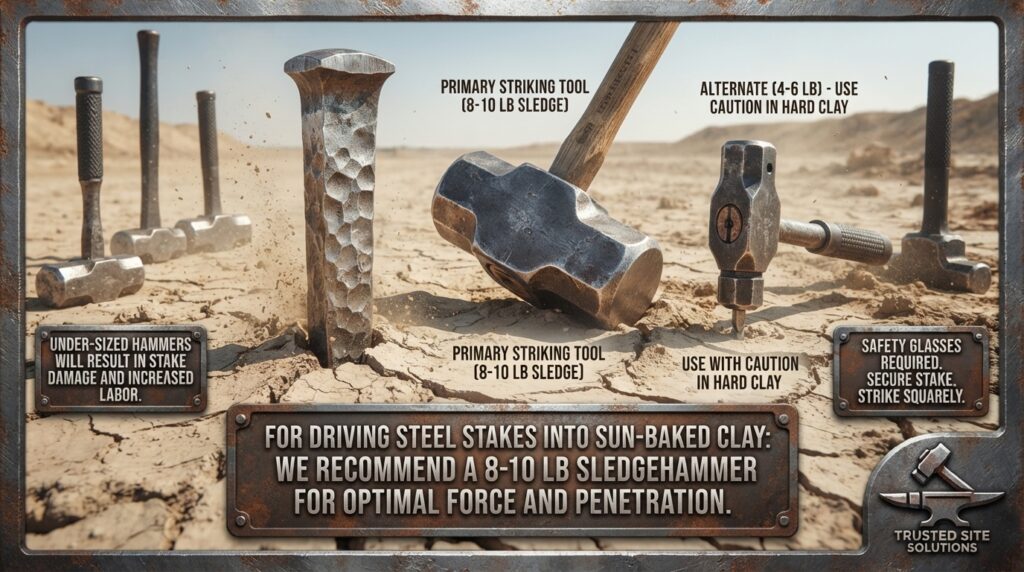
3. Full-Sized Sledgehammers (8 lb – 12 lb)
While an 8 lb sledgehammer has plenty of mass, its long 36-inch handle makes precision difficult when striking a small stake target near ground level. It quickly fatigues your lower back, shoulder, and forearms, increasing the risk of missing the stake head entirely.
Hammer Weight Recommendation Matrix
To select the precise weight for your specific setup, consider the length and thickness of your steel stakes:
| Stake Type & Size | Clay Hardness Level | Ideal Hammer Weight | Recommended Handle Length | Key Benefit |
| Rebar / Heavy Steel (3/8″ to 1/2″ dia, 10-12″ long) | Moderate Dry Clay | 2.5 lb to 3 lb | 10 inches | Lightweight, highly maneuverable, low fatigue |
| Heavy Forged Steel / Nail Stakes (1/2″ dia, 12-18″ long) | Hard Sun-Baked Clay | 3 lb to 4 lb | 10 to 12 inches | Perfect balance of kinetic energy and strike accuracy |
| Commercial Canopy / Event Anchors (5/8″+ dia, 18-24″ long) | Extreme Crust / Hardpack | 4 lb to 6 lb | 12 to 16 inches | Maximum driving force per strike to push through deep layers |
Pro Tip: If you only purchase one hammer for hard soil camping or construction anchoring, choose a 3.5 lb forged steel drilling hammer with a fiberglass or hickory handle. It covers 90% of all hard-ground stake driving tasks.
Regional Soil Profiles: What to Expect Across the US
Different geographic regions present unique clay conditions. Understanding your local terrain ensures you pack the right equipment:
Texas (Blackland Prairie & Hill Country Clay)
Texas clay is notorious for expansive swelling when wet and shrinking into brick-hard blocks when dry.
- Conditions: Deep, dense, cracked surface clay.
- Recommendation: Use a 4 lb hammer paired with smooth, pointed forged steel stakes (avoid spiral stakes, which bind excessively in Texas clay).
California (Central Valley & Inland Empire Hardpack)
California dry spells produce ultra-compacted clay and adobe soils baked under weeks of 100°F+ temperatures.
- Conditions: High surface crust density, often mixed with small river rock or gravel.
- Recommendation: A 3.5 lb to 4 lb hand sledge combined with high-tensile steel rock pegs.
Bay Area & San Francisco (Serpentine & Heavy Marine Clay)
Coastal conditions range from sandy loams to sticky, dense Franciscan bedrock clay on ridges and eastern foothill slopes.
- Conditions: Shallow topsoil over dense clay sublayer.
- Recommendation: A 3 lb drilling hammer is ideal—compact enough for steep gear packing while delivering solid penetration force.
Washington State (Eastern Washington Columbia Basin Clay)
While Western Washington features damp loams, Eastern Washington (Yakima, Tri-Cities, Spokane) features wind-blown loess and dense volcanic clay that bakes hard during summer.
- Conditions: Dry, dusty crust over highly compacted subsoil.
- Recommendation: A 3 lb to 4 lb hammer paired with 12-inch heavy-gauge steel stakes.
New York (Upstate Clay & Hudson Valley Till)
Upstate New York contains dense glacial clay intermixed with cobble and slate fragments.
- Conditions: Heavy wet-to-dry clay cycles filled with hidden rocks.
- Recommendation: A 3 lb drilling hammer with hardened steel stakes that can displace small stones without bending.
Step-by-Step Guide: Driving Steel Stakes into Sun-Baked Clay
Having the right tool is only half the battle. Using correct technique prevents bent stakes, damaged equipment, and physical strain.
Step 1: Pre-Soak the Spot (The Water Trick)
If water is readily available, pour a small cup (4 to 8 oz) directly onto the target penetration spot. Allow 2 to 3 minutes for the dry clay to absorb the moisture. This breaks down surface tension and creates a localized lubricated path for the stake point.
Step 2: Set the Initial Angle
Place the stake point on the ground angled 60° to 70° away from the pull direction of your guyline or tie-down strap.
Step 3: Use Controlled, Short-Arc Swings
Hold the drilling hammer handle near the middle-to-upper third for initial placement strikes. Tap the stake 2 to 3 times to establish a pilot notch in the soil.
Step 4: Shift Grip and Drive
Once the stake is self-standing:
- Slide your grip down toward the base of the handle.
- Raise the hammer 12 to 18 inches above the stake head.
- Let gravity and head weight do the work—swing smoothly from your elbow, not your wrist.
- Drive the stake until only 1 to 2 inches remain above ground level.
Safety Warning: Always wear ANSI-approved safety glasses when striking steel-on-steel. Over time, striking soft steel stakes with a hardened hammer face can cause metal mushrooming or flaking.
5 Field-Tested Hacks for Extreme Clay Ground
- Keep a Masonry Drill Bit in Your Toolkit: If the ground is literally like sun-baked brick, use a cordless hammer drill with a 3/8-inch masonry bit to drill a 6-inch pilot hole. Drive your steel stake directly into the pilot hole for instant grip.
- File Your Stake Tips: Dull or rounded stake tips double the driving force required. Use a hand file to maintain a sharp 45° point on your steel stakes.
- Use Soapy Water as Lubricant: Dip the tip of your steel stake in a small drop of dish soap or silicone spray. Reduced surface friction makes driving up to 30% easier.
- Inspect for “Mushrooming”: If your steel stake top begins to flatten out into a mushroom shape, grind or file the edges back down. Mushroomed edges concentrate strike forces unevenly and can split under heavy hammer blows.
- Carry a Stake Extractor Bar: Getting stakes into hard clay is tough, but getting them out can be harder. Pack a claw pry bar or a dedicated stake puller to leverage stakes out without bending them.
Frequently Asked Questions (FAQ)
1. Can I use a rubber mallet if I swing harder?
No. Swinging harder with a rubber mallet simply deforms the rubber head faster, transferring energy back into your arm. Rubber mallets are strictly meant for soft grass, turf, or loose soil.
2. Is a wooden or fiberglass handle better for a drilling hammer?
Fiberglass handles with rubber grips absorb vibration much better than wood or solid steel handles, reducing joint strain during repeated strikes into hard ground.
3. Will a heavy steel hammer ruin my steel stakes?
Forged steel stakes designed for hard ground can withstand hundreds of strikes. However, cheaper tubular or lightweight steel stakes may bend or mushroom. Use heavy-duty solid steel or rebar stakes for sun-baked clay.
4. What is the difference between a drilling hammer and a sledgehammer?
A drilling hammer (or hand sledge) has a compact 2 to 4 lb head with a short 10-to-12-inch handle designed for one-handed operation. A traditional sledgehammer weighs 8 to 16 lbs with a 36-inch handle requiring two hands.
5. What stake length works best in sun-baked clay?
In dense clay, a 10-inch to 12-inch stake offers exceptional holding power. You rarely need 18-inch stakes in hard clay because the dense compaction provides high shear resistance even at shallower depths.
6. Should I drive stakes straight down or at an angle?
Drive stakes at a 60° angle pointing away from the tent or canopy tension. This utilizes the surrounding clay mass to resist tension forces effectively.
7. How do I remove steel stakes stuck in dry clay without bending them?
Pour water around the base of the stake and wait 5 minutes. Tap the side of the stake gently with your 3 lb hammer in all four directions to break the clay bond, then pull upward using a stake extractor or lever.
8. Is a 2 lb hammer heavy enough for hardpack ground?
A 2 lb hammer works well for thin 3/8-inch steel wire pegs, but struggles with thick 1/2-inch or 5/8-inch heavy-duty canopy stakes. A 3.5 lb hammer is significantly more efficient for heavy stakes.
9. Can I use a dead-blow hammer instead?
Yes, a 3 lb to 4 lb steel-shot-filled dead-blow hammer works surprisingly well. The internal shot prevents rebound and transfers maximum kinetic energy into the stake without damaging the stake head.
10. Are titanium stakes better than steel stakes for sun-baked clay?
Titanium stakes are lightweight and strong, but under heavy strikes from a 4 lb hammer against rock-hard clay, thin titanium pegs can bend or shear. Heavy forged steel or hardened rebar remains the best choice for extreme clay soils.
Conclusion
When facing sun-baked clay in states like Texas, California, Washington, or New York, gear choice makes all the difference between a quick 5-minute setup and an hour of frustration. Leave the rubber mallets and household claw hammers at home. Invest in a dedicated 3-pound to 4-pound steel drilling hammer with a comfortable fiberglass handle—paired with quality forged steel stakes, you will drive anchors into the hardest soil effortlessly every single time.