

The 7 Biggest Tent Stake Mistakes Beginners Make (And How to Fix Them)
Setting up a campsite looks incredibly simple in promotional videos: you roll out the tent, snap the poles together, throw a few metal pegs into the dirt, and relax by the fire. But ask any seasoned backpacker or outdoor survival expert, and they will tell you that the humble tent stake is where most camping trips unravel.
When you get your tent anchors wrong, you aren’t just risking a minor annoyance. A poorly staked tent can result in bent or snapped poles, a ripped rainfly, severe interior condensation, or a shelter that completely collapses or takes flight in the middle of a midnight storm.
Whether you are prepping for your very first car camping trip or looking to troubleshoot why your gear keeps failing, avoid these seven critical tent stake mistakes that almost every beginner makes.
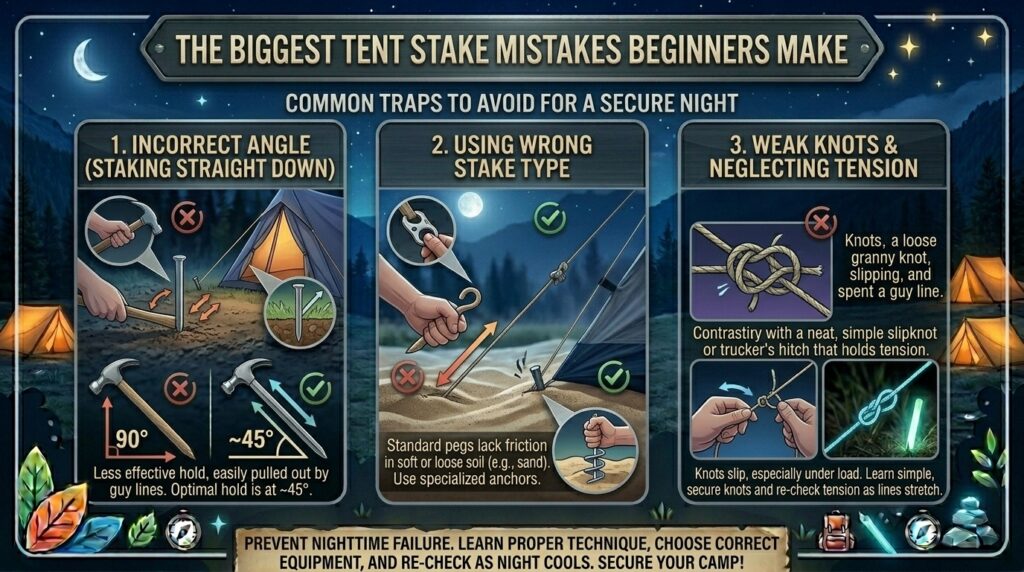
1. Mistake #1: Driving Stakes at a 90-Degree Vertical Angle
The most instinctive way to hammer a tent stake is to place it straight up and down and drive it vertically into the ground. Physically, this is the weakest possible angle.
INCORRECT (90° Vertical)              CORRECT (45° Angled Away)

          \                                      \
           \ [Guy Line Pull]                      \ [Guy Line Pull]
       _____\___________ [Ground]             _____\___________ [Ground]
      |     |           |                    |    /           |
      |     |           |                    |   /            |
      |     | (90° Angle)                    |  /  (45° Angle)|
      |_____|___________|                    |/_______________|
 (Acts like a piston; pulls              (Forces stake to plow through
   out with minimal force)                pounds of earth to escape)
Why It Fails:
Your tent’s guy lines exert a diagonal, upward, and inward pulling force against the anchor. When a stake is driven straight down at 90 degrees, its exit path aligns perfectly with that upward tug. The slightest gust of wind will cause the stake to pump itself straight up out of the dirt like a piston.
The Fix:
Always drive your tent stakes at a 45-degree angle pointing directly away from the tent. This forces the upward tension of the guy line to pull against the entire length of the buried shaft, maximizing soil friction and making it incredibly difficult for the wind to dislodge it.
2. Mistake #2: Leaving the Stake Head Protruding Out of the Dirt
Beginners often leave 2 to 4 inches of the tent stake sticking out of the ground because it makes the pegs easier to pull out when it’s time to break camp and go home.
Why It Fails:
Leaving a stake partially exposed creates a massive leverage arm. When a gust of wind hits your rainfly, it pulls the top of that exposed metal. This leverage allows the wind to rock the stake back and forth, wallowing out a cone-shaped hole in the damp dirt until the anchor fails completely. Furthermore, high-protruding stakes are a dangerous tripping hazard at night that can break a toe or rip your tent’s fabric loops.
The Fix:
Drive your tent stakes completely flush with the soil level, leaving only the very top hook, notch, or pull-cord exposed. This keeps the guy line pulling right at ground level, completely eliminating destructive leverage.
3. Mistake #3: Relying Solely on the Cheap Factory Stakes
Most entry-level tents come packaged with a bundle of cheap, ultra-thin galvanized steel wire skewers. Beginners assume that because these came in the box, they are suitable for all camping trips.
Why It Fails:
These smooth wire pegs provide almost no surface area to grip the earth, making them incredibly prone to slipping out of loose forest soil, sand, or mud. Even worse, they have a remarkably low yield strength. The moment they strike a subterranean rock or a hard patch of clay, they will bend or buckle into a useless curve.
The Fix:
Upgrade your gear kit immediately. Invest in a set of 7000-series aluminum Y-beam stakes (like the MSR Groundhog) for backpacking, or heavy-duty forged steel rock pegs for car camping. Their geometric shapes are structurally reinforced to handle immense physical pressure without bending, and they bite into the earth with far more frictional hold.
4. Mistake #4: Stomping Stakes In with a Heavy Boot Heel
If you don’t have a hammer handy, it is incredibly tempting to place your foot on top of a tent stake and shift your entire body weight onto it to force it into the ground.
Why It Fails:
Your body weight is highly unevenly distributed when balancing on one heel. The second the tip of the stake encounters a hidden pebble or a dense root underground, the stake will instantly tilt. Your boot heel will slide off, causing the thin shaft to snap or bend severely. It can also easily puncture a hole straight through the sole of a soft running shoe.
The Fix:
Never use your foot. Always use a dedicated tool to deliver straight, controlled downward force. A lightweight rubber mallet or a brass-headed camping hammer is ideal. If you are backpacking ultralight, find a smooth, hand-sized stone to use as a primitive anvil, delivering rapid, light taps.
5. Mistake #5: Ignorance of Soil Diversity (One Size Does Not Fit All)
A common beginner assumption is that a tent stake is a universal tool that performs identically on a rocky mountain ridge, a grassy park, or a sandy beach.
Why It Fails:
Different terrains require entirely different anchor physics. Standard thin pegs act like a knife through butter in loose beach sand or deep winter snow—they will slide right out under the slightest tension. Conversely, trying to force a thick plastic stake into hard-packed desert clay will cause the head of the stake to shatter or “mushroom” instantly.
The Fix:
Audit your campsite terrain before you pack.
- Use long, wide-profile plastic stakes or U-shaped snow flukes for sand and snow.
- Use dense, forged steel rock pegs for gravel and clay.
- Use Y-beam aluminum anchors for standard forest loam and grass.
6. Mistake #6: Hitting Obstacles with Full Force
When driving a stake down, you will eventually hit a point where the stake completely stops moving. A classic beginner mistake is to assume the dirt is just stubborn, prompting them to swing their hammer with maximum velocity.
Why It Fails:
If a stake suddenly stops moving, you haven’t hit hard dirt—you have hit a solid, immovable subterranean boulder or a massive tree root. Swinging your mallet with full force against an immovable object delivers an intense kinetic shock back through the metal shaft, instantly bending, kinking, or snapping the stake.
The Fix:
Listen to the feedback of your strikes. If you hear a sharp, metallic ping or feel a rigid bounce-back, stop hitting it. Pull the stake out of the ground, move it two to three inches to the left or right to bypass the obstacle, and try driving it down again at a fresh entry point.
7. Mistake #7: Skipping the External Guy Lines
Most modern tents have loop attachments at the bottom corners of the floor, but they also feature ropes dangling halfway up the sides of the exterior rainfly. Beginners frequently ignore these side guy lines, assuming they are optional accessories meant only for extreme mountaineering.
Why It Fails:
Guy lines serve two critical invisible functions. First, they pull the rainfly completely taut and away from the inner mesh tent walls, preventing condensation from dripping onto your sleeping bag. Second, they distribute the physical load of high winds. Without guy lines securely staked out, a sudden 25 mph late-night breeze can easily bend or fold your aluminum or fiberglass tent poles entirely in half.
The Fix:
If your tent has guy lines, stake them out on every single trip, regardless of the weather report. Pull them out horizontally away from the tent walls, adjust the friction slider to create moderate tension, and anchor them firmly flush to the earth at a 45-degree angle.
Summary: The Perfect Staking Checklist
Before you head out on your next outdoor adventure, memorize this quick, bulletproof checklist to guarantee your shelter remains secure:
- [ ] The Right Gear: Are you using upgraded Y-beam or steel stakes instead of thin factory wires?
- [ ] The 45° Angle: Is every single stake angled away from the tent structure?
- [ ] Drive It Flush: Is the head of every peg completely level with the ground to eliminate leverage?
- [ ] Listen to the Tap: Are you using light, rapid taps with a mallet instead of heavy, destructive swings?
- [ ] Full Setup: Did you stake out all the side guy lines to protect your tent poles from unexpected night winds?
By avoiding these seven common structural errors, you will save your gear from permanent damage, protect your feet from painful nighttime tripping hazards, and sleep soundly knowing your tent is completely locked to the earth.
Keywords: tent stake mistakes, how to use tent pegs, camping tips for beginners, why do tent stakes bend, how to drive tent stakes, guy line setup guide, camp gear maintenance, rubber mallet camping.