
Every seasoned camper has faced the frustration: you’ve found the perfect spot, you’re ready to set up, and you swing your hammer—only to watch your tent stake crumple like aluminum foil. It’s a deflating moment that can turn a peaceful getaway into a struggle against the elements.
At besttentstakes.com, we analyze tent failure from the ground up. If your stakes are bending, it is rarely bad luck. It is almost always a combination of material limitations, improper technique, or geographic challenges. In this guide, we’ll diagnose why your stakes are failing and how to ensure your next pitch is rock-solid.
The Anatomy of a Bend: Understanding Stake Failure
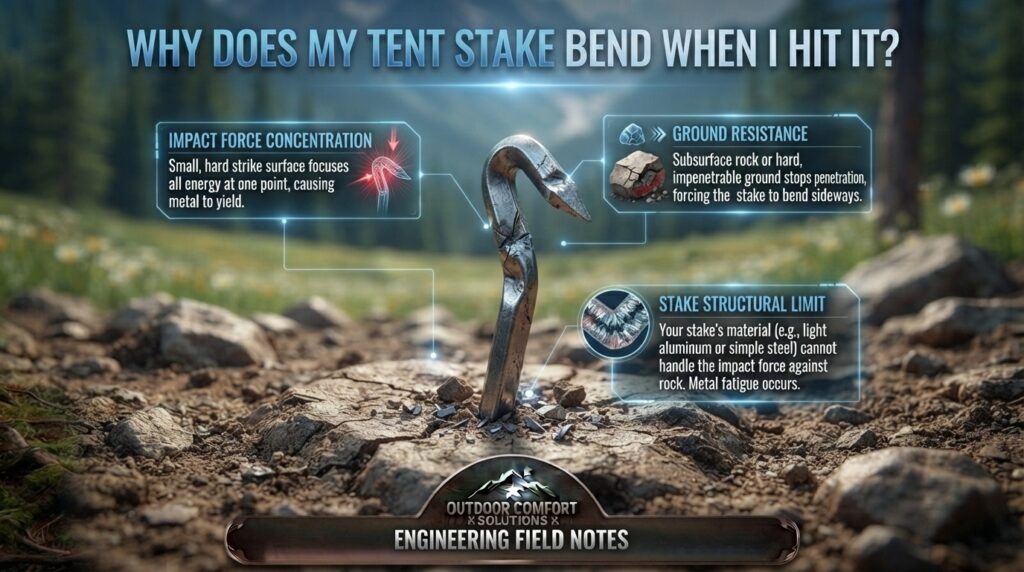
When you hammer a stake into the ground, you are applying a dynamic force to a structural column. Your stake fails when the applied force exceeds the material’s yield strength.
1. The “Off-Axis” Impact (The #1 Culprit)
Even the highest-grade titanium stake will bend if struck at an angle. When you hit a stake off-center, you create a “bending moment.” Instead of the force traveling straight down into the soil, it pushes the head sideways. Because the stake is pinned in the ground at the bottom, the shaft is forced to arc—resulting in an immediate bend.
2. Material Fatigue and “Mushrooming”
If you use a steel hammer on a hollow aluminum stake, the repeated force causes the head to deform (mushroom). Once the head is deformed, the stake is no longer a perfect cylinder. It becomes unbalanced, and subsequent strikes will cause the shaft to kink rather than penetrate.
3. The “Hidden Obstacle” Phenomenon
In states like California (granite) or Texas (hardpan), you aren’t just hammering into soil. You are hammering into subterranean debris. When the tip of your stake strikes a rock, the bottom stops moving, but the top is still moving forward due to the hammer’s momentum. Something has to give—and it’s almost always your stake.
Regional Soil Profiles: Why Stakes Bend Differently Across the US
Your geography dictates the “bend risk.” Understanding the soil profile is the first step toward preventing damage.
| Region | Primary Soil Challenge | Bend Risk Level |
| Texas | Baked Clay / Hardpan | High: The soil is dense; force causes the stake to buckle. |
| New York | Rocky Forest Loam | Medium: Hidden rocks catch the tip of the stake. |
| California | Granite Bedrock | Extreme: Stakes will bend instantly upon rock contact. |
| Washington | Damp / Soft Soil | Low: Usually easy penetration; low bend risk. |
| San Francisco | Coastal Sand | Very Low: No resistance; stake usually pulls out. |
5 Pro-Tips to Prevent Bending
If you want to stop destroying your gear, adopt these field-tested habits:
1. The “Pilot Hole” Technique
If the ground is too hard to push your stake in by hand, do not start hammering. Use a hardened steel rock peg (a sacrificial stake) to drive a hole, pull it out, and then slide your regular stake into the pre-made path.
2. The 90-Degree Rule
The force of your hammer must be perfectly parallel to the axis of the stake. If you are hammering at an angle (to create tension for the tent), make sure your hammer strikes the head squarely on that same axis.
3. Change Your Buffer
If you are using a heavy steel hammer, never strike a soft aluminum stake directly. Place a flat, smooth stone or a thick, folded cloth over the stake head. This spreads the impact energy and prevents localized deformation.
4. Know When to Stop
There is a “hollow” sound when a stake hits a rock, and a “dull thud” when it hits soil. If you hear a high-pitched metallic tink or feel a sudden stop, stop hammering. Move the stake two inches to the left or right.
5. Invest in “Impact-Grade” Stakes
If you frequent rocky areas like the Sierras, stop using thin aluminum wire hooks. You need Y-stakes or Titanium Nail Pegs, which are designed with cross-sectional geometry that resists buckling.
10 Frequently Asked Questions (FAQ)
1. Is my tent stake ruined if it’s bent?
A slightly bent stake can often be straightened using two pairs of pliers. However, once the metal has been “work-hardened” (bent and straightened), it is more brittle and likely to snap next time.
2. Can I use a hammer on titanium stakes?
Yes, titanium is incredibly strong, but you should still avoid “off-axis” strikes. It will survive hits that would destroy aluminum.
3. Why do my stakes bend only in certain states?
Different states have different soil mineralogy and compaction. The arid, clay-heavy soils of Texas or the rocky terrain of California exert much more pressure on a stake than the damp, loamy soils of Washington.
4. What is the best stake for rocky ground?
Hardened steel rock pegs are the gold standard. They are heavy, but they will not bend when they hit a stone.
5. How do I hammer stakes into hardpan without bending them?
Use a rubber mallet rather than a steel hammer. The rubber absorbs the shock, allowing you to drive the stake firmly without the violent impact that causes buckling.
6. Does the angle of the stake affect bending?
Yes. If the ground is uneven, the stake may strike a rock at an angle. Always aim for a flat, clear patch of ground.
7. Should I buy expensive stakes or cheap ones?
Expensive stakes (titanium/7075-T6 aluminum) use superior alloys that are designed to flex without reaching their “yield point” (the point of permanent bending).
8. Are Y-stakes better than nail pegs?
Y-stakes are better for soft soil because they provide more surface area (friction). Nail pegs are better for rocky soil because they have more mass and are less likely to fold.
9. Can I straighten a stake with a rock?
In an emergency, yes. Lay the bent stake on a flat rock and tap the bend with another rock. It’s not elegant, but it can save your campsite.
10. What is “buckling,” and why does it happen?
Buckling occurs when the force you apply to the top exceeds the stake’s ability to remain a straight column. It happens when the stake is too thin for the hardness of the ground.
Conclusion
A bent stake is a diagnostic tool—it’s telling you that your gear choice or your technique isn’t matched to the terrain. By understanding the soil conditions of your camping destination and switching to impact-grade stakes when necessary, you can stop the cycle of destruction.
Remember, the goal is a secure tent, not a test of strength. If you find your gear failing consistently, it’s time to upgrade your kit. Explore our high-durability stakes and rock-hardened options at besttentstakes.com, and head out knowing your foundation is secure.