
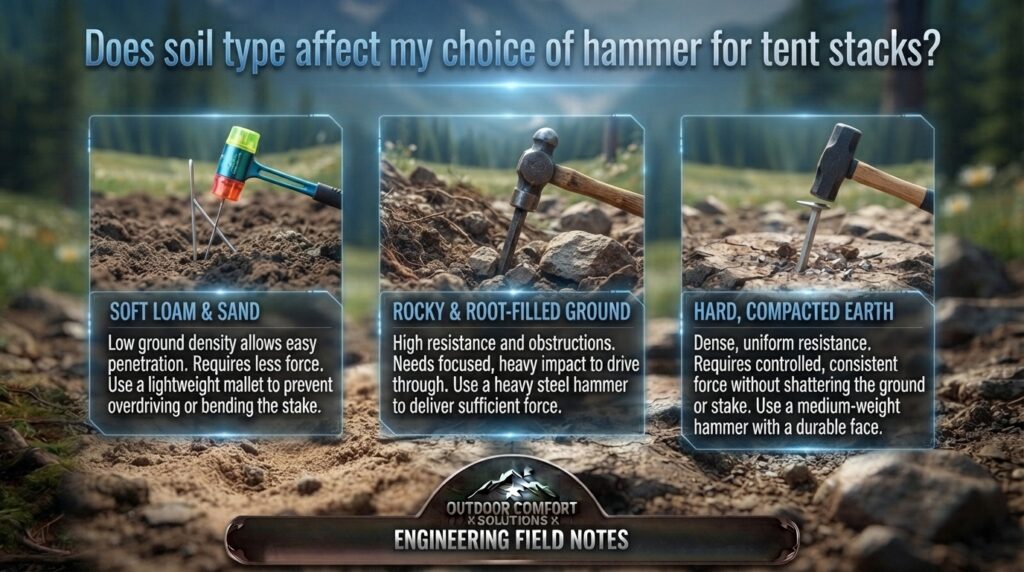
When you are planning a camping trip, your gear selection usually focuses on the tent, the sleeping bag, and the stove. However, the unsung hero of a comfortable night’s sleep is the foundation—your tent stakes. A common question we receive at besttentstakes.com is: “Does soil type really dictate what hammer I should use?”
The answer is an emphatic yes. If you take the same steel claw hammer you use for home repairs to every campsite in the country, you are almost guaranteed to end up with bent stakes, damaged tent fabric, or a shelter that collapses at the first sign of a breeze.
In this guide, we will break down the relationship between soil chemistry, terrain hardness, and the tool you need to get your stakes into the ground securely.
The Soil-Hammer Correlation
Your choice of “hammer” (or whether to use one at all) should be dictated by the resistance the ground offers. Here is how soil types across major US regions impact your setup.
| Soil/Region | Characteristic | Hammer/Tool Recommendation |
| Texas (Hardpan/Clay) | High resistance, dense, baked | Rubber Mallet or Heavy-duty Tent Hammer |
| New York (Forest Loam) | Moderate resistance, roots | Foot/Boot or Rubber Mallet |
| California (Granite/Rocky) | Extreme resistance, unyielding | Steel Rock-Pegs + Dedicated Tent Hammer |
| Washington (Wet Loam) | Low resistance, soft | Your foot (Hammering is unnecessary) |
| San Francisco (Sand) | Zero resistance, loose | No hammer: Use long sand-specific stakes |
How Soil Type Changes Your Technique
1. Hardpan and Baked Clay (Texas)
In arid regions, the ground can be as hard as concrete. A rubber mallet is essential here because you need significant force to penetrate the surface. However, because the ground is so dense, the stake has nowhere to deflect if you hit it wrong. You must use a perfectly vertical strike. If you use a heavy steel claw hammer, you will almost certainly “mushroom” the head of your stakes.
2. Rocky and Granite Terrain (California)
When camping on granite or rocky soil, the problem isn’t just the hardness—it’s the subterranean obstacles. If you try to hammer a standard aluminum stake into a rock, it will bend or snap immediately. In these environments, you should skip the standard stakes and use hardened steel rock pegs. A dedicated, balanced tent hammer with a stake-puller hook is the only tool that gives you the precision to navigate these obstacles.
3. Soft Forest Loam (Washington & New York)
In damp, lush environments, the soil is often a mix of decaying organic matter and fine dirt. This soil is “forgiving.” If you use a heavy hammer here, you will likely drive your stakes so deep that they become impossible to retrieve. In these regions, the best hammer is your boot. Using your heel allows you to feel if you’ve hit a root or a stone, which protects your stakes and the tent’s guy-lines.
The “Hammer vs. Nature” Philosophy
The “No-Hammer” Rule (The Professional Standard)
Experienced backpackers generally follow a “no-hammer” philosophy. They know that if you need a heavy hammer to get your stake in, you are either:
- Using the wrong type of stake for the terrain.
- Trying to force a stake through a rock or root.
By choosing the right stake (e.g., Titanium Nail Pegs for rocky ground, or wide-body Y-stakes for soft ground), you can almost always rely on the “Step-Press” Method. Place your stake, put your heel on the head, and press down. If it doesn’t go in, move it three inches to the left. This prevents 99% of bent stakes.
10 Frequently Asked Questions (FAQ)
1. Is a heavy steel claw hammer ever okay for camping?
Only if you are car camping and using heavy-duty steel rock pegs. For lightweight backpacking stakes, it is almost always too heavy and will destroy your gear.
2. What is the benefit of a rubber mallet?
A rubber mallet dampens the energy of the strike. It provides enough force to move the stake through hard clay without the “shock” that causes aluminum to buckle.
3. Does sand require a hammer?
Never. Hammering in sand is useless because the stake will just pull out. In sand, you need long, wide surface-area stakes buried deep or weighed down with rocks.
4. What should I do if my stake hits a rock?
Stop immediately! Continuing to hammer will only bend the stake. Relocate to a clear patch of ground.
5. Are dedicated “tent hammers” worth the money?
If you frequent rocky or hard-packed environments, yes. They are balanced to strike with precision, and they almost always include a pull-hook, which saves your fingers and your tent fabric.
6. Can I use a rock to hammer in an emergency?
Absolutely. A flat, fist-sized stone is nature’s perfect tent hammer. It is free and works well for most soil types.
7. Why does my stake bend in wet soil?
If it bends in wet soil, the stake is likely too thin or made of low-grade aluminum. Switch to a thicker V-stake for better structure.
8. Is soil type the only factor in stake selection?
No, weather also matters. High winds in a soft-soil area will require longer, more robust stakes than a calm night in the same location.
9. How do I protect the tent fabric when hammering?
Always stake out your guy-lines before driving the stake all the way in. If you are hammering close to the tent, use a buffer like a thick cloth over the stake head.
10. What is the most important “stake skill” for a beginner?
Learning the 90-degree tension rule. Your stake should always be angled away from the tent at a 45-60 degree angle to maximize holding power regardless of the soil.
Conclusion
Your choice of hammer should be as dynamic as the ground you are camping on. In the hard-baked clay of Texas, you need the controlled impact of a rubber mallet. In the lush, soft forests of the Pacific Northwest, you need nothing more than your boot. And in the rocky terrain of California, you need a precise tent hammer and high-strength rock pegs.
At besttentstakes.com, we believe that the right tools make for a better adventure. By matching your staking technique—and your toolkit—to the specific soil type of your destination, you ensure that your shelter remains your sanctuary, no matter how tough the ground may be.