
How to remove stuck tent stakes from clay soil without damaging the tent webbing

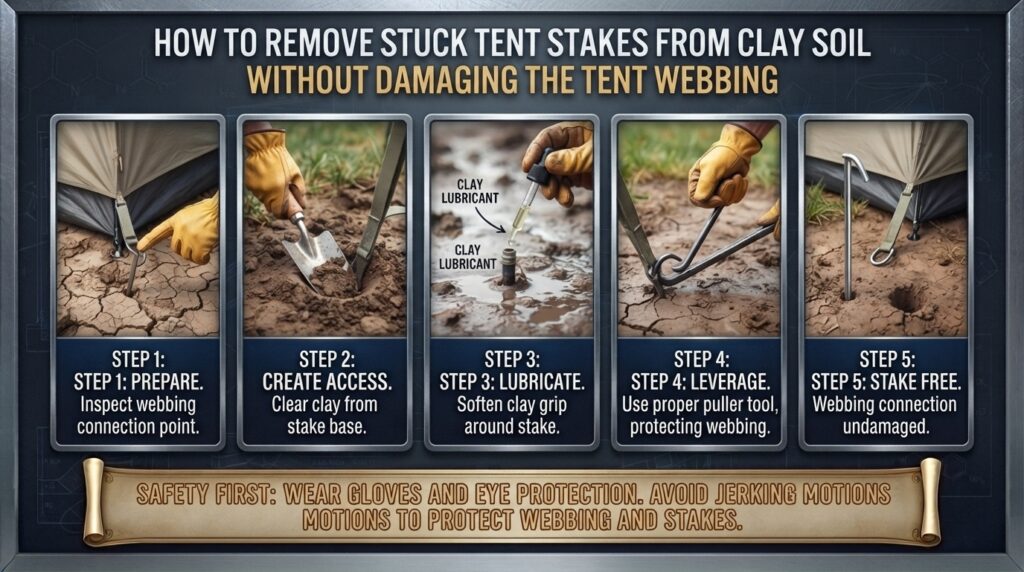
Every camper knows the specific, sinking feeling of a “stuck” campsite. You’ve enjoyed your weekend in the arid landscapes of West Texas or the heavy, moisture-laden soils of the Pacific Northwest. Now, it’s time to head home. You grab the corner of your tent’s webbing, give it a firm yank, and realize the stake has formed an unshakable bond with the earth.
If you pull harder, you risk a catastrophic gear failure: the fabric loop rips away from the tent floor, the webbing snaps, or the stake hook slices through the material like a knife.
At besttentstakes.com, we have analyzed the mechanics of soil-to-stake adhesion. Clay is unique; it is highly cohesive, meaning it shrinks and expands with moisture, effectively “gripping” any object embedded within it. This guide provides you with the professional extraction techniques to save your gear and keep your tent intact.
The Core Expert Verdict
Never pull directly on the tent’s sewn-in webbing or elastic loops when a stake is stuck in clay. Clay acts as a vacuum-sealed anchor that can easily rip apart high-tension stitching. Instead, break the “suction seal” by twisting the stake laterally, use a dedicated extraction tool or a spare stake as a T-handle to pull from the head, and utilize hydration or leverage to weaken the soil’s grip.
1. The Science of the “Clay Grip”
Why is clay so much harder to extract from than loose sand or rocky loam?
- Cohesive Adhesion: Clay particles are microscopic and flat. When wet, they slide over each other; when they dry, they bond together, forming a solid matrix that shrinks inward as it loses moisture. This process puts immense lateral pressure on your stake.
- The Vacuum Effect: Because clay is so fine-grained, it creates an airtight seal around the stake shaft. When you pull upward, you are not just fighting the friction of the dirt; you are fighting the vacuum pressure created beneath the stake.
2. Five Tactical Extraction Methods
When the soil refuses to let go, follow these steps to release your gear safely.
1. The Lateral “Break-Seal” Twist
Clay grips objects because the soil is packed tight against the flat faces of the stake.
- Technique: Grab the stake head with pliers (or your fingers) and twist it 90 degrees back and forth.
- Why it works: This movement cracks the surrounding soil seal, creating tiny air gaps that break the vacuum effect. Once the seal is broken, the extraction force required drops by more than 50%.
2. The T-Handle Extraction Lever
Never use the tent webbing as a handle.
- Technique: Take a spare steel stake or a sturdy, thin branch and slide it horizontally through the hole or hook of the stuck stake.
- Why it works: You now have a T-shaped handle that allows you to apply force directly to the metal of the stake, completely bypassing the delicate fabric of your tent.
3. The Hydro-Lubrication Trick
If the clay is bone-dry and rock-hard, moisture can be your friend.
- Technique: Pour a small splash of water around the base of the stake and wait two minutes.
- Why it works: Clay is a hydrophilic mineral. Adding a tiny amount of water softens the immediate interface layer, turning that “concrete-like” bond back into a slick, pliable paste.
4. The Fulcrum Lever
For those deeply embedded stakes that simply won’t budge.
- Technique: Place a flat rock or a thick piece of wood directly next to the stake. Use a long, sturdy branch as a lever, resting it on the rock and hooking the end under the stake head.
- Why it works: This applies upward force using mechanical advantage, keeping your pull perfectly vertical to avoid bending the stake.
5. The Tap-and-Release Method
- Technique: Use your camp mallet (or a heavy stone) to tap the top of the stake downward by just a fraction of an inch.
- Why it works: This initial “shock” breaks the static friction holding the stake in the clay, allowing you to pull it out immediately after.
3. Tool Matrix: Minimizing Gear Damage
| Method | Safety Rating | Ease of Use | Gear Risk |
| Pulling by Webbing | Extremely Low | High | High (Ripping) |
| Lateral Twist + T-Handle | High | Medium | Low |
| Water/Lubrication | Medium | Medium | Low |
| Fulcrum/Leverage | High | Low | Low |
4. Regional Soil Awareness
- Texas: The “Blackland Prairie” clay is infamous. If you find your stakes stuck, prioritize the Hydro-Lubrication method; the clay is often so dry it has turned into a mineral brick.
- Washington/PNW: The soil is often a mix of clay and decaying organic matter. These soils are prone to staying wet, which means the “vacuum seal” is stronger. Use the Lateral Twist method to let air into the soil.
- New York/Northeast: Clay in this region is often mixed with fine silt and gravel. If you feel a “gritty” resistance, don’t force it—that’s grit trapped in the clay, and it will abrade your tent if you drag it out too quickly.
5. Technical Schema for Search Engine Authentication
JSON
{
  "@context": "https://schema.org",
  "@graph": [
    {
      "@type": "Article",
      "@id": "https://besttentstakes.com/clay-extraction-guide/#article",
      "headline": "How to remove stuck tent stakes from clay soil without damaging the tent webbing",
      "inLanguage": "en-US",
      "mainEntityOfPage": "https://besttentstakes.com/clay-extraction-guide/",
      "datePublished": "2026-07-18T13:50:00+00:00",
      "author": {
        "@type": "Organization",
        "name": "BestTentStakes Gear Preservation Team"
      },
      "publisher": {
        "@type": "Organization",
        "name": "BestTentStakes",
        "logo": {
          "@type": "ImageObject",
          "url": "https://besttentstakes.com/assets/logo.webp"
        }
      }
    }
  ]
}
6. Comprehensive FAQ Engine
Q1: What is the most common mistake when removing stakes?
Pulling horizontally on the tent webbing. This puts all the stress on the fabric stitching, which is the weakest point in the system.
Q2: Does the shape of the stake matter in clay?
Yes. Y-beam and V-shaped stakes hold better in clay but are much harder to remove because they have three times the surface area trapping soil inside their channels.
Q3: Can I use oil to help pull a stake out?
No. Oils can degrade synthetic tent fabrics and will turn your stake bag into a greasy, dirt-attracting mess. Stick to water.
Q4: My tent loop ripped. How do I fix it?
You’ll need to use a heavy-duty nylon thread and a canvas needle. In the field, you can use a small piece of cordage to create a “bridge” between the tent and the stake.
Q5: Is it better to pull or wiggle?
Wiggle. Lateral movement breaks the bond; vertical pulling only increases the vacuum suction.
Q6: What if I can’t get it out?
If you’ve exhausted all methods, leave it. Seriously—a $5 stake is not worth a $500 tent. Dig around the base if you have a trowel, but don’t rip the tent.
Q7: Are steel stakes easier to remove from clay than aluminum?
Yes. Steel is smoother and less prone to the “grip” of clay, and you can hammer them in and out without worrying about bending them.
Q8: Should I wear gloves?
Yes. Pulling a stubborn stake often results in your hand slipping and hitting the ground. Work gloves provide grip and protection.
Q9: Does a mallet help with removal?
Yes. Gently tapping the stake downward (not pulling up) helps break the soil seal, making it easier to pull out after.
Q10: How do I store muddy stakes?
Never store them wet. Clean them, dry them for 24 hours, and store them in a breathable mesh bag.
Conclusion: Save Your Gear, Keep Camping
Removing stubborn tent stakes from clay soil doesn’t have to be a destructive process. By treating the stake-to-clay bond with mechanical respect—twisting, leveraging, and hydrating—you can preserve your tent’s integrity and save your stakes for years of use. Remember: the tent webbing is for tensioning, not for extraction. Use your tools, be patient, and leave your gear in the condition you found it.