
What to do when you cannot push your tent stake into the hard ground

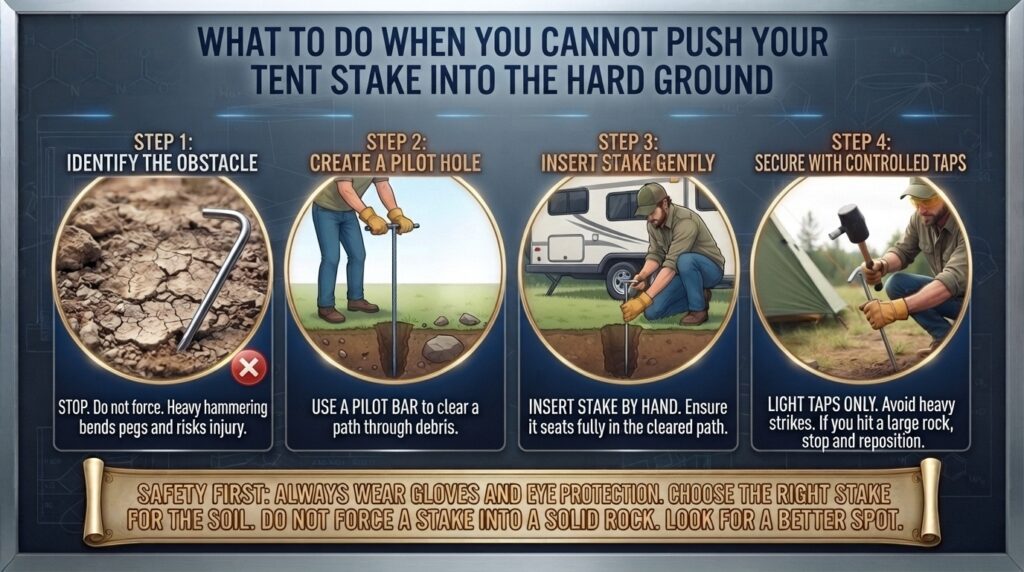
There is nothing more frustrating than arriving at a campsite, exhausted from a long drive or hike, only to find that the ground is as impenetrable as concrete. You’ve found the perfect spot, you’ve unrolled your tent, and you’re ready to relax—but your tent stakes refuse to budge.
Whether you are battling the sun-baked, clay-rich “caliche” of West Texas, the glacial till and buried rocks of the Adirondacks in New York, the dry, hard-packed earth of a California canyon, or the dense, root-filled forest floor of Washington state, the result is the same: bent stakes, sore feet, and a poorly pitched tent that won’t stand up to the wind.
At besttentstakes.com, we specialize in solving the most common camping frustrations. Driving a stake into hard ground isn’t just about force; it’s about geology, technique, and having the right tools for the terrain. This guide will walk you through everything you need to do when the earth refuses to cooperate.
The Core Expert Verdict
When your tent stake refuses to enter the ground, stop pushing with your boot immediately. Forcing a stake against hardpan or stone will only bend the metal, break the stake, or damage your footwear. Instead, use a mechanical advantage: employ a dedicated camp mallet or a heavy rock to drive the stake, shift your position to avoid buried debris, or pivot to alternative anchoring methods like heavy-duty cordage tied to boulders or logs. In extreme cases, use a “pilot hole” technique to break the ground’s resistance before attempting to set your stakes.
1. Understanding the Resistance: Why the Ground Won’t Give
To fix the problem, you need to understand why your stakes are failing. Generally, hard ground falls into three categories, each requiring a different strategy:
A. Surface Compaction (Hardpan & Caliche)
Common in arid climates like Texas and parts of California, the soil is often a mix of clay and minerals that bake into a solid layer under the sun. It isn’t impossible to drive a stake into, but it requires a very thin, very strong steel peg that acts like a cold chisel.
B. Subsurface Obstructions (Rocks & Roots)
In places like New York and Washington, you might have soft topsoil that quickly gives way to a buried rock or a thick, woody root. If you are pushing your stake and it suddenly stops or vibrates, you have hit an obstruction. No amount of force will push a stake through a granite boulder.
C. Frozen or Desiccated Soil
In high-altitude areas or during late autumn, the ground may be frozen or extremely dehydrated. In these cases, the soil particles are locked together, preventing the stake from displacing them.
2. Five Proven Strategies for Impenetrable Terrain
When your boot fails, do not resort to desperation. Use these professional field techniques to secure your tent.
1. The Pilot Hole Method
If you have a steel stake or a heavy-duty screwdriver, use it to punch a hole first.
- How: Drive your “breaker” tool into the ground, wiggle it back and forth to create a void, and then pull it out.
- Benefit: Now that you’ve created a channel, your actual tent stake will slide into place with ease. This saves your high-end aluminum stakes from being ruined.
2. The 45-Degree Angle Pivot
Many campers try to drive stakes straight down. This is the hardest angle to achieve in hard ground.
- How: Set your stake at a 45-degree angle pointing away from the tent.
- Benefit: This creates a much larger surface area contact against the hard earth and allows the stake to “slice” through compact layers more effectively.
3. The “Big Rock, Little Rock” Anchor
If the ground is solid rock, put the stakes away.
- How: Tie a loop of utility cord (paracord) to your tent’s stake-out point. Tie the other end to a large, heavy rock (or a cluster of rocks).
- Benefit: The weight of the rock provides superior tension to any stake. This is the gold standard for desert and mountain camping.
4. The Controlled Mallet Strike
Your boot sole is soft; it absorbs energy. A mallet or a rock transfers energy.
- How: If you don’t have a mallet, find a heavy, flat-faced rock. Use short, rhythmic, vertical taps.
- Benefit: Controlled strikes prevent the stake from bending. If the stake doesn’t move after three taps, stop—you are hitting a rock.
5. Leveraging Natural Anchors
Look at your environment. Are there sturdy low-lying bushes, roots, or trees?
- How: Use extra guyline to extend your reach to these natural features.
- Benefit: This uses the natural strength of the landscape to hold your tent, bypassing the need for ground-based anchors entirely.
3. The Gear You Need: Tactical Comparison
If you camp in Texas, New York, or California regularly, your standard kit is likely insufficient. Use this table to decide if it’s time for an upgrade.
| Stake Material | Ideal Terrain | Resistance to Hard Ground | Carry Weight |
| Forged Steel | Hardpan / Rock | Best (Unbendable) | Heavy |
| Titanium Nail | Packed Dirt / Gravel | Excellent (Stiff) | Ultralight |
| Aluminum Y-Beam | Standard Soil | Good | Moderate |
| Plastic/ABS | Sand / Loose Soil | Poor (Will Snap) | Light |
4. Professional Staking Protocol
1.Probe the Site:Ground Assessment.
Before setting up, use your hand to feel the ground. If it’s hard, don’t try to force a stake immediately. Identify if it’s “hard-clay hard” or “rock-solid hard.”
2.Precision Driving:Angle and Strike.
Set the stake at 45 degrees. Use your mallet or rock to deliver precise taps. Listen to the sound; a hollow thud is good, a high-pitched metallic ping means you’ve hit a rock.
3.The Three-Inch Rule:Adjustment.
If the stake stops abruptly, move your attempt three inches to the left or right. Most rocks are small; you only need to miss the edge of it to find a path into the dirt.
4.Deep Drive:Flush Security.
Ensure the hook is flush with the ground. A stake left sticking out is a tripping hazard and is more likely to leverage out of the ground.
5.Final Anchor Check:Tensioning.
Once the tent is up, give each guyline a firm tug. If a stake pulls loose, it’s time to move to the “Big Rock” anchor method.
5. Regional Challenges: A Field Guide
- Texas Triangle (Austin, Dallas, Houston): The soil here is legendary for being rock-hard. Carry steel. Aluminum will fail you.
- New York (Adirondacks/Catskills): Focus on Y-beam stakes. Their three-sided design allows them to slip past small stones that would stop a round stake dead.
- California/San Francisco: If near the coast, you need wide stakes for sand. If inland near the Sierras, use titanium nails.
- Washington (Pacific Northwest): The challenge isn’t hardness; it’s roots. Use thin titanium stakes to “needle” between roots, or use the “deadman” anchor method.
6. Comprehensive FAQ Engine
Q1: Why do my tent stakes bend when I try to push them in?
You are likely using thin aluminum stakes on compacted ground. The metal isn’t strong enough to displace the soil, so it buckles under the force of your weight.
Q2: What should I use instead of a hammer?
A palm-sized rock with a flat face is the perfect backcountry mallet. Just be careful not to crush your fingers!
Q3: Is it okay to leave my tent partially un-staked if the ground is too hard?
No. High winds can pick up an un-staked tent in seconds, causing massive damage. If you can’t stake, you must use rock anchors.
Q4: Will steel stakes rust in the damp Washington forests?
If you don’t dry them after the trip, yes. Always air-dry your stakes for 24 hours before putting them back in your gear bag.
Q5: What do I do if I hit a big root in a forest?
Move. Roots are structural for the tree; you don’t want to damage them, and you won’t be able to drive a stake through them anyway.
Q6: Can I use a drill to make holes in hard ground?
Only for car camping, and only if you have a high-torque cordless drill with a masonry bit. It’s overkill for most, but effective.
Q7: Why do some stakes have pull-loops?
High-strength stakes hold so well that they are hard to pull out! The loop is there so you can hook another stake through it and pull straight up.
Q8: How deep should a stake be?
Ideally, the entire shaft should be buried. If the hook is flush with the dirt, your tent is secure.
Q9: Can I use duct tape to secure my tent to a rock?
No, it will leave a sticky residue and fail immediately under tension. Use paracord.
Q10: What is the lightest stake for hard ground?
Titanium “nail” or “skewer” style stakes are the best balance of ultralight weight and high-strength penetration.
Conclusion: Master Your Campsite
Camping in hard ground doesn’t have to be a nightmare. By carrying the right tools—specifically hardened steel or titanium stakes—and knowing when to swap “force” for “finesse,” you can set up a rock-solid tent anywhere. Remember, if the ground says no, don’t force it; adapt your strategy, use the environment, and enjoy your stay.