
Should I use a rubber mallet or a rock to drive tent stakes in

Every camper, from the weekend warrior in the Adirondacks to the seasoned overlander navigating the hardpan of West Texas, has faced the same moment of truth: you have your tent laid out, your stakes are in hand, and you are staring at a piece of ground that looks like it hasn’t seen rain in a decade. You reach for your gear—or your surroundings—to drive those pegs home. But which is better? Should you carry a specialized rubber mallet, or is a found rock the smarter choice?
At besttentstakes.com, we’ve tested countless setups against the varied terrains of California, Washington, and beyond. The answer isn’t just about weight; it’s about the protection of your gear, the efficiency of your camp setup, and the geological realities of the campsite you’ve chosen.
The Core Expert Verdict
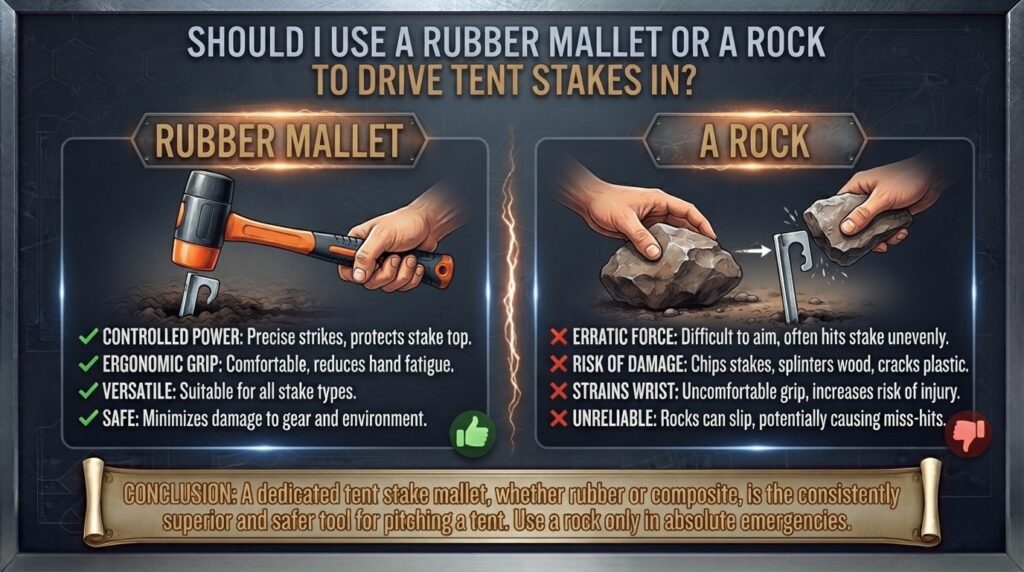
The ideal choice depends on your camping style. A rubber mallet is superior for protecting your high-end aluminum stakes from deformation and provides a consistent, controlled strike. However, a rock is a viable, weight-saving alternative if you are backpacking or camping in extremely hard, rocky terrain where a rubber mallet would be too light or prone to damage. Never strike your stakes with a boot, as it causes lateral force that leads to structural bending.
1. The Case for the Rubber Mallet
For most car campers and base-camp enthusiasts, the rubber mallet is the gold standard.
Why It Wins
- Precision: The weight and balance of a dedicated camping mallet allow for clean, vertical strikes. This keeps the stake aligned correctly as it enters the ground.
- Material Preservation: Rubber (or a rubber-coated head) is softer than the stake. When you strike a metal stake with a metal hammer, you often chip the paint or anodization. Chipped stakes rust. A rubber mallet leaves the stake’s finish intact.
- Reduced Noise: Camping is about peace. A rubber mallet provides a dull thud rather than the high-pitched, echoing clang of metal-on-metal or rock-on-metal, which can disturb neighbors at a crowded campsite.
The Trade-off
- Weight: It’s an extra item to pack. In the ultralight world, every ounce counts, and a mallet is a luxury item.
2. The Case for the “Found Rock”
When you are deep in the backcountry of the Cascades or hiking the Sierra Nevada, a mallet is extra weight you don’t need.
When to Choose a Rock
- Backpacking: If you are counting grams, you can’t justify a mallet.
- Extreme Hardpan: In some parts of Texas or the arid West, the ground is so hard that a standard rubber mallet will bounce right off. You need the density of a rock to transfer enough force to penetrate the soil.
Best Practices for Using a Rock
- Pick the Right Rock: Look for a palm-sized rock with a flat face. Avoid jagged, crumbling rocks that will spray debris into your eyes or break into smaller pieces when struck.
- Protect the Stake: If you have an aluminum stake, place a small, thick leaf or a piece of folded cloth between the rock and the stake head to act as a buffer.
- Use Caution: Always wear glasses or ensure no one is standing nearby. Striking rock-on-rock or rock-on-metal can cause small shards to fly.
3. Comparison Table: Mallet vs. Rock
| Feature | Rubber Mallet | Found Rock |
| Weight | 8–16 oz | 0 oz (Found on-site) |
| Strike Precision | High | Low |
| Gear Protection | High (Dampens impact) | Low (Causes chips) |
| Versatility | Good | Poor (Hard to find perfect shape) |
| Noise Level | Low | High |
| Ideal Terrain | Grass, Soft/Firm Soil | Hardpan, Rocky, Gravel |
4. The “No-Strike” Rule: Why Your Boots are the Enemy
You will see campers using their heels to stomp stakes into the ground. Do not do this.
When you kick a stake, you are applying force at an angle (lateral force). This creates a “moment of leverage” that bends the neck of the stake immediately. Once a stake is bent, it is structurally compromised and will never again drive straight into the ground. Even if you manage to get it in, a bent stake provides less surface area for grip, making your tent much more likely to pull out during a windstorm.
5. Regional Recommendations: What Works Where?
- Texas: The hard clay often requires a heavy-duty steel peg. A rubber mallet may be too soft for the hardest spots, but it’s great for the majority of the site. Bring a mallet, but know when to use a flat rock for the stubborn areas.
- New York/Adirondacks: You will hit rocks. A rubber mallet is perfect for the soil areas, but keep your eyes open for a good rock when you hit those granite patches.
- California/Pacific Coast: If you’re in sandy soil, neither matters much—push them in by hand. If you’re in the mountains (Sierra), a rock is your best friend due to the extreme hardness of the terrain.
- Washington/San Francisco: For coastal and forest settings, soil is often loose or root-filled. A mallet is the best tool for the job to ensure you don’t damage your gear while navigating roots.
6. Comprehensive FAQ Engine
Q1: Is it worth carrying a mallet for a weekend trip?
If you are car camping, yes. It makes setup faster, quieter, and cleaner.
Q2: What if my rubber mallet isn’t heavy enough?
If you find yourself having to hit the stake 50 times, you are hitting an obstruction (like a buried rock). Stop and move the stake two inches to the side.
Q3: Does using a rock ruin my tent stakes?
It can chip the powder coating, which leads to rust. If you use a rock, be gentle and try to avoid striking the metal directly if possible.
Q4: Can I use a metal hammer?
Only if you have hardened steel pegs. Using a metal hammer on thin aluminum stakes will crush the head of the stake.
Q5: How do I remove a stake that I drove in with a rock?
Use the hook of another stake to pull it out. Don’t pull by the fabric loops!
Q6: What if I lose my mallet?
Use a large, flat rock, but wrap the stake head in a piece of rag or even a heavy sock to protect it.
Q7: Are there “ultralight” mallets?
Yes, some are made of high-density plastic or hollow aluminum. They are a good middle ground for backpackers.
Q8: Does the hardness of the ground affect my mallet choice?
Yes. Hard ground requires a more durable, heavier tool. In extremely hard ground, a rubber-coated metal hammer is better than pure rubber.
Q9: My stakes keep bending. Is it the mallet or the stake?
It’s usually the stake. You are likely using aluminum shepherd hooks in rocky ground. Switch to forged steel or high-grade titanium.
Q10: How do I store my mallet?
Keep it in your stake bag or a dedicated gear bin. If it gets wet, let it dry so the handle (if wooden) doesn’t rot.
Conclusion
The debate between a rubber mallet and a rock ultimately comes down to your priorities: weight vs. gear care. For the majority of campers, a high-quality rubber mallet is the superior tool—it keeps your gear pristine and makes camp setup a breeze. However, if you are tackling the most rugged, remote environments in Texas or California, knowing how to safely use a rock is an essential skill.
Whichever you choose, remember the golden rule: Don’t kick your stakes. Protect your gear, respect the campsite, and you’ll be ready for your next adventure.