How to anchor a tent properly when the ground is too hard for stakes

You have arrived at your destination—whether it’s the sun-baked, clay-hardened plains of West Texas, the rocky, glacial till of New York’s Adirondack Mountains, or the granite-laden terrain of the California Sierras. You lay out your tent, excited for a night under the stars, but when you reach for your tent stakes, you hit a wall—literally.
The ground is as hard as concrete, and no matter how hard you push or how many times you strike with your mallet, the stakes refuse to penetrate. This is the moment most campers panic, but seasoned outdoor enthusiasts know that a tent stake is only one way to secure a shelter.
At besttentstakes.com, we have field-tested every trick in the book for securing a tent when the earth refuses to cooperate. If you cannot stake into the ground, you must turn to gravity, mass, and friction. Here is your definitive guide to anchoring a tent when the ground is impenetrable.
The Core Expert Verdict
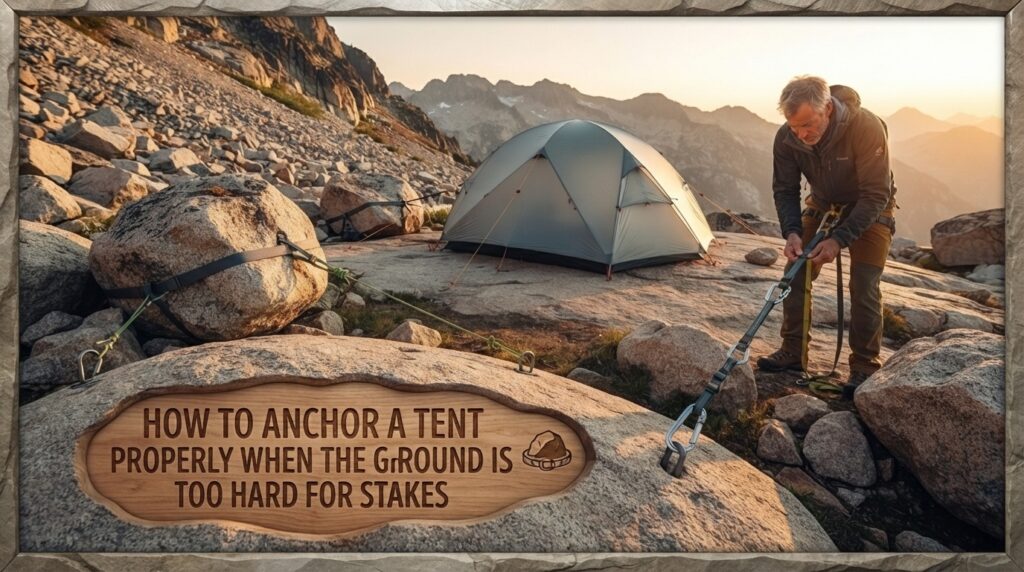
When ground-based staking is impossible, you must shift your mindset from “penetration” to “dead-weight anchoring.” The best way to secure a tent on hard or rocky ground is to utilize the environment: tie your guy lines to heavy boulders, secure them to the bases of sturdy trees, or create “deadman” anchors using rocks and logs. Never leave your tent unanchored; even on hard surfaces, a sudden gust can turn your tent into a sail and send it tumbling, potentially damaging both your gear and the surrounding environment.
1. The Physics of Anchoring: Gravity vs. Friction
When you cannot pierce the soil, you have to use physics to your advantage. There are two primary ways to hold a tent in place without a stake:
- Mass Anchoring: Using the sheer weight of an object (a large rock or log) to hold the tent down.
- Friction Anchoring: Wrapping lines around stationary objects (trees or posts) where the friction of the cord prevents movement.
If the ground is too hard, you are effectively turning your tent into a massive wing. A tent doesn’t just need to be “weighted down”; it needs to be tethered to something that cannot be moved by wind.
2. Five Pro-Techniques for Hard-Ground Anchoring
When you realize your stakes won’t work, don’t waste energy bending your pegs. Execute these professional alternatives immediately:
1. The “Big Rock, Little Rock” (BRLR) Method
If you find a large boulder, you have found a perfect anchor.
- The Technique: Tie a loop of paracord around the middle of a small, sturdy rock. Place this “little rock” on the ground and then roll a massive, immovable “big rock” directly on top of it to trap the cord.
- The Pro-Tip: Ensure the cord is pulled taut before you place the big rock on it to minimize slack.
2. The Deadman Anchor (Buried Weight)
If there is a thin layer of loose gravel or dirt on top of the hard rock, you can use a “deadman.”
- The Technique: Tie your guy line to the center of a sturdy, foot-long branch or a flat, heavy piece of slate. If you can dig a small trench, lay the object horizontally in it and pile as many rocks as you can on top.
- The Pro-Tip: The wider the object, the better. A horizontal stick is far more effective than a vertical one.
3. Tree and Root Tethering
In forested areas like those in Washington, trees are your best friend.
- The Technique: Instead of trying to stake into hard root-filled dirt, extend your guy lines using extra cordage to wrap around the base of a sturdy tree.
- The Pro-Tip: Always tie your cord as close to the base of the tree as possible to prevent the tent from “tugging” against the tree’s trunk in a way that might injure the bark.
4. Sandbag/Stash-Bag Counterweight
If you are car camping, your gear itself is your best anchor.
- The Technique: Fill your empty storage bags or stuff sacks with rocks, gravel, or even heavy camping equipment. Place these heavy bags inside your tent, near the corners, or tie your guy lines directly to the handles of the heavy bags.
- The Pro-Tip: This is exceptionally useful in desert environments like Big Bend, Texas, where you can easily find rocks of all sizes to fill your bags.
5. Multi-Point Tensioning (The “Web” Setup)
On hard, flat surfaces like rocky ledges, sometimes one anchor isn’t enough.
- The Technique: Create a “web” by running a long line between two solid objects (two trees or two large boulders) and tethering your tent corners to the center of that line. This distributes the stress and prevents the tent from shifting.
3. The Gear You Need: The “Hard-Ground” Kit
If you know you are heading to rocky regions (like the Sierras or Adirondacks), carry this specialized gear:
| Item | Purpose | Why it helps |
| Extra Paracord | Tethering | Allows you to reach far-away trees or boulders. |
| Heavy-Duty Carabiners | Quick-Connect | Makes attaching lines to rocks/logs much faster. |
| Steel Rock Stakes | Penetration | Can force a hole where others fail. |
| Stuff Sacks | Weighting | Used as sandbags when filled with local rock/gravel. |
| Tensioner Adjusters | Precision | Maintains tension on lines tied to distant objects. |
4. Professional Staking Protocol
1.Identify Anchor Points:Assess the Site.
Walk around your perimeter. Can you find three or four objects within reach that could serve as anchors? If yes, you are set.
2.Connect the Web:Extend Your Lines.
Use extra paracord to extend your tent’s tie-out points. Do not force the tent to stretch; use the cordage to bridge the gap between the tent and the anchor.
3.The:Apply Initial Tension.
Tighten your guy lines until they are taut but not strained. A good guy line should “pluck” like a guitar string when flicked.
4.Double-Check Movement:Secure the Anchors.
Once tensioned, push or pull on your anchor rocks. If they shift at all, add more weight.
5.Check Periodically:Monitor Conditions.
If the wind picks up, your anchor rocks may settle into the dirt. Re-tighten your tensioners every few hours if necessary.
5. Regional Field Realities
- Texas: The heat makes clay hard. Use bags filled with rocks; the desert floor is rarely short on loose gravel and stones.
- New York (Adirondacks/Catskills): Use the massive glacial boulders common in these forests to your advantage.
- California/San Francisco: If camping on exposed coastal bluffs, use the “Deadman” anchor method to ensure your tent stays put during heavy Pacific gusts.
- Washington: The forest floor is soft but filled with roots. Use your extra paracord to bridge the distance to sturdy tree trunks.
6. Comprehensive FAQ Engine
Q1: Is it dangerous to leave a tent unanchored on hard ground?
Yes. A sudden gust can flip a tent, snap poles, and send your gear flying—potentially hurting someone or damaging your shelter.
Q2: What is the lightest way to anchor a tent without stakes?
The “stuff sack” method. Use your own gear bags filled with local rocks.
Q3: Can I use duct tape to anchor lines to rocks?
Never. Duct tape will fail in seconds due to dust and moisture. Use proper knots like a taut-line hitch.
Q4: Will wrapping lines around trees hurt the trees?
It can strip the bark. Use a piece of cloth or your jacket between the line and the tree to protect the bark.
Q5: How many anchor points do I need?
At a minimum, secure the four corners of your tent and the main fly tie-outs.
Q6: Can I use water jugs as anchors?
Yes, if you are car camping. A full gallon jug is heavy and makes a perfect corner anchor.
Q7: What if there are no rocks or trees around?
Use a “Deadman” anchor. Dig a shallow trench, bury a heavy stick, and pile dirt and rocks on top.
Q8: Should I use heavy stakes as “weights” instead of stakes?
No, that’s risky. Stakes aren’t heavy enough. Use rocks.
Q9: My guy lines are too short. What do I do?
Always carry 50 feet of lightweight paracord in your kit for exactly this reason.
Q10: How do I know if my tent is secure enough?
If you can pull on the tent and it doesn’t move, you’re good to go.
Conclusion
Camping on hard, rocky ground doesn’t mean your tent has to be unstable. When you can’t stake, you must become an improviser. By using heavy boulders, tree trunks, and clever “deadman” anchors, you can ensure your shelter is as secure on a slab of granite as it is on a soft meadow. Pack a little extra cordage, keep your eyes open for natural anchors, and you’ll never have to worry about a “stuck” campsite again.