Best lightweight tent stakes for ultralight backpacking in loose sand and soft soil

When you are miles into the backcountry—whether you are traversing the shifting dunes of California’s coastal beaches, setting up camp on the soft, mossy forest floors of Washington, or navigating the loamy, damp terrain of New York’s river valleys—your tent is your only refuge. But for the ultralight backpacker, standard steel tent pegs are out of the question. They are too heavy, and more importantly, they are completely ineffective in soft terrain.
In loose sand or damp, soft soil, a standard thin stake will pull right out the moment a light breeze hits your tent. You need specialized hardware that balances featherlight weight with maximum surface-area displacement.
At besttentstakes.com, we have obsessed over the engineering of ultralight gear. In this guide, we break down the materials, shapes, and field techniques required to anchor your ultralight shelter securely when the ground refuses to hold a standard peg.
The Core Expert Verdict
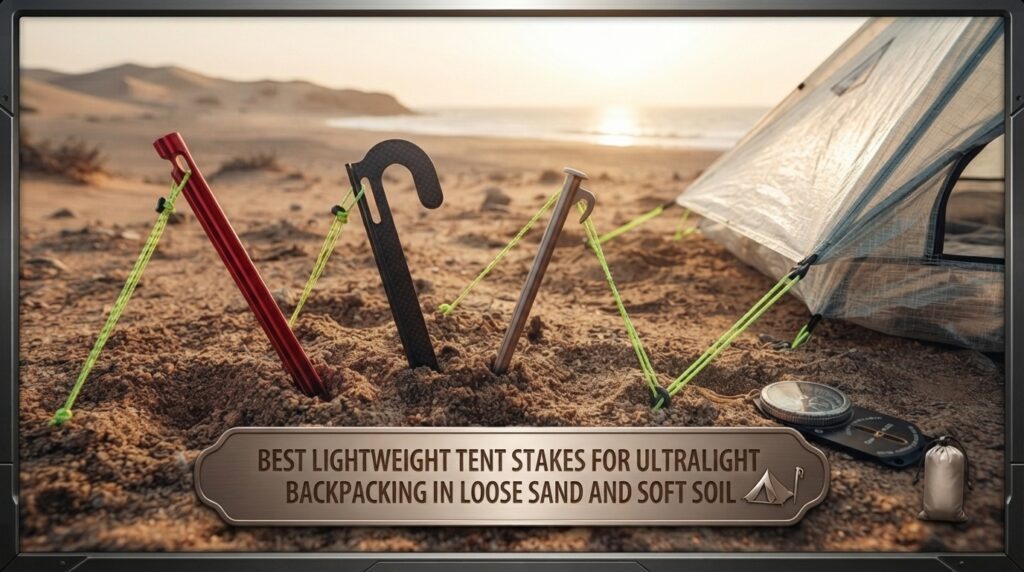
For ultralight backpacking in loose sand or soft soil, you must prioritize “high-surface-area” stake geometries over raw metal thickness. The best stakes for these conditions are wide, curved “U-channel” or “scoop” stakes made from 7000-series aircraft-grade aluminum. While titanium shepherd hooks are great for alpine rock, they fail in sand. If the ground is extremely soft, skip the stakes entirely and use the “buried deadman” method, which uses the weight of the sand itself to hold your tent secure.
1. The Physics of the “Sand-Hold”
Why do stakes pop out of soft ground? It comes down to soil shear strength.
In hard dirt, a stake is held in place by friction. In soft sand or loose duff (the layer of decaying leaves and moss found in the Pacific Northwest), there is almost no friction. To secure your tent, you need to engage a volume of soil.
- Surface Area Displacement: A thin, round stake cuts through sand like a knife through butter. A wide, curved stake acts like a shovel, pushing against a large “wall” of sand particles. The more sand you engage, the higher the holding power.
- The “Deadman” Effect: If a stake is angled correctly, the tension of your guyline actually pulls it deeper into the sand. This is why the shape of the stake is more important than its weight.
2. Choosing the Right Materials for Ultralight Gear
When every gram counts, you need materials that offer the best strength-to-weight ratio.
- 7000-Series Aluminum: The gold standard for sand/soft soil stakes. It is light enough to carry in your pack but stiff enough to hold its shape when you drive it in.
- Carbon Fiber: Extremely light, but generally brittle. Use caution with carbon fiber stakes in rocky areas, though they perform surprisingly well in pure, clean sand.
- Titanium: While the lightest, titanium is often too thin for sand. A titanium shepherd hook will slide out of sand even if you bury it deep. Only use titanium if you are certain you can find a way to anchor it to a rock or log.
3. Top-Performing Stake Geometries
| Stake Profile | Ideal Environment | Holding Power | Extraction Difficulty | Weight |
| Wide U-Channel (Scoop) | Loose Sand / Beaches | Excellent | Low | Low |
| Wide V-Angle | Soft Garden Loam / Moss | High | Moderate | Low |
| Snow/Sand “Deadman” | Deep Sand / Deep Snow | Extreme | High | Medium |
| Titanium Shepherd Hook | Alpine Trails / Hard Dirt | Low | Very Low | Very Low |
| Threaded Auger | Compacted Sand / Ice | High | Moderate | Medium |
4. Field Tactics: When Stakes Aren’t Enough
Sometimes, even the best wide stakes aren’t enough. Here is how ultralight hikers manage soft ground:
1. The Buried Deadman Anchor
If your stakes are pulling out, stop trying to drive them into the surface. Instead:
- Tie your guyline around a flat, heavy rock, a sturdy stick, or even a stuff-sack filled with sand.
- Dig a hole 8–10 inches deep.
- Place the object horizontally in the hole and bury it.
- Pack the sand down firmly. The weight of the soil above the object will hold your tent in even gale-force winds.
2. The “Cross-Stake” Configuration
If you only have standard V-stakes, you can double your holding power by driving two stakes into the same loop in a “cross” (X) pattern. This forces the ground to displace twice the amount of soil to pull the anchor free.
3. The Natural Tether
In Washington’s forests or California’s coastal scrub, use the land. Tie your guyline to a heavy log, a shrub base, or a large rock. This is the ultimate “ultralight” tactic because it requires zero extra weight.
5. Regional Packing Strategies
- California Coast/San Francisco: If you’re hiking the beach, bring dedicated U-channel sand stakes. They are wider and longer than standard stakes.
- Washington/PNW: The ground is often a mix of soft moss and roots. Use the “Deadman” method here, as stakes often hit roots or slip through the soft duff.
- New York/Adirondacks: The loamy, damp soil is great for wide V-angle stakes. They grab the earth well and are easy to pull out when you leave.
- Texas: If you find yourself in the soft, silty soil of East Texas, use wide V-angle stakes. Avoid shepherd hooks at all costs!
Comprehensive FAQ Engine
Q1: Why do my titanium stakes fail in sand?
They are too narrow. They don’t engage enough sand particles to create resistance, so they slide through the soil like a needle through silk.
Q2: What is the lightest way to anchor a tent in sand?
Using a “deadman” anchor with a rock or stick found at the site. It weighs nothing and provides the strongest hold.
Q3: How long should a sand stake be?
At least 8–10 inches. The longer the stake, the more sand it engages.
Q4: Can I use plastic stakes?
Some plastic “snow stakes” work well in sand, but they are bulky and hard to pack. Aluminum “scoop” stakes are usually better for backpackers.
Q5: How do I keep my sand stakes from disappearing?
Add a small, bright-colored piece of cord or tape to the top. Sand hides stakes incredibly well.
Q6: What if I’m in a high-wind area?
Use two stakes per guyline in a “V” formation, or switch to the deadman burial method.
Q7: Are carbon fiber stakes good for sand?
They are light, but they lack the “bite” of aluminum scoop stakes. They are better suited for firm soil.
Q8: Should I clean sand stakes after a trip?
Yes. Sand is highly abrasive. If you don’t clean it off, it will scratch your tent and your other gear.
Q9: Can I use water bottles to anchor my tent?
Yes! If you have empty water bottles, fill them with sand, bury them, and tie your guyline to the neck. It’s an effective, zero-weight solution.
Q10: Why do my stakes pull out overnight?
Sand settles and shifts. It’s a good idea to check your line tension before you go to sleep.
Conclusion
Choosing the right stake for soft terrain is about understanding that your goal isn’t to pierce the earth, but to trap it. By using wide-profile scoop stakes or mastering the “buried deadman” anchor, you can enjoy a secure, stable tent regardless of how soft or sandy the ground gets. Don’t settle for standard shepherd hooks; upgrade your kit, learn these field tactics, and you’ll find that the softest ground is no longer a barrier to a great night’s sleep.