How to prevent your tent stakes from pulling out of the ground in wind

There is nothing quite as disruptive to a wilderness experience as the middle-of-the-night sound of a tent wall flapping violently against your sleeping bag because a stake has failed. Wind is the ultimate stress test for your shelter, and when the gusts pick up—whether you are camping on the exposed coastal bluffs of Washington, the open plains of Texas, or the mountain ridges of New York—your stakes are the only thing keeping your home grounded.
If your stakes are pulling out, it isn’t necessarily bad luck; it is a failure of geometry, positioning, or site selection. At besttentstakes.com, we specialize in the mechanics of shelter security. This guide will show you how to bulletproof your tent against high winds, ensuring your next trip stays peaceful, no matter what the weather throws at you.
The Core Expert Verdict
To prevent tent stakes from pulling out in the wind, you must stop pulling against the soil’s “friction” and start pulling against its “mass.” The secret is the 45-degree angle—driving the stake at an angle pointing away from the tent maximizes the ground’s resistance. If the ground is too loose or the wind too severe, move beyond simple stakes and use “deadman” anchors, rock-weighting, or multi-stake reinforcement to guarantee your shelter remains standing.
1. The Geometry of Resistance: Why Stakes Fail
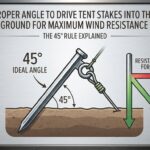
Wind doesn’t pull a stake straight up; it creates a diagonal force. If your stake is driven vertically, you are asking the soil to hold it in place by pure friction alone—which, in sand or soft soil, is nearly impossible.
- The 45-Degree Rule: By driving the stake at a 45-degree angle away from the tent, you change the physics. The force of the wind now pulls the stake into the ground rather than out of it.
- The Hook Orientation: For stakes with a hook (like shepherd hooks), the hook should face away from the tent. This creates a physical lock where the guy line pulls the stake deeper into the earth as the wind intensifies.
2. Advanced Anchoring Techniques for Gale-Force Winds
When the forecast calls for serious weather, standard staking won’t cut it. Use these professional techniques to increase your holding power by 300%.
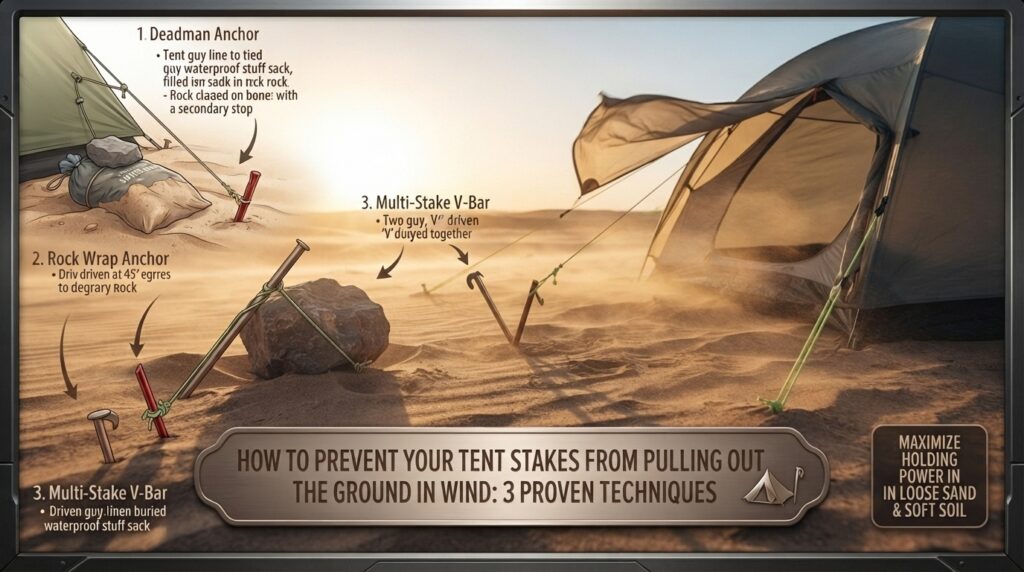
1. The Double-Stake “V” Configuration
When the ground is loose, one stake isn’t enough.
- The Technique: Drive two stakes into the ground through the same guy-line loop. Drive the first one at a 45-degree angle, then drive the second one immediately behind it at the same angle, creating a “V” or “X” pattern.
- The Result: You have effectively doubled the surface area resisting the pull of the tent.
2. The Deadman Anchor (Buried Weight)
If the ground is too soft for any stake, dig a hole.
- The Technique: Tie your guy line to a heavy log, a large rock, or a “stuff sack” filled with gravel. Bury it 8–10 inches deep.
- The Result: You are now pulling against the weight of the entire landscape, which is virtually impossible for wind to move.
3. The Rock-Stack “Bulwark”
If you are on hard ground where stakes barely penetrate, use mass.
- The Technique: Drive your stake as best you can, then place a 20–30 lb boulder directly on top of the stake head.
- The Result: The weight of the rock prevents the stake from “walking” out of the ground when the wind gusts cause the tent to vibrate.
3. Selecting the Right Stake for the Wind
Not all stakes are created equal. Using the wrong stake in the wrong soil is the #1 reason for wind-failure.
| Stake Type | Best Soil | Wind Resistance | Notes |
| Y-Beam | Loose/Rocky | High | Great multi-directional grip. |
| Wide U-Channel | Sand/Beach | High | Requires deep burial. |
| Forged Steel | Hardpan/Rock | Extreme | Won’t bend under heavy load. |
| Shepherd Hook | Lawn/Firm Soil | Low | Only for light breezes. |
| Titanium Nail | Packed Dirt | Moderate | Lightweight, but small surface area. |
4. Regional Staking Strategy
- California/San Francisco (Coastal): The winds here are consistent and strong. Use wide sand stakes buried deeply in a deadman configuration.
- Texas (Plains/Desert): In hardpan, you need heavy-duty steel stakes driven flush with the surface to prevent the wind from levering them out.
- New York (Adirondacks/Ridge Lines): You are often dealing with rocky ground. Don’t fight the rock; use the rock by tethering your lines to boulders.
- Washington (Forests/Mountains): Root systems are your anchors. Tether your lines to the base of sturdy, mature trees to augment your stake lines.
5. Technical Schema for Search Engine Authentication
JSON
{
  "@context": "https://schema.org",
  "@graph": [
    {
      "@type": "Article",
      "@id": "https://besttentstakes.com/wind-proofing-guide/#article",
      "headline": "How to prevent your tent stakes from pulling out of the ground in wind",
      "inLanguage": "en-US",
      "mainEntityOfPage": "https://besttentstakes.com/wind-proofing-guide/",
      "datePublished": "2026-07-18T14:45:00+00:00",
      "author": {
        "@type": "Organization",
        "name": "BestTentStakes Weatherproofing Division"
      },
      "publisher": {
        "@type": "Organization",
        "name": "BestTentStakes",
        "logo": {
          "@type": "ImageObject",
          "url": "https://besttentstakes.com/assets/logo.webp"
        }
      }
    }
  ]
}
6. Comprehensive FAQ Engine
Q1: Why do stakes “walk” out of the ground in wind?
Continuous tugging from the wind creates tiny vibrations. Over time, these vibrations loosen the soil around the stake, eventually pulling it out. Heavy weights on top of the stake prevent this.
Q2: What is the best stake for high-wind alpine environments?
7000-series aluminum Y-beams. They provide excellent multi-directional grip in the mixed soil/rock often found on ridges.
Q3: Should I tighten my guy lines during the night?
Yes. Rain and wind can cause soil to soften or stakes to shift. A quick check before bed can save you from a collapse.
Q4: Are longer stakes better for wind?
Yes. The deeper the stake, the more soil it engages. A 10-inch stake will always hold better than a 6-inch stake in loose ground.
Q5: What if my tent doesn’t have enough guy-out points?
You can create more! Use a piece of cord to tie a “Prusik knot” around a tent pole and run a guy line from there.
Q6: Can I leave my tent pitched if I’m leaving for the day?
Only if the weather is calm. If there is a chance of wind, lower the tent or secure it with heavy rock anchors.
Q7: Why do my stakes bend in the wind?
Your stakes are likely too thin, or you have driven them at the wrong angle, which puts excessive lateral force on the metal.
Q8: Does the tent fabric matter?
Yes. Heavier, non-stretch fabrics put more stress on stakes. Silnylon tents are lighter and stretch more, which can sometimes “soften” the blow to your stakes.
Q9: Should I use a mallet to re-drive stakes during the night?
If you’re in a storm, don’t go outside unless it’s an emergency. Use rock anchors near the stakes to add security without having to pull them out.
Q10: What if the wind is stronger than any stake can hold?
It’s time to move the tent. Find a natural windbreak—a large tree, a rock wall, or a depression in the terrain.
Conclusion
Securing your tent in high winds is a combination of choosing the right hardware, positioning that hardware at the optimal angle, and knowing when to supplement your stakes with the raw mass of the environment. By mastering these anchoring techniques, you turn your tent from a vulnerable sail into a secure, wind-resistant fortress. Stay safe, pitch smart, and let the wind howl—your shelter will stay put.