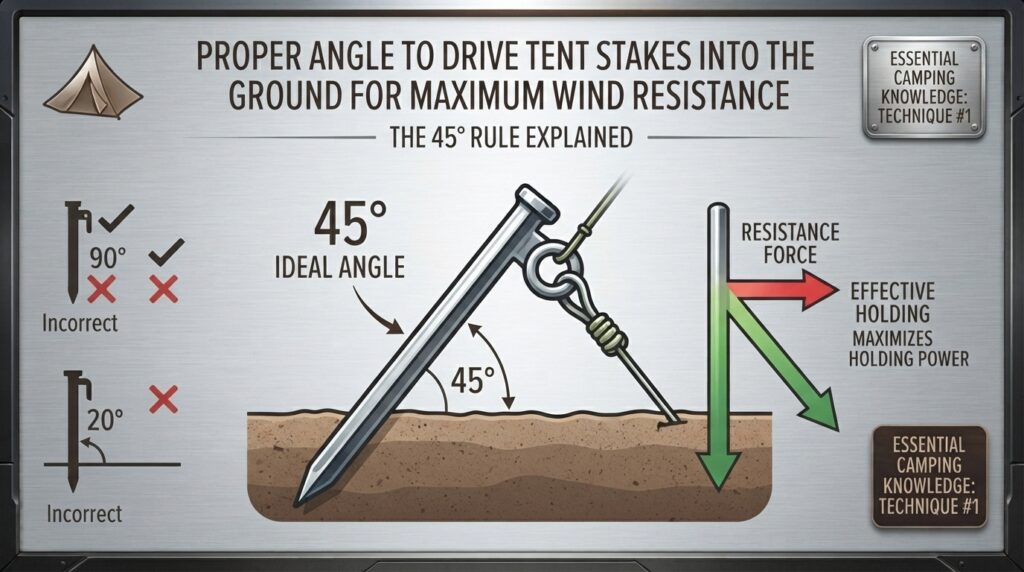
Proper angle to drive tent stakes into the ground for maximum wind resistance

You’ve spent hours researching the perfect tent, you’ve picked a scenic spot in the high desert of West Texas or the windswept coastal bluffs of California, and you’re ready to hunker down. But all that preparation can be undone in seconds by a single, poorly placed tent stake.
Most campers treat staking as an afterthought—a quick “hammer it in and hope for the best” approach. However, for those who camp in areas prone to sudden, gusty winds, the angle of your stake is the single most important factor between a peaceful night’s sleep and a middle-of-the-night tent collapse.
At besttentstakes.com, we have analyzed the physics of stake failure. Whether you are battling the hard, rocky ground of the New York Adirondacks or the soft, moisture-laden forest floors of Washington, the geometry of your anchor is what dictates whether your shelter stays upright or turns into a kite.
The Core Expert Verdict
For maximum wind resistance, the proper angle to drive a tent stake is 45 degrees pointing directly away from the tent. This orientation converts the lateral wind load on your tent into compressive force, effectively “locking” the stake deeper into the ground rather than levering it out. Driving a stake vertically is the most common mistake; it relies solely on friction, which fails under high-tension wind loads.
1. The Physics of Why 45 Degrees Wins
When wind hits your tent, it pushes the fabric, which in turn yanks on your guy lines. This creates a diagonal tension force.
- Vertical Driving (The Failure Mode): If you drive your stake straight down (90 degrees), the pull from the guy line acts as a lever. It tries to “rock” the stake out of the ground. Because the ground is often soft or loose at the surface, the stake will wiggle, widen the hole, and eventually pop out.
- 45-Degree Angle (The Secure Mode): By driving the stake away from the tent, the line of pull is aligned with the long axis of the stake. Instead of prying the stake up, the wind pull pushes the stake down into the dirt. You are essentially using the resistance of the entire soil column to hold your tent in place.
2. Terrain-Specific Adjustments to the 45-Degree Rule
While 45 degrees is the universal baseline, you must adapt this to your specific regional terrain.
The Texas Hardpan and Caliche
In parts of Texas, the ground is so hard it behaves like rock. You often cannot drive a stake at 45 degrees because the ground is too dense.
- Strategy: Drive your stake as close to 45 degrees as the ground allows. If you can only manage 60 degrees, that is acceptable—but compensate by using high-strength forged steel stakes that won’t snap under the increased impact force.
New York and the Northeast (Rocky Terrain)
In the Adirondacks or Catskills, you aren’t just fighting soil; you’re fighting buried rocks.
- Strategy: If you hit a rock at 45 degrees, don’t force it. The rock is a better anchor than the dirt! Try to align your stake so that it “cradles” against the side of the rock.
Washington and the PNW (Soft/Mossy Soil)
The Pacific Northwest features soft, organic soil that lacks cohesion.
- Strategy: Increase your angle to 30 degrees (flatter). This provides a larger surface area of stake in contact with the ground, which is necessary when the soil isn’t dense enough to hold a 45-degree angle securely.
California Coastal Dunes
Sand has zero internal friction.
- Strategy: Use the “deadman” method. Drive your stake at a flat angle (nearly parallel to the ground) and bury it 8–10 inches deep. The weight of the sand above the stake is your only real defense.
3. Comparative Stability Table
| Driving Angle | Friction/Resistance | Suitability for High Wind | Risk of Failure |
| 90° (Vertical) | Low | Very Poor | High (Leverage pull-out) |
| 45° (Optimal) | High | Excellent | Low |
| 30° (Shallow) | Moderate | Moderate | Moderate (Requires deep soil) |
| 0° (Parallel/Deadman) | Extreme (Mass) | Best for Sand/Snow | None (If buried deep) |
4. Pro-Tips for Maximum Security
- The Hook Orientation: Always face the hook of the stake away from the tent. If the hook faces the tent, the line can easily slide off under tension.
- Flush Driving: Drive the stake until the hook is touching the ground. Any “neck” left exposed acts as a lever arm, giving the wind an advantage to bend your stake.
- The Pluck Test: After setting your stakes at 45 degrees, give them a firm tug. If the ground moves, you have a weak anchor. Don’t wait for a storm to find out; reset it now.
- Use a Mallet, Not a Boot: Using your boot to stomp a stake in often results in an uneven angle or a bent stake. Use a mallet or a rock to maintain a clean, straight 45-degree entry.
Comprehensive FAQ Engine
Q1: What happens if I drive my stakes vertically?
You are relying on the soil’s friction to hold the stake. In high wind, the tent creates leverage that pulls the stake out like a cork from a bottle.
Q2: Why 45 degrees specifically?
It’s the geometric “sweet spot.” It minimizes the leverage arm (preventing bending) while maximizing the soil volume the stake has to pull through.
Q3: What if I hit a rock at 45 degrees?
Move the stake! Never force a stake into a rock. The rock won’t move, but your stake will bend.
Q4: Does the stake material change the angle?
Yes. If you have thin titanium shepherd hooks, they will bend if driven at the wrong angle in hard ground. Use 45 degrees and be gentle.
Q5: What do I do in deep sand?
Forget the angle; bury it. A stake in sand at 45 degrees will still pull out. Bury it flat and pile sand on top.
Q6: Can I use two stakes at different angles for more security?
Yes, this is known as “double staking.” It’s excellent for high-wind storm-proofing.
Q7: Should the stake head be completely underground?
Yes. Driving the stake flush with the ground prevents the wind from snapping the stake at the ground line.
Q8: How can I tell if my tent is properly wind-resistant?
If the guy line is taut and the stake doesn’t move when you yank the line, your angle and tension are correct.
Q9: Does the type of soil change the optimal angle?
Yes—softer soil requires a shallower angle (30°) to gain more surface area, while hard soil is fine at 45°.
Q10: How do I pull out a stake that is driven at 45 degrees?
Use the hook of another stake to pull it out at the same 45-degree angle. Don’t pull straight up.
Conclusion
Mastering the 45-degree stake angle is one of the simplest, most effective “hacks” for a safer camping experience. It transforms your gear from a collection of metal spikes into a sophisticated anchoring system. By respecting the physics of force distribution, you can pitch your tent with confidence, knowing that no matter how hard the wind blows, your stakes are designed to hold.
For more expert advice on gear maintenance and campsite selection across the U.S., keep exploring besttentstakes.com.