
You’re miles into the backcountry, the sun is dipping below the horizon, and a sudden wind shear starts ripping through your campsite. You pull out your tent, grab your ultralight aluminum stakes, and start driving them into the ground.
Thwack.
Your mallet or rock hits a hidden root or stone, and instead of sinking smoothly, your premium aluminum stake folds like a cheap lawn chair.
A bent tent stake is more than a minor annoyance; it compromises your shelter’s structural integrity. If you are camping in the high winds of the Pacific Northwest, the rocky terrains of Central Texas, or the exposed peaks of California’s Sierra Nevada, a failed stake can mean a collapsed tent in the middle of the night.
But don’t pack up your gear just yet. While aluminum is notorious for work-hardening and snapping if mishandled, you can absolutely rescue a bent stake in the field if you know the right techniques. This comprehensive guide will walk you through the physics of aluminum stakes, step-by-step field repair methods, and critical strategies to prevent them from bending in the first place.
The Physics of Aluminum Stakes: Why They Bend (and Snap)
Before you grab a pair of pliers or a heavy rock and start hammering away at your bent gear, it is vital to understand what is happening to the metal on a molecular level.
Unlike steel, which is highly forgiving and can be bent back and forth multiple times, aluminum possesses a property known as low ductility combined with a high susceptibility to work-hardening.
When an aluminum stake is manufactured—whether it is a classic 7075-T6 alloy Y-stake or a budget 6061 hook stake—the metal is treated to achieve a specific balance of lightness and rigidity. The moment the stake bends, the crystal structure of the aluminum at the point of the bend is stressed and compressed.
[ Normal Stake Structure ]  --> Uniform, aligned molecular bonds
[ Bent Stake Structure ]    --> Compressed on the inside curve, stretched/weakened on the outside
If you try to force the stake straight using raw, unguided pressure, you introduce immediate micro-fractures along the tension side (the outside of the bend). The next time you apply pressure, or the next time the wind caught your tent guyline, the stake will snap cleanly in two.
Therefore, field repair isn’t about making the stake look perfectly brand new; it’s about restoring enough straightness for it to function without passing the metal’s breaking point.
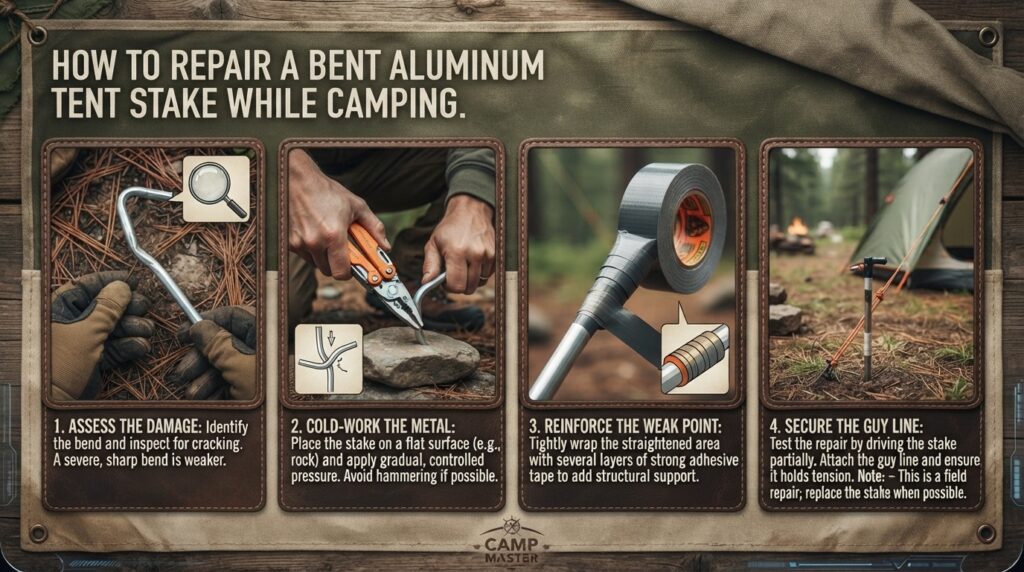
4 Field Methods to Repair a Bent Aluminum Stake
If you find yourself with a deformed stake in the backcountry, evaluate the severity of the bend. If it is bent at an angle greater than 45 degrees, structural failure is highly likely during repair. However, for standard 15-to-45-degree bends, choose one of the following four field-tested methods based on the gear you have available.
Method 1: The Dual-Tree Leverage Trick (Best for Heavy Y-Stakes)
This is the safest and most controlled way to straighten a stake without using high-impact force (like hammering), which easily shatters brittle aluminum.
- Find a Tight Gap: Look for two closely growing trees, a split rock, or a sturdy metal loop on a piece of camp gear (like a vehicle tow loop if car camping).
- Insert the Stake: Slip the bent portion of the stake into the gap, ensuring the apex of the bend rests right against the fulcrum (the tree trunk or rock edge).
- Apply Gradual, Counter-Pressure: Hold the straight end of the stake and slowly, smoothly apply pressure in the opposite direction of the bend.
- Check Continuously: Do not try to fix it in one massive push. Apply a small amount of pressure, release, check the straightness, and repeat until the stake is functional.
Method 2: The Log and Rock Sandwich (Best for Hook/Pin Stakes)
If your stake is a simple round pin or hex stake and you don’t have heavy tools, you can use natural materials found around your campsite.
- Clear a Flat Base: Find a flat, hard surface, such as a large, stable rock or a fallen log.
- Position the Apex Upward: Lay the stake down so that the bend forms a “frown” or an arch rising off the hard surface. The two straight ends should touch the ground, with the bent apex in the air.
- Use a Buffer: Place a thick piece of wood or a piece of leather/heavy fabric over the bend. Never strike bare aluminum directly with a sharp rock; this creates notches that act as stress-concentration points, causing the metal to snap.
- Tap Gently: Using a smooth, flat rock or a camp mallet, tap the wood buffer directly above the apex. Use light, repetitive taps rather than heavy, crushing blows.
Method 3: The Multi-Tool / Pliers Realignment
If you carry a heavy-duty multi-tool (like a Leatherman or Gerber) in your backpacking repair kit, you can leverage its jaws for a controlled fix.
- Grip the Bend Closely: Clamp the pliers of your multi-tool directly adjacent to the bend, rather than far away from it. This isolates the metal and prevents you from creating a secondary “S-curve” bend.
- Use Small Incremental Adjustments: Instead of grabbing the tip and pulling, work your way along the curve, making tiny 2-to-3-degree adjustments at a time.
- Support the Spine: If repairing a Y-profile or V-profile stake, ensure you aren’t flattening the perpendicular fins of the stake, as these fins give the stake its structural hold in the dirt.
Method 4: The Internal Mandrel (For Tubular/Hollow Stakes)
Hollow aluminum stakes are incredibly light but collapse completely if they buckle. If a tubular stake kinks, it loses nearly all its strength.
- Find a Solid Core: Locate a sturdy stick, a long bolt, or a thin steel rod that fits snugly inside the hollow diameter of the tent stake.
- Slide the Mandrel In: Slowly slide the internal core down into the tube until it reaches the point of the bend.
- Force the Re-expansion: As you push the solid rod through the kinked area, it will force the collapsed outer aluminum walls back into a round shape from the inside out.
Quick Reference: Stake Repair Feasibility
| Stake Profile Type | Common Material Alloy | Repair Difficulty | Best Field Method | Risk of Snapping |
| Y-Profile / Tri-Beam | 7075-T6 Aluminum | High | Dual-Tree Leverage | Very High |
| Shepherd’s Hook (Pin) | 6061-T6 Aluminum | Low | Log & Rock Sandwich | Low |
| V-Angle Stake | Stamped Aluminum | Medium | Multi-Tool / Pliers | Medium |
| Tubular / Hollow | Aircraft Aluminum | Extreme | Internal Mandrel | High |
Pro-Tips for Working with Aluminum in the Field
- Warm the Metal (Car Campers Only): If you have a camp stove running, holding the bent portion of the stake near the heat (not directly in the roaring flame, as you don’t want to melt or ruin the heat treatment) can make the molecules slightly more cooperative. Warm to the touch is perfect.
- Accept “Straight Enough”: Do not obsess over getting the stake perfectly laser-straight. If it is within 5 to 10 degrees of straight, leave it alone. The extra manipulation required to get it perfect will only weaken the metal further.
- Mark Repaired Stakes: Once you return home, use a piece of colored electrical tape or a sharpie to mark the stake that was bent. Move this stake to a low-tension area of your tent setup (like a vestibule door or a gear shed tie-out) rather than using it for a primary windward guyline.
Ground Conditions Across the US: Where Stakes Fail Most
Different camping environments pose unique threats to your aluminum tent stakes. Understanding the soil anatomy of your specific region will help you avoid bending stakes in the first place.
1. Texas (Central & West Texas)
- The Threat: Caliche and Limestone.
- The Reality: The soil in areas like the Texas Hill Country or Big Bend features a thin layer of topsoil covering hard, compressed calcium carbonate (caliche) or solid limestone shelves. Forcing an aluminum stake straight down here is a guaranteed way to bend it.
- The Strategy: Angle your stakes intentionally or look for natural rock anchors using the “Big Stone, Little Stone” system instead of hammering into the caliche.
2. California & Washington (Sierra Nevadas & Cascades)
- The Threat: Glacial Till, Granite Scree, and Compacted Volcanic Ash.
- The Reality: Alpine environments are littered with buried granite rocks left behind by glacial movements or volcanic activity.
- The Strategy: Use a trowel or your boot to clear the top 2 inches of pine needles and soft loam to see what lies directly beneath before driving your stakes home.
3. New York & The Northeast
- The Threat: Dense Root Systems and Glacial Cobble.
- The Reality: Camping in the Adirondacks or Catskills means dealing with dense networks of shallow hardwood roots and hard, rounded river rocks embedded in wet, dense clay.
- The Strategy: If your stake hits an obstruction 3 inches down, do not force it. Pull it out, clear the spot, and shift the angle or position by a few inches.
10 Frequently Asked Questions (FAQs)
1. Can I use a heavy hammer to straighten my aluminum tent stakes?
No. Direct, high-impact force from a heavy hammer or a large rock will shock the brittle structure of hardened aluminum (like 7075-T6), causing it to fracture or snap instantly. Controlled, gradual leverage is always safer than hammering.
2. Is it safe to use a bent stake that has been straightened out?
It is safe for low-tension applications, such as securing a tent vestibule, a footprint, or a rainfly gear storage loop. However, do not use a repaired stake for the main structural corners of your tent or windward guylines, as its structural integrity has been permanently compromised.
3. Why do some aluminum stakes snap immediately when I try to bend them back?
This happens because of a phenomenon called work-hardening. When the aluminum bent the first time, the metal molecules in that specific spot became harder, more brittle, and less flexible. Forcing them back to their original position exceeds the metal’s remaining ductility, leading to a clean break.
4. What is the difference between 6061 and 7075 aluminum tent stakes?
6061 aluminum is more malleable, cheaper, and easier to bend back without breaking, but it bends far more easily under pressure. 7075 aluminum (often used in high-end Y-stakes) is much stronger, stiffer, and harder to bend, but if it does bend, it is highly prone to snapping during repair.
5. What should I do if my aluminum stake breaks completely in half in the backcountry?
If you have no spare stakes, you can create a “deadman anchor.” Tie your tent’s guyline around the center of the broken stake piece, a thick stick, or a heavy rock, and bury it 6 to 12 inches horizontally under the dirt or snow, compacting the ground on top of it.
6. Can I use fire or camp stove heat to make bending the stake easier?
You must be incredibly cautious. While mild heat can soften aluminum slightly, overheating it will permanently destroy the manufacturer’s T6 heat treatment, making the metal incredibly soft, gummy, and useless. If you can’t touch the stake comfortably with bare hands, it is too hot.
7. How do I prevent my stakes from bending when driving them into hard ground?
Never use your boot to stomp a stake directly into hard earth. Instead, clear the surface debris, push the stake in by hand at a 45-degree angle pointing away from the tent, and tap it gently with a lightweight camp mallet or a flat wood block acting as a cushion.
8. Are Y-profile stakes easier or harder to repair than round hook stakes?
Y-profile stakes are significantly harder to repair because their three perpendicular fins must stay properly aligned to maintain strength. If the fins crush or twist, the stake loses its structural integrity, whereas round pin stakes can be rolled and flattened much more easily.
9. Should I replace my aluminum stakes with titanium or steel?
If you frequently camp in rugged, rocky environments like Central Texas or alpine scree fields, switching to heavy steel stakes (for car camping) or ultralight titanium stakes (for backpacking) will greatly reduce bent gear. Titanium offers an excellent strength-to-weight ratio and handles bending stresses better than aluminum.
10. How long can I expect a repaired aluminum tent stake to last?
A carefully repaired aluminum stake can last for several more trips if it is only driven into soft soil or sand and kept away from high-stress guylines. However, it will always be the weakest link in your shelter system and should be replaced once you return home.
Conclusion
A bent aluminum tent stake doesn’t have to ruin your backpacking trip or leave your shelter flapping helplessly in the wind. By understanding that aluminum requires gentle, incremental leverage rather than brutal force, you can easily implement the dual-tree leverage trick or a log-and-rock sandwich to get your stakes straight enough to survive the night.
Remember the golden rule of backcountry gear maintenance: isolate the bend, protect the metal from direct rock impacts, and never over-correct. Keep your stakes clean, read the soil conditions of your campsite carefully, and always pack one or two lightweight spares in your repair kit just in case the wilderness wins the battle against your gear.