Differences between Y-beam and shepherd hook tent stakes for various camping terrain types

Whether you are mapping out a grueling leg of the Pacific Crest Trail through California’s rugged Sierra Nevada, navigating the dense, root-tangled floor of New York’s Adirondack Mountains, pitching a shelter in the notoriously damp loam of Washington’s Olympic Peninsula, or anchoring against the howling winds of a Central Texas caliche plain, your tent stakes are the unsung heroes of your sleep system.
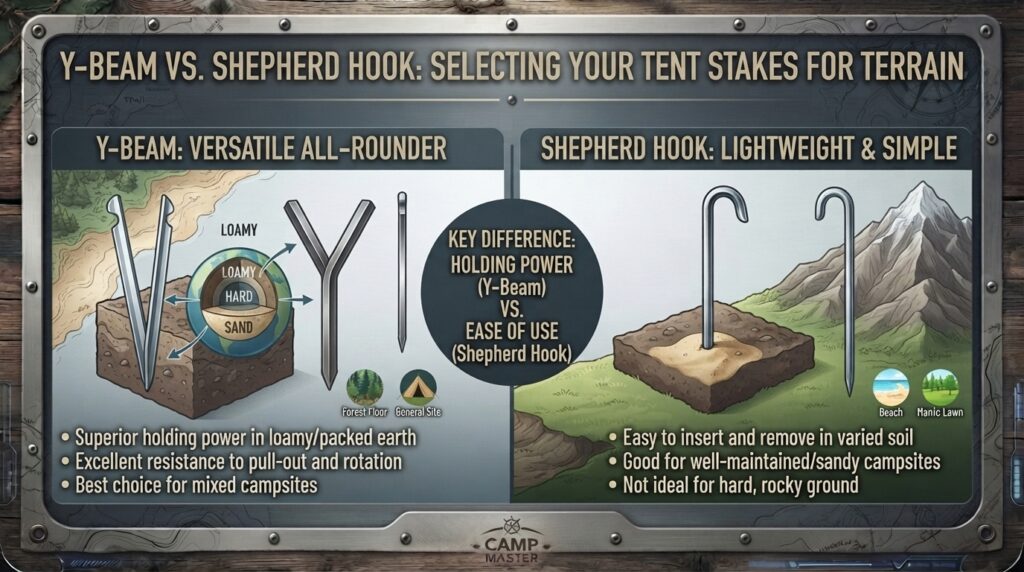
When configuring a shelter setup, gear selection usually boils down to a classic backcountry showdown: Y-Beam stakes vs. Shepherd Hook stakes.
These two distinct geometries represent opposite philosophies in outdoor gear engineering. One relies on maximum surface area and structural interlocking to hold fast against high-tension loads. The other prioritizes surgical precision, minimal weight, and the ability to slide into tight spaces where larger pegs fail.
Choosing the wrong shape for your destination can result in a midnight shelter collapse or a pouch full of bent, ruined metal. This comprehensive guide breaks down the metallurgical, mechanical, and geographical differences between Y-Beam and Shepherd Hook tent stakes so you can build the ultimate anchor kit for your upcoming camping trips.
1. Geometric Profiles and Mechanical Principles
To understand how these stakes perform in the field, we have to look at their cross-sectional engineering and how they interact with soil mechanics.
      [ Y-Beam Cross-Section ]               [ Shepherd Hook Cross-Section ]
               ▲
               │
         ◄─────┼─────►  Three structural fins               ●  Minimal surface area
               │        at 120° angles                         Ultra-slim wire profile
               ▼
Y-Beam (Tri-Beam) Anatomy
A Y-Beam stake features a three-finned cross-section radiating from a rigid central core, typically spaced at 120-degree angles.
- The Locking Mechanism: When a Y-Beam is driven into the earth, soil is forced into the three open structural channels between the fins. This creates an interconnected wedge of highly compressed dirt. For the guyline to pull the stake out, it must physically lift or shear through this entire pocket of captured soil.
- Structural Integrity: The three-finned geometry provides phenomenal resistance to lateral forces. It is incredibly difficult to bend a Y-Beam along its longitudinal axis because the perpendicular fins act as structural trusses.
Shepherd Hook (Pin/Wire) Anatomy
A Shepherd Hook stake is forged from a continuous cylindrical rod of metal—usually high-grade aluminum or titanium—featuring a sharp, tapered point at the bottom and a classic curved crook at the summit.
- The Friction Mechanism: Lacking fins or channels, a Shepherd Hook relies almost entirely on the surface friction between the smooth metal rod and the surrounding soil particles.
- The Needle Effect: Because its cross-sectional area is tiny, it requires very little force to displace the soil as it descends. It functions like a surgical needle, pushing past microscopic obstructions rather than trying to plow through them.
2. In-Depth Technical Comparison Matrix
Before analyzing how these stakes perform in specific geographical regions, let’s look at their core performance metrics side by side.
| Feature / Metric | Y-Beam Stakes (e.g., 7075-T6 Aluminum) | Shepherd Hook Stakes (e.g., Titanium Wire) |
| Average Weight per Piece | 0.50 – 0.65 oz (14 – 18 grams) | 0.19 – 0.30 oz (5 – 8 grams) |
| Primary Holding Force | Soil Shear Resistance (Massive) | Material Surface Friction (Low) |
| Penetration Power | Medium (Displaces significant soil volume) | Exceptional (Slices between small pebbles) |
| Bending Resistance | High (Truss-like design prevents warping) | Low to Medium (Prone to folding if overloaded) |
| Pack Volume & Nesting | Bulky (Fins take up space in stake sack) | High (Ultra-slim, packs down flush) |
| Primary Failure Mode | Fin twisting or notch creasing | Right-angle folding or spinning |
| Average Unit Cost | $2.00 – $3.50 | $3.00 – $5.00 (Titanium variants) |
3. Terrain-Specific Breakdown: Where Each Shape Dominates
No single stake shape can conquer every type of dirt. Let’s look at how Y-Beams and Shepherd Hooks perform across the diverse camping environments found throughout the United States.
Compaction & Rocky Soils (California & West Texas)
- The Ground Reality: The high-altitude backcountry of California’s Sierra Nevada is dominated by highly compacted granite sand, loose scree, and decomposing bedrock. Similarly, West Texas features dense caliche—a dry, concrete-hard sedimentary layer of calcium carbonate—and shallow limestone shelves.
- Y-Beam Performance: Driving a wide Y-Beam into these environments can be a nightmare. The broad fins frequently strike solid rock shelves just two inches below the surface. If you attempt to force it down with a heavy camp stone, the unyielding ground will bend or warp the fins.
- Shepherd Hook Performance: This is where the Shepherd Hook shines. Its razor-thin wire profile can worm its way through tiny, microscopic fissures between buried granite pebbles and caliche chunks. If it hits an immovable stone, you can easily pull it back, shift it half an inch, and slide it all the way down.
Spongy Loam, Spagnum Mud, & Forest Duff (Washington & The PNW)
- The Ground Reality: Camping in the damp coastal rainforests or alpine valleys of Washington state means pitching your shelter on deep layers of decomposing organic mulch, wet pine needle loam, and slick, waterlogged mud.
- Y-Beam Performance: The Y-Beam is the absolute king here. Spongy forest duff has incredibly low shear strength. The wide, three-sided profile of a Y-Beam acts like a mini-anchor, grabbing onto a massive volume of soil and holding fast even when the ground turns to soup during an overnight Pacific Northwest downpour.
- Shepherd Hook Performance: Shepherd Hooks are highly prone to failure in wet loam. Because they lack surface area, the constant tension of a wind-strained guyline will easily slice the thin wire right through the soft mud like a warm knife through butter, causing your tent to sag or collapse.
Root-Dense Environments & Glacial Cobble (New York & The Northeast)
- The Ground Reality: The trails of New York’s Adirondacks and Catskills wind through dense, ancient hardwood forests. The underground landscape is an intricate maze of thick tree roots interspersed with smooth, rounded glacial boulders.
- Y-Beam Performance: Trying to drive a Y-Beam into a root mat will either split the root or severely gouge your stake. However, if you can find a clear pocket of dense northeastern clay between the roots, a Y-Beam provides immovable security.
- Shepherd Hook Performance: The Shepherd Hook offers unparalleled tactical versatility among roots. It can wedge directly into the tight joints where two roots intersect, using the wood itself as a natural mechanical anchor.
Wind-Swept Coastal Sand & Dunes (San Francisco & Coastal California)
- The Ground Reality: Pitching a tent along the windy coastal bluffs of San Francisco or the sandy beaches of the Pacific coast presents zero penetration resistance but incredibly high pull-out risks due to shifting sand particles.
- Y-Beam Performance: A standard Y-Beam performs decently in coarse sand if driven deeply and backed up with a heavy stone, but it can still slip under high wind loads.
- Shepherd Hook Performance: Completely useless. A wire hook has no chance of holding in loose sand and will pull loose under the slightest breeze.
4. Ground Anchor Capability Matrix
To help you visualize your layout at a glance, this matrix ranks the performance of both styles across standard backcountry ground types.
| Terrain Type | Y-Beam Holding Power | Y-Beam Penetration | Shepherd Hook Holding Power | Shepherd Hook Penetration |
| Hard-Baked Caliche (Texas) | Fair | Poor | Good | Excellent |
| Alpine Granite Scree (California) | Good | Fair | Fair | Exceptional |
| Deep Forest Loam (Washington) | Exceptional | Good | Poor | Excellent |
| Dense Tree Roots (New York) | Fair | Poor | Good | Exceptional |
| Coastal Beach Sand (San Francisco) | Fair | Excellent | Sub-Poor | Excellent |
5. Field-Tested Tips for Flawless Staking
No matter which stake geometry you pull out of your pack, your installation technique dictates whether your shelter survives the night. Implement these five tips on your next trip:
- The Master 45-Degree Angle: Never drive either style of stake straight down at a 90-degree angle. Always tilt the top of the stake 45 degrees away from the tent body, pointing the tip directly toward the shelter. This mechanical positioning forces guyline tension to pull against the length of the shaft rather than pulling it straight up out of the hole.
- Mitigate Shepherd Hook Spinning: The single biggest flaw of a Shepherd Hook is its tendency to rotate or “spin” sideways under heavy wind loads, allowing the guyline loop to slip right off the hook. To prevent this, always drive the stake flush until the hook is pressed firmly against the dirt, or place a flat stone directly over the head of the hook to lock it in place.
- Adopt the “Hybrid Kit” Strategy: Savvy long-distance thru-hikers rarely carry an all-or-nothing stake pouch. Instead, build a hybrid fleet. Carry four heavy-duty Y-Beam stakes for the high-tension, structural corners of your shelter, and four to six ultra-lightweight titanium Shepherd Hooks for minor pull-outs, vestibule doors, and groundsheets.
- The Wood Buffer Trick: If you must use a rock to tap a Y-Beam stake into stubborn, hard-packed earth, never strike the bare metal head directly. This creates structural nicks that lead to fracturing. Place a flat piece of bark or a thick stick over the head of the stake to act as a shock-absorbing cushion.
- Post-Trip Maintenance: Aluminum Y-Beams love to collect thick, wet mud inside their three structural channels. If left uncleaned, this acidic forest soil can cause micro-pitting and corrosion over time. Wipe your stakes down with a handful of dry grass or a camp towel before sliding them back into your pack.
6. 10 Comprehensive Frequently Asked Questions (FAQs)
1. Which stake style is genuinely lighter for an ultralight backpacking kit?
Shepherd Hook stakes—specifically those forged from high-grade titanium wire—are significantly lighter. A premium titanium wire hook weighs roughly 0.20 ounces (5.7 grams), whereas a standard aluminum Y-Beam weighs about 0.55 ounces (15.5 grams). Over an 8-stake setup, switching to hooks can instantly shave nearly 3 ounces off your pack’s base weight.
2. Why do Y-Beam stakes hold so much better in soft, muddy ground?
It comes down to surface area and soil displacement. The three wide fins of a Y-Beam lock a massive volume of earth into its channels. In soft mud or wet loam, this forces the guyline to try and pull up a heavy wedge of compressed dirt, whereas a smooth Shepherd Hook can easily slice through loose mud.
3. Can I repair a bent Y-Beam stake while out in the backcountry?
It is very difficult. Because Y-Beams are engineered for maximum rigidity using hardened alloys (like 7075-T6 aluminum), they are highly susceptible to work-hardening. If a fin creases or bends out of true, attempting to force it straight with pliers or a rock will usually cause the brittle metal to snap cleanly in half.
4. Is it safe to tap a titanium Shepherd Hook into hard ground using a camp rock?
Yes, provided you do so with caution. Titanium possesses exceptional yield strength and hardness compared to aluminum. You can tap a titanium wire hook firmly against tough ground without flattening the tip or mushrooming the head, but avoid heavy, crushing blows that could bend the main shaft.
5. What should I do if my Y-Beam stake hits an unyielding rock shelf just two inches down?
Do not try to force it through via raw hammering power. Pull the Y-Beam out, clear the surface debris with your boot, and try angling the stake wildly to the left or right to find a gap. If that fails, lay the stake completely flat on the ground, tie your guyline to it, and place a heavy “anchor stone” directly over it.
6. Are there specific tent types that require Y-Beam stakes over Shepherd Hooks?
Yes. Non-freestanding shelters (such as trekking-pole tents or ultralight tarps) rely entirely on pitch tension to remain upright. A single stake failure can cause the entire structure to collapse onto your face at night. For these tents, you should always use robust Y-Beam stakes for the primary high-tension structural corners.
7. Why do some Shepherd Hook stakes have high-visibility painted heads?
Because wire hooks have an incredibly low profile, they can easily disappear into forest leaves, pine needles, or grass when you break camp at dawn. Manufacturers paint or dip the heads in high-visibility neon coatings—or attach reflective cord loops—so you don’t accidentally leave a $4 stake behind in the dirt.
8. Do Y-Beam stakes take up significantly more space in a backpacking gear sack?
Yes. Due to their protruding three-finned shape, Y-Beams cannot lay perfectly flush against one another. They form a loose, bulky bundle in your gear pouch. Conversely, Shepherd Hooks can be neatly stacked and nested together like a tight bundle of pencils, occupying minimal pack volume.
9. Which style offers a longer overall lifespan across multiple thru-hikes?
If used in appropriate terrains, titanium Shepherd Hooks often boast a longer lifespan because they are virtually immune to corrosion and handle repeated minor flexes without breaking. Aluminum Y-Beams are highly durable but will eventually suffer structural fatigue if constantly driven into rocky, unforgiving ground.
10. Can I use Y-Beam stakes in snowy winter conditions?
Only in very packed, icy snow where you can tap them in like a nail. In fresh, loose, or powdery snow, neither standard Y-Beams nor Shepherd Hooks provide enough surface area. For winter camping, you must upgrade to specialized, extra-wide snow anchors or use the “deadman” technique, burying branches or stuffed gear sacks horizontally.
Conclusion
The debate between Y-Beam and Shepherd Hook tent stakes isn’t about finding a single winner; it’s about understanding the soil anatomy of your campsite.
If your adventures consistently lead you into the spongy, wind-lashed forests of Washington or require the rock-solid security of a non-freestanding tent, the Y-Beam is an indispensable tool that trades a few extra grams for maximum holding insurance. If you are an ultralight purist scaling the granite shelves of California or weaving through the dense root systems of New York, a set of surgical Shepherd Hooks will lighten your load and simplify your setup.
Analyze your terrain, pack a smart hybrid mix, and head out into the backcountry knowing your shelter is anchored by the right tool for the ground beneath you.