Best heavy duty tent stakes for camping in the hard packed clay of Texas

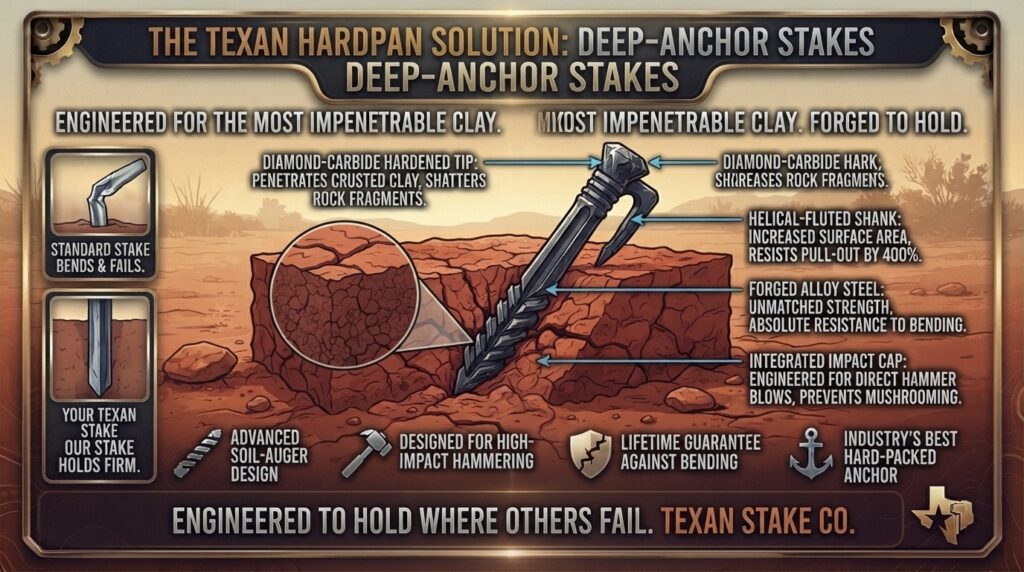
Any seasoned camper who has tried to pitch a tent in the Lone Star State knows that Texas soil is legendary—and not for its hospitality. From the sweeping expanses of West Texas to the hills surrounding Austin and the dense pine woods out East, the ground is frequently composed of heavily compacted, sun-baked clay.
Often referred to locally as “black gumbo” or “caliche,” this substrate dries under the intense Texas sun into a material with a compressive strength closely matching industrial concrete.
Trying to use standard aluminum wire pegs or flimsy plastic ground pins in this soil is a recipe for disaster. One strike from a camp hammer, and those factory stakes will buckle, bend, or shatter.
To anchor a tent, awning, or canopy securely in this challenging environment, you need heavy-duty stakes specifically designed to pierce dense clay without deforming.
For readers of besttentstakes.com, this guide explores the metallurgy, engineering, and tactical techniques required to master the hard-packed clay of Texas.
1. Understanding Texas Soil Mechanics: The Science of Compacted Clay
To select the perfect anchoring system, you must understand what happens underneath your footprint. Texas clay is unique due to its dense, microscopic particle structure and high concentration of shrink-swell minerals like smectite.
[Wet State: "Black Gumbo"] ──> Absorbs water, turns into sticky, high-suction mud.
[Dry State: "Caliche/Hardpan"] ──> Solar baking evaporates moisture, locking particles into a concrete-like matrix.
When it rains, the clay expands and becomes a sticky mud that clings to everything. But when the long dry spells set in, solar radiation evaporates every drop of moisture. The clay particles compress tightly together, forming an unyielding crust.
Additionally, many Texas regions feature a sub-surface layer of caliche—a hardened sedimentary material where calcium carbonate physically cements gravel, sand, and clay into solid blocks.
When a tent stake is driven into this material, it encounters immense frictional skin resistance along its shaft and extreme end-bearing resistance at the tip.
If your stake lacks a high enough yield strength, the force of your mallet strikes will cause the shaft to undergo classic column buckling, rendering the stake useless.
2. Top Material Classes for Texas Clay: Steel vs. Titanium vs. Engineered Polymers
To survive repeated impacts against sun-baked hardpan, a tent stake must be constructed from elite, high-tensile materials. Let’s break down the three best choices for this landscape.
A. Forged S45C Carbon Steel (The Ultimate Powerhouse)
When it comes to pure, unadulterated strength, forged carbon steel is the undisputed king of the Texas campground. Forging alters the internal grain structure of the steel under immense pressure, making it incredibly resilient.
- Performance in Clay: These stakes operate like industrial masonry nails. They can be driven directly into caliche, hard clay, and rocky ground without bending or dulling.
- Design Advantage: They usually feature thick, solid cylindrical shafts, a sharp point to cleanly displace tightly packed soil, and a flat, wide welded driving head that provides a clean striking target for a heavy hammer.
B. Grade 5 Titanium (Aerospace-Grade Ti-6Al-4V)
If you are backpacking through Big Bend National Park or trailing along the Caprock Canyons, carrying pounds of heavy steel stakes will quickly wear you down. Grade 5 titanium is the perfect premium alternative.
- Performance in Clay: Boasting a tensile strength exceeding $130,000\text{ psi}$, Grade 5 titanium handles heavy mallet blows with ease. It features excellent elastic memory, meaning that if it hits an obstruction, it can flex slightly and spring back completely straight.
- Design Advantage: It delivers the strength of thick steel at roughly half the weight, making it an exceptional option for ounce-counting backpackers who refuse to compromise on structural integrity.
C. Heavy-Duty Steel Ground Screws
For large family cabin tents, pop-up canopies, and tailgating shelters at sports events, screw-style anchors offer a modern mechanical advantage.
- Performance in Clay: Instead of relying on brute force to displace the clay vertically, these anchors use sharp, helical threads to cut into the compacted dirt layers.
- Design Advantage: Driven by a cordless impact driver or a solid steel turning bar, they lock into the subterranean structure, offering incredible pull-out resistance that outperforms standard straight pins.
3. Geometric Profiles: Slicing Through the Hardpan
The physical shape of a stake determines how easily it cuts through hard ground and how well it stays anchored under wind loads.
Solid Cylindrical Nail Pins
- The Profile: A straight, solid round rod with a sharp, tapered point.
- Why it works in Texas: This is the most efficient shape for piercing hard surfaces. It minimizes the surface area contact during the initial drive, focusing all your hammer’s energy directly onto a single point to punch through the hard clay crust.
V-Shaped & U-Shaped Steel Stakes
- The Profile: An angled or troghed channel made of heavy-gauge stamped steel.
- Why it works in Texas: While harder to drive into clay than a slim nail pin, the V-profile offers exceptional surface area contact. Once driven home, it resists lateral shifting from high prairie winds, making it highly secure.
4. Analytical Performance Comparison: Tent Stakes for Hard Clay
| Feature / Metric | Forged Carbon Steel Spikes | Grade 5 Titanium Pins | Heavy-Duty Steel Ground Screws | Standard Aluminum Wire Pegs |
| Material Base | Heated Forged S45C Steel | Ti-6Al-4V Titanium Alloy | Zinc-Plated Carbon Steel | 6000-Series Soft Aluminum |
| Bending Resistance | Absolute Maximum | Exceptional | High | Very Low (Bends instantly) |
| Weight Per Stake | $6.0\text{–}9.5\text{ oz}$ (Heavy) | $0.6\text{–}1.3\text{ oz}$ (Ultra-Light) | $8.0\text{–}14.0\text{ oz}$ (Very Heavy) | $0.3\text{–}0.5\text{ oz}$ (Featherweight) |
| Best Drive Tool | 3lb Steel Sledge / Drilling Hammer | Camp Mallet / Smooth Rock | Cordless Drill / Impact Driver | Hand pressure or light plastic mallet |
| Pull-Out Resistance | High (Excellent friction grip) | Medium (Relies on deep placement) | Maximum (Threaded mechanical lock) | Negligible (Slipping hazard) |
| Ideal Use Case | Car Camping, Overlanding, Texas State Parks | Thru-hiking Big Bend, Wilderness Backpacking | Large Canopies, Group Gazebos, Long-term camps | Casual backyard setups on soft grass lawns |
5. Field Tactics: How to Drive and Extract Stakes in Texas Clay
Using the right hardware is only half the battle; proper technique is critical when dealing with hard ground.
The Installation Process
Never try to force a stake straight into hard clay with frantic, heavy swings—this can mushroom the stake head or damage your tools. Follow these steps for a clean, stable pitch:
1.Remove the Dry Loose Topsoil:Clear the striking zone.
Scrape away loose sand, gravel, and dry grass from your placement point to expose the true hard clay crust beneath.
2.Set the Angle to 45 Degrees:Angle for maximum holding power.
Position the stake at a 45-degree angle pointing directly away from the tent body. This orientation ensures that the lateral tension from your guylines pulls against the full length of the buried shaft rather than lifting it out.
3.Execute Controlled Mallet Strikes:Use rhythmic, focused impact.
Using a heavy steel hammer or a solid rock, apply firm, rhythmic, and controlled downward blows. Ensure your hammer strikes the head squarely to keep the energy traveling straight down the shaft. If the stake stops moving forward, pull it out slightly, adjust the angle to bypass any hidden caliche rocks, and continue driving.
4.Drive Fully Flush to the Ground:Minimize external leverage.
Drive the stake all the way down until the head is flush with the dirt. Leaving a portion of the shaft exposed creates a lever arm that makes it easier for high winds to pull the stake loose or bend the metal.
The Extraction Process: Overcoming the Clay Grip
Once Texas clay dries around a straight metal stake, it creates a tight, high-friction seal that can feel almost welded shut. Trying to yank a stake out by pulling on your tent’s fragile webbing loops will easily tear the fabric seams.
Instead, utilize a secondary metal stake as a lever. Slip the tip of the second stake through the hook or eyelet of the buried one, twist it 180 degrees to break the clay’s suction seal, and pull straight upward along the 45-degree angle of entry. If it is completely stuck, pour a splash of water around the base of the stake and let it sit for five minutes; the water will soften the clay matrix, allowing you to slide the stake out easily.
6. Pro Tips for Camping on Hard Texas Ground
- Ditch the Rubber Mallet: Lightweight rubber or plastic mallets bounce right off forged steel stakes when striking hard clay, wasting your energy. Invest in a 2-pound to 3-pound steel drilling hammer or short-handle sledge. The solid metal-on-metal impact transfers energy directly into the dirt, driving stakes efficiently.
- Pre-Drill the Ground: If you frequently camp on ultra-dense caliche or dry hardpan, pack a cordless drill equipped with a 12-inch masonry or auger drill bit (3/8-inch diameter). Drill a quick pilot hole into the hard ground at each corner, then slide your heavy-duty stakes inside. This technique saves time and saves your arms from exhaustion.
- Keep Your Steel Clean: Texas clay is rich in minerals that can accelerate rust if left on metal. After breaking camp, scrape off any caked-on mud from your steel stakes, dry them thoroughly with a rag, and apply a light coat of silicone spray before storing them.
7. 10 Comprehensive Frequently Asked Questions (FAQs)
1. Can I use standard plastic tent stakes in Texas clay?
No. Standard yellow or orange plastic stakes are designed for soft, sandy, or loamy soils where high surface area is needed. Attempting to hammer a plastic stake into sun-baked Texas clay will cause the tip to dull instantly, and the head will shatter under the impact of a metal hammer.
2. What length of stake is best for hard-packed clay?
For hard clay, an 8-inch to 10-inch stake is the ideal choice. In soft soils, you need a longer stake (12–16 inches) to find stable ground. However, in dense clay, the soil is incredibly strong just a few inches down. A shorter, thicker stake is easier to drive home and much less likely to buckle under impact.
3. Why are my heavy-duty aluminum stakes bending in Central Texas?
Even high-strength 7075-T6 aluminum stakes can bend if they hit a hidden chunk of caliche or flint rock beneath the surface. Aluminum works great for general backpacking, but it lacks the pure structural hardness of forged carbon steel when dealing with concrete-like subsoils.
4. How does wet “black gumbo” clay affect tent stakes compared to dry clay?
Wet black gumbo clay behaves completely differently than dry hardpan. When wet, it turns into a slick, sticky paste that loses its compressive strength but develops intense suction. In wet gumbo, a thin nail stake can pull out easily. You will want to switch to a wide V-shaped steel stake or a threaded ground screw to grip the slippery mud securely.
5. Will using a steel hammer damage the heads of my forged steel stakes?
High-quality forged steel stakes (like S45C carbon steel) are specifically hardened to withstand metal-on-metal impacts. While the protective paint or zinc plating on the head will chip off over time, the structural steel itself will easily resist mushrooming or cracking.
6. Can I use heavy-duty landscape spikes from a hardware store instead of tent stakes?
Yes, large 10-inch to 12-inch steel landscape spikes or “timber spikes” are a highly effective, budget-friendly option for camping on hard ground. They are incredibly strong and drive easily into clay. The only drawback is that they lack a built-in rope hook or eyelet, so you will need to loop your guylines carefully beneath the large flat head.
7. What is caliche, and why is it so tough on camping gear?
Caliche is a distinct geological layer common in arid and semi-arid regions of Texas. It forms when dissolved calcium carbonate precipitates within the soil, binding sand, clay, and gravel into an incredibly hard, stone-like layer. It acts exactly like a natural sheet of concrete hidden just beneath the topsoil.
8. Is it better to use smooth or ribbed stakes in hard clay?
Smooth nail stakes are vastly superior for initial installation in hard clay. Ribbed or notched stakes create immense friction against the dense dirt walls, making them exhausting to drive into the ground. A smooth shaft slides in cleanly, and the natural compaction of the clay provides plenty of friction to hold it in place.
9. How do I prevent my tent guylines from slipping off flat-headed nail stakes?
Look for heavy-duty nail stakes that feature a welded lateral hook or an enclosed steel eyelet just below the driving head. Threading your guyline through an enclosed eyelet guarantees that even if the wind shifts violently or the line slackens, the cord can never slip off the top of the stake.
10. Do titanium shepherd-hook stakes work well in Texas state parks?
Thin titanium shepherd-hook stakes (often used by ultra-light backpackers) can slip into small cracks between rocks, but they are generally too thin for hard-packed state park campsites. The small surface area of the hook head can be painful to drive in without a tool, and they can twist sideways in high winds if the clay isn’t perfectly packed around them.
Conclusion: Establish a Secure Footing for Your Next Texas Adventure
When building out your core content and gear advice on besttentstakes.com, remember that a campsite is only as reliable as its foundation. Texas landscapes offer incredible beauty—from the stark, desert horizons of the west to the rolling hills of the center—but they demand respect and the right gear.
Upgrading your camp kit with dedicated, heavy-duty forged S45C carbon steel stakes or robust Grade 5 titanium pins is the single best way to protect your shelter from the state’s notoriously tough ground.
By using the right tools, driving your stakes at a proper 45-degree angle, and opting for smooth nail profiles, you can conquer the hardest sun-baked clay with ease. This ensures your tent stands secure against sudden prairie winds, leaving you free to enjoy the big Texas sky in comfort.