
Can I use heavy-duty landscape spikes from a hardware store instead of tent stakes?

Every car camper, overlander, and festival-goer eventually faces the same dilemma. You arrive at your campsite—whether it’s a sun-baked clay plot in Texas, a gravelly mountain terrace in New York’s Adirondacks, or a rocky, hard-packed clearing near San Francisco—and find the ground is as hard as asphalt. You pull out the flimsy aluminum wire pegs that came with your tent, strike them once with a mallet, and watch them bend into useless metal hooks.
Desperate for a solution that doesn’t involve spending premium outdoor-retailer prices on specialized stakes, you wonder: Can I just run to the nearest Home Depot, Lowe’s, or local hardware store and use heavy-duty landscape spikes instead?
The short answer is yes, absolutely—but with a few critical modifications.
Heavy-duty landscape spikes, timber ties, and massive structural nails are incredibly cheap, virtually unbendable, and highly effective at anchoring tents into the most unforgiving ground imaginable. However, because they are engineered for structural lumber and erosion fabrics rather than camping, they lack the rope-holding hooks and high-visibility features of dedicated tent stakes.
For the savvy audience at besttentstakes.com, this guide covers the metallurgy, economics, and practical rigging hacks needed to successfully convert hardware-store spikes into high-performance, storm-proof tent anchors.
1. The Anatomy of a Landscape Spike vs. a Dedicated Tent Stake
To understand how to safely swap these fasteners, we need to look at how their structural designs differ.
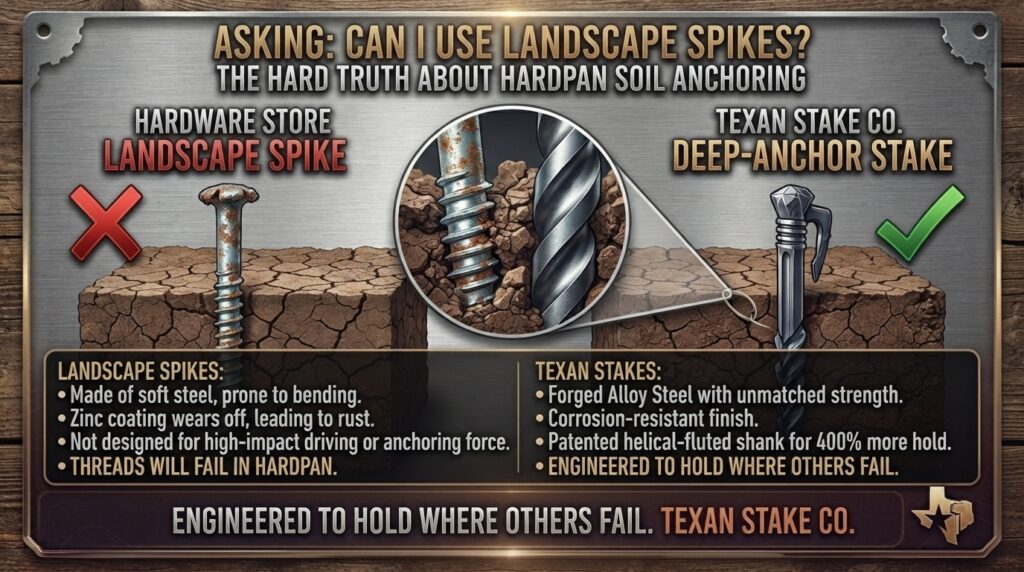
[Hardware Landscape Spike] ──> Straight Head / No Hook ──> High Zinc/Galvanized Steel Core (Cheap, Heavy)
[Dedicated Camping Stake]  ──> Integrated Hook/Eyelet   ──> Forged Steel or Premium Alloys (Pricey, Light)
Landscape Spikes and Timber Nails
Commonly sold in 8-inch, 10-inch, and 12-inch lengths, these are essentially massive, heavy-gauge carbon steel nails. They are manufactured to secure heavy railroad ties, landscape timbers, or thick weed-barrier fabrics. They are available in two main variations: smooth-shaft spikes and spiral-grooved/ring-shank timber ties. They are coated with a thick layer of hot-dip galvanization to resist rust when buried underground for decades.
Premium Forged Tent Stakes
High-end camping spikes (like Snow Peak Solid Stakes or custom overlanding pins) are also made from hardened steel. However, they are engineered specifically for outdoor recreation, featuring built-in cast eyelets, integrated attachment hooks, and reflective pull-loops designed to catch your guylines and keep you from tripping in the dark.
2. The Direct Comparison: Hardware Store vs. Outfitter Shop
Before driving to your local big-box home improvement center, review how basic contractor hardware measures up against purpose-built camping gear.
| Evaluation Metric | Hardware Store Landscape Spikes (e.g., 10″ Galvanized) | Retail Camping Forged Stakes (e.g., Premium 10″ Steel) |
| Material Composition | Hot-dipped galvanized carbon steel | Forged S45C carbon steel / liquid-coated |
| Average Cost per Unit | $0.80 to $1.50 (Highly affordable) | $4.50 to $8.00 (Premium pricing) |
| Bending Resistance | Exceptional; handles 3-pound sledge strikes easily | Exceptional; engineered for rock/caliche |
| Weight per Stake | $5.0\text{–}7.5\text{ oz}$ (Heavy, bulky) | $4.5\text{–}6.5\text{ oz}$ (Slightly optimized) |
| Guyline Security | Poor out-of-the-box (Flat head allows rope slip) | Excellent (Integrated hook or welded eyelet) |
| Availability | Universal (Any local hardware store or lumber yard) | Specialized (Must order online or visit outdoor shops) |
| Best Substrate Fit | Hard-packed clay, caliche, dense gravelly till | Rocky trail dirt, hardpan, standard dirt lawns |
3. Regional Soil Performance: Where Landscape Spikes Win
Hardware-store spikes perform differently depending on the specific geography and soil profile of your destination. Let’s look at how they handle our target states:
Texas: Conquering Caliche and Sun-Baked Gumbo
Texas campgrounds are notorious for sun-baked clay and hidden subsurface caliche blocks (calcium carbonate deposits that act like natural concrete sheets).
- The Challenge: Flimsy outdoor-store pegs collapse instantly under the heavy impacts needed to crack this ground.
- The Spike Solution: 10-inch galvanized landscaping spikes are perfect here. Their heavy carbon steel core acts exactly like a masonry chisel, breaking through caliche without deforming.
Washington & California: Navigating Glacial Till and Granite Gravel
From the dense glacial till of Washington’s rainforest clearings to the gravelly, root-choked soils of northern California and San Francisco’s coastal headlands, campers face highly abrasive terrains.
- The Challenge: Sharp granite gravel can scrape away thin protective coatings on standard pegs, leading to rapid rust.
- The Spike Solution: The thick, rugged hot-dip galvanization on contractor spikes provides an exceptionally durable shield against abrasion. You can hammer them past rocky gravel and underground roots repeatedly without exposing the raw iron core beneath.
New York: Woodland Roots and Adirondack Hardpan
Setting up a basecamp in New York’s state parks or the Catskill mountains means competing with dense networks of rubbery hardwood roots and compacted, damp forest soils.
- The Challenge: Wide, finned aluminum stakes (like Y-beams) get caught on roots, making them incredibly difficult to drive deep or extract safely.
- The Spike Solution: The slim, smooth cylindrical profile of an 8-inch or 10-inch timber nail slips cleanly past dense roots, allowing you to establish a secure, deep anchor point without causing unnecessary damage to the surrounding environment.
4. The Critical Danger: Why Unmodified Spikes Fail
While landscape spikes have excellent structural strength, using them straight out of the box introduces a major safety risk to your campsite: guyline slippage.
Because a contractor nail features a completely flat, circular head with no built-in catch loop, your tent’s guylines rest directly against the smooth steel shaft. When sudden, high-velocity wind gusts hit your tent walls, the shelter will pull upward and flex.
Without a hook to retain it, the guyline can easily slide straight up the smooth shaft and pop over the flat head, instantly releasing the line and causing your tent to collapse mid-storm.
5. DIY Hacks: How to Convert Hardware Spikes Into Pro Tent Stakes
To make hardware-store spikes safe and effective for long-distance camping trips, implement these simple, low-cost modifications at home before hitting the trail:
The Paracord Loop Modification (The Best Solution)
You can easily create an absolute mechanical stop for your ropes using basic 550 paracord.
        [Flat Nail Head]
              ══╦══
  (Tie Loop) ──(O)  <-- Prusik or Girth Hitch below head
                ║
                ║   <-- Loop hangs down to catch guyline hook
                ║
- Cut a 10-inch strip of high-visibility or reflective 550 paracord.
- Tie the ends together using a secure fisherman’s knot or an overhand loop to create a closed ring.
- Loop the cord around the shaft of the landscape spike directly below the flat head using a girth hitch or a prusik knot, pulling it as tight as possible.
- When you drive the spike into the ground, clip or tie your tent’s guyline directly through this paracord loop instead of wrapping it around the metal shaft. The flat head of the nail prevents the cord loop from sliding off, keeping your lines completely secure.
The Washer Modification
Go to the bulk fastener aisle at the hardware store and purchase a pack of steel flat washers with an internal diameter just slightly smaller than the head of your spike, along with a pack of matching rubber O-rings.
- Slide the steel washer onto the spike from the pointed tip upward until it rests flush against the flat head.
- Slide a tight rubber O-ring up right behind the washer to compress and lock it firmly against the head, preventing it from rattling or sliding down the shaft.
- The extending lip of the steel washer creates a wide rim that acts as a highly effective shield, preventing your looped guylines from ever sliding upward off the stake.
Add High-Visibility Dip Paint
Because raw galvanized steel matches the gray color of gravel and dirt, driven spikes become invisible hazards around your basecamp. To save your toes from painful late-night stubs, dip the top 2 inches of each modified spike into a can of neon orange or bright yellow liquid rubber plasti-dip or wrap them with reflective tape.
6. Pro Tips for Installing and Extracting Heavy Hardware Spikes
To maximize your efficiency when working with heavy hardware spikes on tough ground, follow this tactical setup checklist:
1.Use a 3-Pound Steel Drilling Hammer:Ditch lightweight camp mallets.
Do not use a soft rubber or lightweight plastic mallet to drive thick steel landscaping spikes into hard clay; the mallet will bounce off fruitlessly, absorbing your energy. Invest in a 2-pound to 3-pound steel drilling hammer. The solid metal-on-metal impact drives heavy spikes effortlessly.
2.Execute the 45-Degree Angular Rule:Angle against the load vector.
Always drive your landscape spikes into the dirt at a 45-degree angle pointing directly away from the tent body. Driving a spike straight up-and-down significantly reduces its pull-out resistance, making it easy for wind gusts to slide the stake right out of its entry channel.
3.Drive the Head Flush to the Soil Line:Eliminate external leverage arms.
Hammer the spike all the way down until your DIY paracord loop or washer rests completely flush with the ground. Leaving several inches of the thick metal shaft exposed creates a lever arm; high winds pulling on an exposed shaft can easily loosen the surrounding soil and pull the stake free.
4.Extract Using the Twist-and-Lever Method:Break the suction seal safely.
Once hard clay or dense loam dries around a straight steel spike, the frictional hold can feel like concrete. Never try to pull the spike out by yanking on your tent’s fragile fabric loops. Instead, slide the shaft of a spare spike horizontally underneath the head of the buried one, twist it 180 degrees to break the soil’s suction seal, and pull straight upward along the original 45-degree angle.
7. 10 Expert Frequently Asked Questions (FAQs)
1. Are smooth landscape spikes better than spiral-grooved timber spikes for camping?
For general camping, smooth-shaft landscape spikes are vastly superior. While spiral-grooved or ring-shank timber spikes provide incredible permanent holding power in construction lumber, driving them into rocky or hard-packed clay requires immense effort. More importantly, extracting a ribbed or spiral spike from dry clay at the end of your trip can be incredibly difficult, often requiring a crowbar.
2. Will galvanized hardware spikes rust after being exposed to wet weather?
Landscape spikes treated with hot-dip galvanization are exceptionally rust-resistant. The thick layer of zinc protects the underlying steel core from water, mud, and acidic soils. They will easily survive years of wet camping trips without significant rust, though you should wipe off excess mud before packing them away.
3. Can I use a cordless impact driver with long timber screws instead of spikes?
Yes, using heavy-duty 10-inch or 12-inch structural timber screws (like Spax, TimberLOK, or GRK structural screws) paired with a portable cordless impact driver is an excellent strategy for car camping or overlanding. The screw threads cut mechanically into hard clay and caliche, providing unmatched holding power and effortless motorized extraction at the end of your stay.
4. How much weight do hardware spikes add to a standard backpacking kit?
A single 10-inch galvanized steel landscape spike weighs between 5.5 and 7.5 ounces. Carrying a full set of eight spikes adds roughly 3 to 4 pounds of dead weight to your gear pack. For car campers, this weight is irrelevant, but for wilderness backpackers, it is far too heavy. Backpackers should stick to lightweight Grade 5 titanium nail stakes instead.
5. Can I use basic rebar pins from the hardware store instead of landscape spikes?
Yes, short sections of pre-cut steel rebar (such as 12-inch by 3/8-inch rebar pins) are widely used for securing large canvas wall tents, shade structures, and camp setups at desert festivals like Burning Man. Rebar offers incredible structural strength, but its rough, ridged surface is highly abrasive to tent guylines, so you must use a heavy-duty carabiner or chain link at the top to protect your ropes from fraying.
6. What size of landscape spike is the ideal sweet spot for family camping tents?
The 10-inch length with a 3/8-inch diameter is the ultimate sweet spot. An 8-inch spike can occasionally pull loose in softer topsoils under high winds, while a 12-inch spike is often unnecessary and increases your chances of hitting deep, immovable bedrock shelves that stop your progress completely.
7. Why do my tent’s tensioning plastic sliders keep slipping on my DIY paracord loops?
Standard plastic line tensioners are designed to grip thin, stiff 2mm tent cord. If your DIY loop uses thick, soft 4mm paracord, the plastic slider may not compress the line tightly enough to hold under tension. Upgrade your tent’s guylines to aluminum three-hole tensioners or learn to tie a reliable taut-line hitch knot directly to the loop.
8. Is it safe to use a regular claw hammer to extract landscape spikes from hard campground dirt?
Yes, a standard household claw hammer works perfectly for extracting these spikes. Slide the claw under the flat head of the nail and pull back on the handle to lift it out. To protect the environment, place a small scrap block of wood under the head of the hammer; this creates a solid fulcrum and prevents the tool from leaving deep gouges in the park’s turf.
9. Can I use bright spray paint instead of Plasti-Dip to make my hardware spikes visible?
You can use standard high-visibility spray paint, but it will chip and flake off the galvanized steel shaft after just a few strikes from your metal hammer. A rubberized coating (like liquid Plasti-Dip) handles the vibrations of hammer impacts much better, providing a durable, bright safety color that lasts for multiple seasons.
10. Do big-box hardware stores sell any spikes that have built-in hooks out of the box?
Generally, no. Standard hardware stores do not stock traditional hooked tent stakes in their fastener aisles. However, you can occasionally find steel “J-hook” rebar stakes or canopy pins over in the seasonal garden department, where they are sold for securing trampolines, soccer goals, or seasonal holiday lawn decorations.
Conclusion: Smart Resourcefulness Leads to Better Basecamps
When developing your gear guides, content strategy, and user resources on besttentstakes.com, focusing on high-value, practical advice is what builds long-term reader trust. The outdoor industry often leads consumers to believe that they must buy expensive, specialized gear for every scenario. However, a deep understanding of basic materials and physics allows you to find excellent alternatives right at your local neighborhood shop.
Swapping out expensive, specialized pegs for a set of modified hardware-store landscape spikes is a time-tested strategy for car campers and overlanders who regularly deal with brutal ground conditions.
Whether you are anchoring a massive multi-room family tent against high winds on the open plains of Texas, pitching a canopy on the rocky clearings of California, or setting up a basecamp along the tough glacial soils of New York, these modified contractor spikes offer an unbendable, highly secure foundation at a fraction of the cost. By implementing a few simple modifications like paracord pull-loops and high-visibility coatings, you can confidently build a storm-proof basecamp anywhere your wheels take you.