Why do standard aluminum tent stakes bend so easily in the Texas Hill Country?

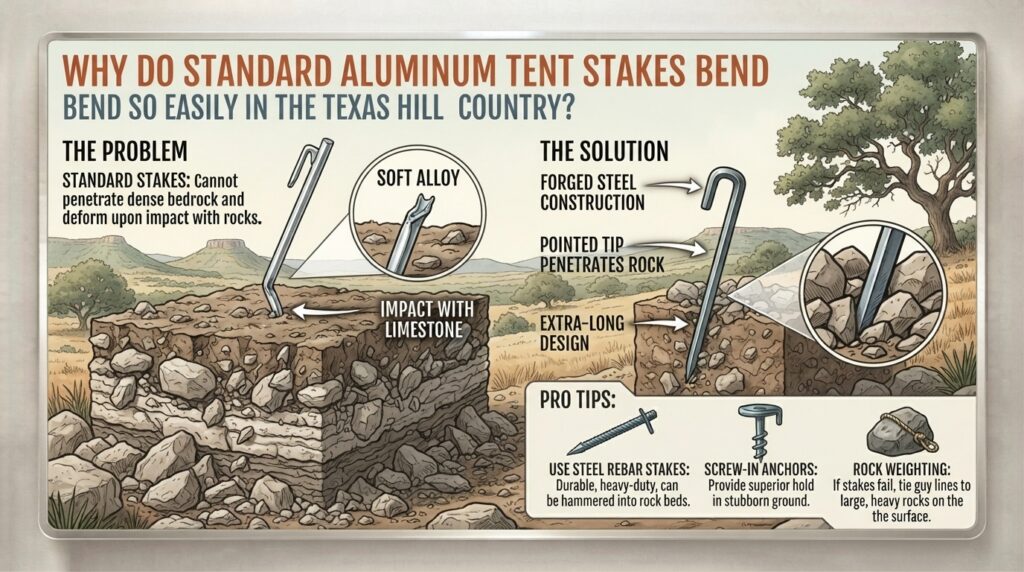
If you have ever set up camp near the clear waters of the Frio River, under the shadows of Enchanted Rock, or along the rolling terrain of Garner State Park, you have likely experienced a frustrating ritual: swinging a mallet or rock at a standard aluminum tent stake, only to watch it crumple like an aluminum soda can.
The Texas Hill Country is famous for its natural beauty, but beneath its scenic surface lies some of the most punishing, stake-destroying terrain in North America. Standard aluminum tent stakes—the smooth, hook-shaped pegs included in the bag of almost every new tent—are fundamentally unsuited for Central Texas ground.
1. The Underground Enemy: Texas Hill Country Geology
To understand why tent stakes fail in Central Texas, you have to look beneath the surface. The Hill Country sits on the Edwards Plateau, an ancient marine ecosystem formed millions of years ago.
┌───────────────────────────────────────────────────────────┐
│               0 - 2 Inches: Loose Topsoil / Organic Dust   │
├───────────────────────────────────────────────────────────┤
│               2 - 6 Inches: Chert, Flint & Gravel Layers  │
├───────────────────────────────────────────────────────────┤
│               6+ Inches: Cemented Caliche & Limestone     │
└───────────────────────────────────────────────────────────┘
The soil profile in Central Texas typically consists of three challenging layers:
- Thin Topsoil: In many areas, you will find only 1 to 3 inches of loose topsoil. This layer offers zero structural resistance or friction to hold a tent stake against high wind loads.
- Chert, Flint, and Gravel Aggregates: Just below the topsoil sits a dense layer of sharp, hard rock fragments embedded in clay. When a stake strikes one of these stones, all downward driving force shifts sideways.
- Caliche and Solid Limestone: Beneath the gravel lies caliche—a concrete-like sedimentary layer of calcium carbonate—or solid limestone bedrock. Hitting caliche with a standard stake is equivalent to trying to drive a peg into a concrete driveway.
2. Structural Failure Mechanics: Why Cheap Aluminum Bends
Most entry-level tents ship with shepherd’s crook stakes made from soft, extruded 6061-series aluminum wire. These pegs fail in Texas terrain due to specific mechanical vulnerabilities:
- Lack of Structural Ribbing: Smooth round wire offers no geometric reinforcement against lateral shear forces.
- Eccentric Loading at the Hook: Striking the curved hook top transfers the impact force slightly off-center. When the tip encounters hard caliche, this off-center load causes the shaft to buckle instantly.
- Low Yield Strength: Soft aluminum alloys yield and deform under relatively minor impact pressure when obstructed.
3. Comparing Tent Stake Materials and Geometry for Hard Ground
When camping in Central Texas, choosing the right combination of material strength and cross-sectional geometry is essential.
| Stake Profile / Type | Material Alloy | Structural Shape | Penetration Power | Texas Hill Country Performance |
| Shepherd’s Crook | 6061 Aluminum | Smooth Round Wire | Very Low | ❌ Fails instantly. Bends or curls upon hitting rock/caliche. |
| Y-Beam / Tri-V | 7075-T6 Aluminum | 3-Blade Star Beam | Moderate to High | 🟨 Good. Excellent holding power; can penetrate dense clay, but strike head can deform if hammered hard into solid limestone. |
| Nail / Peg Style | Titanium (Grade 5) | Solid Round Rod with Flat Strike Cap | High | 🟩 Very Good. Extremely lightweight and puncture-capable; slides past rock edges. |
| Forged Steel Nail | S55C Carbon Steel | Thick Solid Tapered Pin | Maximum | 🏆 Best Overall. Drives through caliche, gravel, and soft limestone like a masonry nail. |
| Spiral Lag Thread | Zinc-Plated Steel | Hex-Head Screw Thread | High (Requires Impact Driver) | 🛠️ Alternative. Threads directly into hardpan caliche using cordless tools. |
4. Field Guide: How to Secure a Tent in Rocky Texas Terrain
If you are setting up camp on hardpan soil or limestone, standard staking techniques will not work. Use these proven strategies to secure your shelter safely:
1.1. Probe the Ground First:Identify subterranean obstacles.
Before driving stakes with full force, press a thin metal pin or driver stake into the dirt by hand to locate rock seams and avoid solid limestone ledges hidden just below the topsoil.
2.2. Drive at a 45 to 60-Degree Angle:Maximize friction and mechanical advantage.
Angle the stake away from the tent body. Driving at an angle increases surface friction against the soil and prevents the guyline from slipping off the top under tension.
3.3. Use Controlled Taps with a Mallet:Distribute force evenly.
Avoid heavy swings with large rocks or steel sledges. Short, controlled taps from a brass or rubber camping mallet reduce peak shock loads on the stake head, preventing shaft deformation.
4.4. Deploy the ‘Big Rock’ Method:Deadman anchoring technique.
If the limestone layer is too shallow to drive stakes completely, wrap your guyline securely around the center of a heavy rock, then pile several more large rocks over it to create a weight-based anchor.
Regional Conditions: Central Texas, West Texas, Pacific NW, and Beyond
Campers face unique ground challenges depending on where they pitch their tents across the country:
1. Texas Hill Country & Austin Region
- Ground Characteristics: Extremely shallow topsoil over calcified hardpan (caliche) and fractured limestone.
- Recommended Gear: Forged carbon steel stakes (e.g., Snow Peak Solid Stakes) or 8-inch threaded steel lag bolts.
2. West Texas (Big Bend & Palo Duro Canyon)
- Ground Characteristics: Highly compacted desert clay, gravel washes, and volcanic rock outcrops.
- Recommended Gear: High-strength 7075-T6 Y-Beam aluminum stakes or steel nail pegs paired with high-tension guyline tensioners.
3. Pacific Northwest (Washington Cascades & Oregon Coast)
- Ground Characteristics: Deep, damp loam, needle duff, and soft forest soil over wet river rocks.
- Recommended Gear: Longer V-shaped or Y-beam aluminum stakes (8–10 inches) designed for high holding friction in loose, damp soil.
4. California & Sierra Nevada Granite
- Ground Characteristics: Exposed granite slabs, loose alpine scree, and dry, compacted subsoil.
- Recommended Gear: Ultralight titanium nail stakes for thin rock seams or weight-based rock anchors for solid granite surfaces.
10 Large Frequently Asked Questions (FAQ)
1. Why do tent manufacturers include cheap aluminum stakes with expensive tents?
Tent manufacturers use basic shepherd’s crook wire stakes to keep total product weight low and reduce manufacturing costs. These included stakes are meant only for soft grass or pristine soil, expecting campers to upgrade based on local terrain.
2. Can I use a regular carpenter’s hammer to drive stakes in the Texas Hill Country?
Steel claw hammers transfer too much direct impact energy to lightweight aluminum or titanium heads, causing them to mushroom or bend. Use a rubber mallet, brass-headed camping hammer, or a flat, smooth river stone with controlled strikes.
3. What are “Lag Bolts” for tent stakes, and do they really work in caliche?
Yes! Many Texas car campers use 3/8-inch by 8-inch galvanized steel lag screws driven with a portable cordless impact driver. They thread directly into dense caliche and hardpan, offering exceptional holding power and easy removal.
4. Are titanium stakes completely immune to bending in rocky soil?
No. While Grade 5 titanium offers a superior strength-to-weight ratio compared to aluminum, thin titanium wire or V-stakes can still bend if hammered directly into solid limestone. Solid titanium nail stakes perform better because they lack thin side flanges.
5. How long should my tent stakes be for camping in Central Texas?
In hard, rocky soil, 6 to 8 inches is ideal. Longer 10-to-12-inch stakes are difficult to drive fully into shallow topsoil without hitting impenetrable limestone layers.
6. What is caliche soil, and why is it so difficult to penetrate?
Caliche is a hardened layer of soil where calcium carbonate particles bind together like natural cement. Common in arid regions like Central and West Texas, it forms a dense, rock-like barrier just below the surface.
7. How do I remove a steel stake that is jammed tightly between underground rocks?
Do not pull straight up on the guyline loop. Use a stake extractor tool or hook another spare stake under the head, then twist the stake 360 degrees to break the soil seal before pulling it out at the angle it entered.
8. Will 7075-T6 aluminum stakes survive Texas campsites?
Yes, high-grade 7075-T6 aluminum Y-beam stakes (like MSR Groundhogs) perform well in rocky soil if driven carefully. However, forged steel remains the most durable choice for repeated use in caliche.
9. What should I do if the ground is pure limestone slab with no soil?
When pitching on solid rock, use the Little-Rock/Big-Rock method: tie your guyline around a small anchor rock, then pile several heavy stones on top of the line to hold the tent securely against wind.
10. How can I pull bent aluminum stakes back into shape at the campsite?
You can straighten bent wire aluminum stakes by wedging the bent shaft into a narrow gap—such as between picnic table slats or a trailer hitch—and applying gradual leverage by hand. Note that bent metal loses structural integrity and will bend more easily next time.
Conclusion
Standard aluminum wire stakes fail in the Texas Hill Country because smooth, thin wire cannot withstand the intense forces required to penetrate dense gravel, caliche, and underlying limestone. By upgrading to forged steel stakes, solid titanium nail pegs, or high-strength Y-beam designs, you can secure your campsite reliably anywhere in Texas without damaging your gear.