Can I use a regular household hammer to drive stakes into rocky soil?

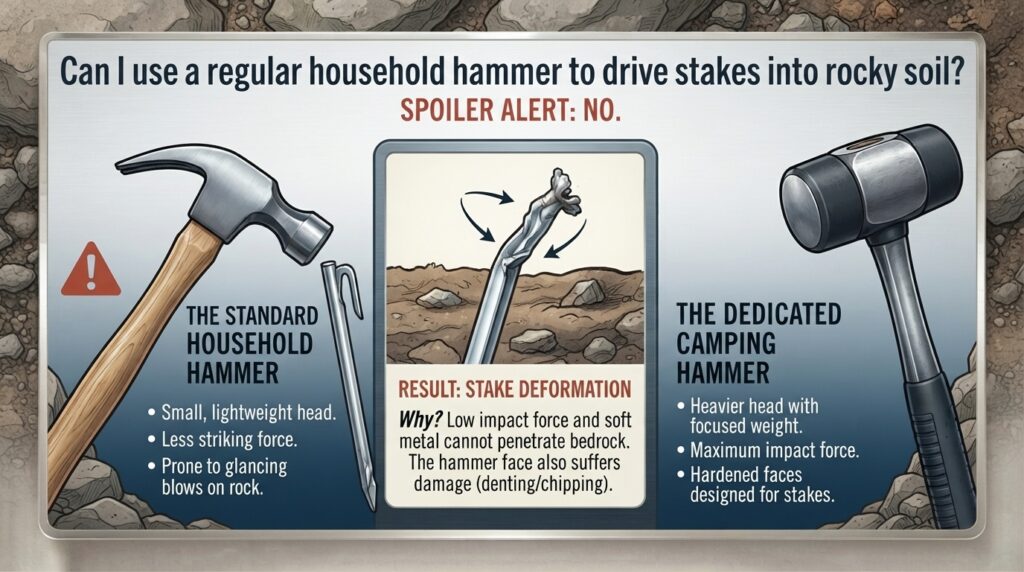
Technically yes, but practically speaking, it is a bad idea that will likely ruin your tent stakes.
While a standard 16-ounce household claw hammer can push a peg into soft grass, using hardened steel tool face against aluminum, plastic, or titanium stakes in rocky soil leads to mushroomed heads, snapped shafts, dangerous metal shrapnel, and bent gear.
When driving stakes into tough terrain—like caliche in Texas, granite scree in California’s Sierra Nevada, or glacial till in Washington—matching the striking tool to the stake material is essential.
The Physics of Failure: Why Household Hammers Destroy Tent Gear
A standard claw hammer is engineered specifically for striking hardened steel nails into soft wood. It achieves this using a small, hardened steel striking face (Rockwell C hardness of 50 to 60).
When you strike lightweight tent stakes in rocky soil with a household hammer, two primary physics failures occur:
1. Hardness Mismatch (Mushrooming & Flaking)
Most aluminum tent stakes use 6061 or 7075 alloys, which are significantly softer than the steel face of a claw hammer. When an aluminum stake hits a subterranean rock, the upward resistance stops its momentum. The force from the hammer face has nowhere to go, causing the soft aluminum head to compress, spread, and mushroom outward.
Hardened Steel Hammer Face (Rc 50-60)
         │
         ▼  (High Peak Energy Impact)
Soft Aluminum / Plastic Stake Head
         │
         ▼  (Obstruction: Subterranean Rock)
Result ──► Deformed / Mushroomed Head + Metal Splinters
2. High-Frequency Shock Waves (Shaft Buckling)
Standard claw hammers deliver sharp, concentrated impact energy over an extremely short duration. Without shock-absorbing material (like rubber, brass, or wood) to cushion the blow, this high-peak shock wave travels down the stake shaft. When the tip encounters a rock, the kinetic energy reflects back up the shaft, causing it to buckle or snap at its weakest geometric point.
Comparison: Household Hammers vs. Purpose-Built Camping Tools
Using the right tool for the job keeps your gear intact and makes pitch setup significantly faster. Here is how striking tools compare when driving stakes into rocky terrain:
| Tool Type | Head Material | Shock Absorption | Risk to Aluminum Stakes | Performance in Rocky Soil |
| Household Claw Hammer | Hardened Forged Steel | None | ❌ High. Mushrooms aluminum and fractures plastic. | 🔴 Poor. High energy transfer damages gear when striking underground rocks. |
| Rubber Mallet | High-Density Rubber | Very High | 🟩 Very Low. Will not deform soft metals. | 🟡 Moderate. Bounces on hardpan/caliche; requires extra physical effort. |
| Brass-Headed Camp Mallet | Soft Brass | Moderate | 🟩 Low. Brass deforms slightly to protect aluminum heads. | 🟢 Excellent. High mass drives stakes smoothly through gravel and clay. |
| Dead-Blow Mallet | Steel Shot inside Polyurethene | High | 🟩 Low. Absorbs rebound force. | 🟢 Great. Delivers maximum kinetic transfer without bouncing. |
| Forged Steel Camp Hammer | High-Carbon Steel with Extractor | Low to Moderate | 🟨 Moderate. Safe only on forged steel or heavy nail stakes. | 🏆 Best for Heavy Steel Stakes. Ideal for driving steel pegs into caliche/rock. |
Field Protocol: How to Drive Stakes into Rocky Soil Without Damage
When setting up camp on rocky riverbeds, hardpan caliche, or gravelly forest floors, follow this step-by-step protocol to preserve your gear:
1.1. Probe the Ground First:Locate subterranean obstacles.
Before striking with full force, push the stake gently into the soil by hand or tap lightly to feel for underground boulders, roots, or solid bedrock layers.
2.2. Position at a 45 to 60-Degree Angle:Select the proper angle.
Drive the stake into the ground angled slightly away from the tent. This increases holding friction against the soil and allows the point to glance off round river rocks rather than hitting them flat.
3.3. Use Short, Rhythmic Strikes:Controlled taps over heavy swings.
Avoid swinging a heavy hammer from above your shoulder. Use short, 6-to-8-inch wrist-driven taps. Short strikes keep the force vector straight along the shaft, preventing off-center bending.
4.4. Shift Position or Pivot to Rock Anchors:Adapt when hitting impassable bedrock.
If a stake stops moving after 2 inches, do not force it with a heavy steel hammer. Pull it out, shift 3 inches to the side, or transition to a “deadman” rock anchor setup.
Regional Soil Profiles: TX, NY, CA, WA & SF
Camper experiences with driving stakes vary significantly based on regional soil geology:
1. Texas Hill Country (Austin, San Antonio, Garner State Park)
- Soil Profile: Thin topsoil covering dense caliche (calcified limestone) and sharp chert gravel.
- The Verdict on Hammers: Household claw hammers will destroy aluminum Y-beam stakes in seconds here. Use a heavy dead-blow mallet or brass hammer paired with forged steel nail stakes (e.g., Snow Peak Solid Stakes).
2. New York & Adirondacks / Catskills
- Soil Profile: Glacial till consisting of dense clay interspersed with smooth granite cobbles and slate fragments.
- The Verdict on Hammers: Claw hammers often shear off plastic stake hooks in cold weather. Switch to 7075-T6 aluminum nail pegs or titanium pins tapped with a dead-blow mallet.
3. California & San Francisco Bay Area (Sierra Nevada, Coastal Ranges)
- Soil Profile: Decomposed granite, hardpacked coastal scrub clay, and exposed shale ledges.
- The Verdict on Hammers: In Yosemite or Tahoe, granite bedrock will bend soft aluminum wire stakes instantly if struck with a claw hammer. Use lightweight brass-headed mallets or rock-stacking guyline anchors.
4. Washington State (Cascades, Olympic Peninsula)
- Soil Profile: Deep forest duff over dense river gravel, basalt rock layers, and damp clay.
- The Verdict on Hammers: Moisture allows stakes to enter easily at first, but underlying basalt stops soft pegs short. A rubber mallet or brass-headed camp hammer works best without damaging stake pull-cords.
10 Large Frequently Asked Questions (FAQ)
1. Why did the head of my plastic tent stake shatter when hit with a claw hammer?
Standard ABS plastic or nylon stakes become brittle—especially in cold weather. The hard steel face of a claw hammer delivers an unyielding shock wave that shatters plastic instantly upon hitting ground resistance.
2. Can I cushion a claw hammer by putting a piece of wood over the stake?
Yes! Placing a small block of scrap wood over the head of the tent stake acts as a sacrificial cushion. The wood absorbs the peak shock wave and distributes the hammer’s force evenly across the stake head.
3. Is a brass camp mallet better than a rubber mallet for rocky ground?
Yes. Rubber mallets bounce off hard surfaces like caliche and rock, wasting kinetic energy. A brass mallet provides dense mass to drive stakes into hard ground while remaining soft enough to prevent deformation of aluminum heads.
4. What happens if I mushroom the top of my aluminum tent stake?
Mushroomed aluminum creates sharp, jagged metal burrs that can slice your hands, slice guyline cords, or puncture your tent carry bag during packing. Burred edges should be filed down flat before re-use.
5. Are forged steel stakes safe to strike with a regular household hammer?
Forged high-carbon steel stakes (such as S55C steel pegs) are hard enough to withstand steel claw hammer strikes without deforming. However, a specialized camp hammer with a stake-extractor hook remains more convenient.
6. What should I do if a stake gets wedged tightly between rocks underground?
Never pry the stake sideways with a claw hammer’s claw—this will snap aluminum and titanium shafts. Instead, slip another stake or pull-hook through the stake eyelet and twist 360 degrees to loosen the surrounding soil before pulling straight up.
7. How do I avoid bending ultralight titanium wire stakes in rocky ground?
Tap titanium wire stakes gently using a light wooden branch or brass mallet. If you encounter solid rock, re-angle the stake 45 degrees or move the anchor point a few inches away rather than pounding harder.
8. What is a “dead-blow” hammer and why is it popular for camping?
A dead-blow hammer has a hollow head filled with steel shot or sand. When it strikes a stake, the internal shot shifts forward a millisecond later, absorbing the rebound bounce and delivering maximum driving energy into hard soil.
9. Can I use a heavy rock found at the campsite instead of carrying a hammer?
Yes, campsite rocks can work well if selected carefully. Choose a flat, smooth river stone with adequate palm surface. Avoid sharp or brittle rocks that could shatter in your hand.
10. Does angle matter when driving stakes into hard ground?
Yes. Driving a stake at a 45 to 60-degree angle pointing away from the tent maximizes soil holding friction and allows the point to slide past round subterranean stones rather than hitting them head-on.
Conclusion
While you can use a regular household hammer in an emergency, its hardened steel face and unyielding shock delivery will quickly ruin aluminum, titanium, and plastic tent stakes when driving into rocky soil. To protect your gear and set up camp efficiently in challenging terrain, upgrade to a brass-headed camp mallet, rubber mallet, or dead-blow hammer paired with heavy-duty forged steel or Y-beam stakes.