How can I pull bent aluminum stakes back into shape at the campsite?

You are miles into the backcountry, pitching your shelter before an incoming storm, and thwack—your aluminum stake hits a subterranean boulder. Instead of driving smoothly into the soil, it emerges looking like a banana.
A bent aluminum stake is more than just an eyesore. It compromises your tent’s structural integrity, reduces ground holding power by up to 70%, and leaves your guylines loose when sudden mountain winds roll in.
The good news? You can safely straighten bent aluminum stakes right at your campsite using leveraged leverage techniques with natural elements (rocks, trees, or log crotches) or simple camp tools (pliers, axe heads, or tent pole segments).
Metallurgy 101: Understanding Aluminum Work Hardening & Stress Fatigue
Before picking up a rock or pair of pliers, it is crucial to understand why aluminum behaves the way it does when bent. Unlike forged steel or malleable copper, aluminum alloys react distinctively to mechanical stress.
The Science of 7075-T6 vs. 6061-T6 Alloys
Most quality outdoor gear utilizes extruded or forged aluminum alloys, typically:
- 7075-T6 Aluminum: Extremely high strength-to-weight ratio (zinc is the primary alloying element). Used in high-end Y-beam or tri-cleat stakes (like MSR Groundhogs). It is stiff and brittle. High risk of snapping if bent past 45 degrees.
- 6061-T6 Aluminum: Uses magnesium and silicon. Commonly used in classic shepherd crook stakes and tubular pins. It is more ductile than 7075, making it easier to bend back without immediate snapping.
       DEFORMATION ZONE           CRITICAL FAILURE
   [Unbent] ---> [Bent] ---> [Plastic Strain] ---> [SNAP!]
                   ^
            Field Repair Zone
    (Requires slow, controlled leverage)
What Happens During “Work Hardening”?
When aluminum bends, the crystalline lattice structure of the metal shifts, creating localized work hardening (or strain hardening) at the apex of the bend.
Critical Fact: Bending the stake back forces those same metal crystals to shift in reverse. Every single bend cycle weakens the structural integrity at that precise point. If you bend an aluminum stake back and forth more than 2 to 3 times, micro-fractures will form, eventually causing catastrophic snap failure.
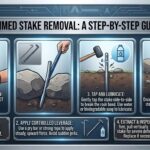
6 Field-Tested Methods to Straighten Aluminum Stakes at Camp
Whether you are camping in the high deserts of Texas, mountain forests of Washington, or coastal parks in Northern California, use these six campsite-proven techniques sorted by available equipment and level of leverage.
1.Method 1: The Two-Rock Sandwich (Best for Gentle Bends):Requires: 1 Large Flat Anvil Rock + 1 Round Striking Rock.
If your stake has a smooth curve (under 30 degrees), natural stone leverage is the safest field technique.
- Locate a broad, flat boulder to serve as your “anvil.”
- Place the bent stake on the flat rock with the apex of the bend pointing upward like a bridge.
- Take a smooth, medium-sized river stone (2-3 lbs).
- Apply firm, steady downward pressure directly onto the raised apex rather than smashing it rapidly.
- For tubular or round shepherd-crook pegs, rotate the stake 90 degrees between gentle taps to ensure a smooth, round profile without flattening the walls.
2.Method 2: The Tree Root or Fork Crevice (Best for Severe Bends):Requires: Mature Tree Root Gap or V-Shaped Branch Fork.
This method provides maximum mechanical advantage using natural levers.
- Find a narrow V-shaped tree fork or a tight gap between two strong surface roots.
- Insert the short side of the bent stake into the crevice up to the apex of the bend.
- Hold the long end of the stake with your dominant hand (wrap it in a camp towel or leather glove for palm protection).
- Apply slow, continuous leverage away from the bend direction.
- Stop frequently to check alignment—over-correcting will fatigue the aluminum faster than the original bend.
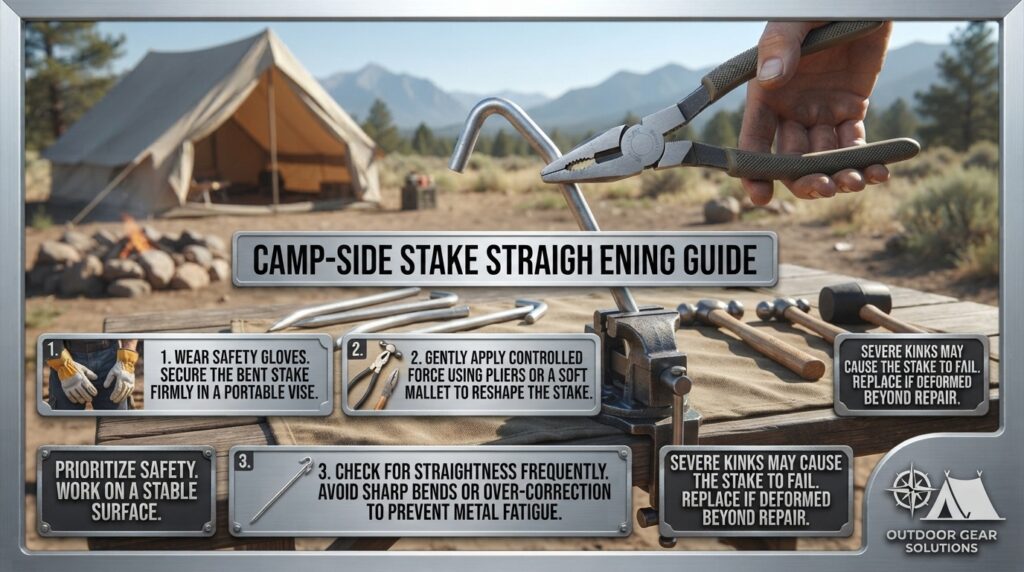
3.Method 3: Multi-Tool / Lineman Pliers (Best for Y-Beam & Tri-Cleat Stakes):Requires: Multi-Tool with Pliers (Leatherman, Gerber).
Tri-blade stakes (like MSR Groundhogs or DAC V-stakes) cannot be straightened on flat rocks without flattening their structural ridges.
- Grip the central spine of the bent stake with your multi-tool pliers directly at the apex of the bend.
- Use your non-dominant hand to hold the lower half of the stake firmly.
- Slowly bend the spine back into alignment using small incremental adjustments along the fin.
- Work along the entire damaged area in 1/4-inch steps rather than forcing one single point.
4.Method 4: The Camp Chair / Table Frame Socket:Requires: Tubular Camp Chair Leg or Metal Folding Table Frame.
Most portable camp chairs feature hollow aluminum leg tubes that act as built-in lever pipes.
- Slide the straight end of your bent stake inside the hollow tube opening of a heavy-duty camp chair frame.
- Slide it in until the apex of the bend sits right at the lip of the chair tube.
- Use the chair frame as a stationary anchor while slowly levering the exposed end of the stake straight.
5.Method 5: The Camp Stove / Warm Water Annealing Hack:Requires: Camp Stove + Pot of Hot Water (Optional Heat Treatment).
Extremely cold temperatures (sub-40°F) make aluminum brittle and dramatically increase snap risks.
- Heat a pot of water on your camp stove until it reaches a simmer (around 160°F to 180°F).
- Submerge the bent section of the stake in the hot water for 2–3 minutes.
- Note: While this temperature is not high enough for true industrial heat treating (which requires 600°F+), warming the cold metal reduces thermal brittleness and makes field levering significantly safer in cold high-altitude environments like Mt. Rainier or the Sierra Nevada.
6.Method 6: The Log & Hatchet Back-Blade Technique:Requires: Camp Axe/Hatchet + Hardwood Log Segment.
- Place the bent stake on a flat hardwood log with the bend curve facing upward.
- Position the flat, wide poll (back unsharpened side) of your hatchet directly over the bend.
- Press down firmly using your body weight, rolling the hatchet back and forth to press the metal smooth against the wood cushion.
Comparing Stake Designs: Repairability & Durability Matrix
Not all tent stakes react equally to field repairs. The table below outlines how different aluminum profiles handle bending, repair difficulty, and structural survival rates:
| Stake Design / Profile | Common Aluminum Alloy | Resistance to Bending | Field Repair Difficulty | Post-Repair Structural Integrity |
| Shepherd Crook (Round Pin) | 6061-T6 Aluminum | Low | Very Easy (Can use rocks or tree roots) | 65% to 80% (Remains usable for soft ground) |
| Y-Beam / Tri-Cleat (Groundhog style) | 7075-T6 Forged Aluminum | Very High | Hard (Requires pliers; prone to fin cracking) | 40% to 50% (Weakened along the spine) |
| V-Shaped Angle Peg | 6061 or 7075 Sheet | Medium | Moderate (Requires wood block leverage) | 50% to 60% (Prone to twisting along seam) |
| Hollow Tubular Pins | 7075 Seamless Tube | High | Extremely Hard (Kinks crush the inner void) | 10% to 20% (Usually snaps instantly) |
| Flat Nail Pegs | Hardened Aluminum / Alloy | Medium-High | Easy (Flat anvil rock pounding) | 70% to 80% (Good post-repair life) |
Geographic Guide: Soil Conditions across Key States & Target Regions
Understanding local soil conditions across major camping regions helps you choose the right stake style and avoid bends before they happen.
California & San Francisco Bay Area
- Soil Profile: Coastal sandstone, serpentine rock, and compacted clay (e.g., Mount Tamalpais, Big Sur, Yosemite Valley).
- Bending Hazard: High density of hidden granite gravel and tree roots near campsites.
- Pro Tip: Never force an aluminum stake into California granite soil with a heavy rock. If it stops halfway, move the stake location 3 inches rather than driving it blindly.
Washington State (Cascades & Olympic Peninsula)
- Soil Profile: Thick glacial till, damp forest duff overlying basalt bedrock, saturated volcanic clay.
- Bending Hazard: High moisture hides submerged river cobble beneath soft moss layers.
- Pro Tip: In saturated coastal soils, use wide V-angle or Y-beam aluminum stakes. If you hit a buried basalt rock, pull back immediately to prevent 7075 aluminum snapping.
Texas (Hill Country, West Texas & Coastal Plains)
- Soil Profile: Caliche (hardened natural calcium carbonate), sun-baked Blackland clay, and limestone shelves (e.g., Big Bend, Enchanted Rock).
- Bending Hazard: Caliche acts like natural concrete during dry summer months.
- Pro Tip: Soft 6061 wire stakes will bend on the first strike in Texas caliche. Switch to heavy forged steel or thick solid-rod aluminum stakes.
New York (Adirondacks & Catskills)
- Soil Profile: Glacial cobble, heavy dense clay, interlaced hardwood tree root systems.
- Bending Hazard: Adirondack soil is notorious for “floating rocks”—loose cobble buried 2–4 inches beneath pine needles.
- Pro Tip: Carry a multi-tool with sturdy pliers for Adirondack trips; straightening bent fins on Y-stakes is a daily chore on rocky trail sites.
When to Repair vs. When to Recycle: Safety Checklist
Driving a severely fatigued aluminum stake into high-stress guylines can cause shelter failure during nighttime storms. Use this safety checklist before reusing a repaired stake:
- [ ] Inspect for Micro-Fractures: Hold the straightened area under bright light or flashlight. Look for faint white stress lines or visible surface cracks along the aluminum grain.
- [ ] Check for Structural Kinks: Is the metal smooth, or does it feature a sharp, creased pinch point? Sharp kinks reduce holding strength by more than 80%.
- [ ] Flex Test: Gently bend the stake 5 degrees with your hands. If it feels spongey or unnaturally soft at the repair point, the metal alloy has exceeded its plastic yield limit.
- [ ] Re-Assign Usage: Move repaired stakes to non-critical shelter points (e.g., vestibule flaps, gear storage corners, ground tarp corners) rather than main windward guylines or ridge lines.
10 Frequently Asked Questions (FAQ)
1. Will heating my aluminum tent stake over a campfire make it easier to bend?
No, be extremely careful. Heating aluminum over an open campfire can easily exceed 900°F, destroying its factory heat treatment (“-T6” temper rating) and turning high-strength 7075 aluminum into soft, useless metal. Stick to warm water soaking (under 200°F) for cold-weather flexibility.
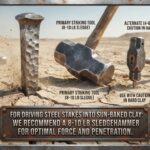
2. Can I use a hammer to pound a bent aluminum stake flat on a rock?
Pounding aluminum violently with a steel hammer or heavy rock flattens the round profile and causes immediate work hardening, leading to cracks. Instead, use firm, steady press leverage rather than sharp impact strikes.
3. Why did my Y-beam (Groundhog style) stake snap when I tried to unbend it?
Y-beam stakes are typically made from 7075-T6 aluminum, which is engineered for high stiffness, not flexibility. When bent past 30–45 degrees, the crystalline lattice structure fractures upon re-alignment.
4. How can I prevent my aluminum stakes from bending in the first place?
Clear topsoil debris with your boot heel before driving stakes, use a rubber/wooden mallet instead of heavy rocks, and drive stakes at a 60-degree angle facing away from your tent to distribute tension evenly.
5. Is it safe to use a repaired aluminum stake on my tent’s main guyline?
It is not recommended. Repaired stakes have lost 20% to 50% of their structural yield strength. Reserve repaired stakes for low-tension anchor points like vestibule doors, rainfly guy-outs, or footprint corner webbing.
6. What is the difference between 6061 and 7075 aluminum stakes?
6061 aluminum is more ductile and flexible; it bends more easily but can be straightened multiple times in the field. 7075 aluminum is significantly stiffer and stronger, but brittle—it resists bending longer, but is far more likely to snap during field repairs.
7. Can I use a hollow tent pole section as a leverage sleeve to unbend a stake?
Avoid using active tent pole segments! The thin walls of your tent poles can easily dent or crack under concentrated point leverage, leaving you with both a broken stake and a destroyed tent pole frame.
8. How many times can you straighten the same aluminum stake?
At most 1 to 2 times. Beyond two bending cycles, the localized work hardening will cause the aluminum to split or snap under standard tension loads.
9. What tool should I pack if I’m camping in heavy rock zones like the Sierra Nevada or Texas Hill Country?
Pack a small multi-tool featuring sturdy needle-nose pliers and consider carrying 2–4 extra forged steel or titanium stakes for high-impact rocky anchor points.
10. How do I recycle broken or snapped aluminum tent stakes properly?
Clean off all dirt, remove cord loops or plastic caps, and place the aluminum shanks into your standard municipal curbside recycling bin (marked for aluminum metal scrap).
Conclusion
A bent aluminum stake doesn’t have to ruin your backcountry trip. By applying controlled mechanical leverage using tree forks, rock sandwiches, or multi-tool pliers—and respecting the limits of metal fatigue—you can safely restore your stakes to working condition right at camp.
Remember: always reassign repaired stakes to low-tension vestibule points, avoid overheating aluminum over campfires, and carry a couple of forged backup pegs when heading into notoriously rocky terrain across California, Washington, Texas, or New York. Safe travels, and keep your shelter secure!