Can fiberglass tent poles survive high winds, or should I upgrade to aluminum?

When a midnight windstorm sweeps through your campsite—whether you are pitch-camping along the breezy Pacific coastline in San Francisco, battling dusty gusts in West Texas, or pitched above the treeline in Washington’s Cascade Range—few sound profiles evoke as much anxiety as the severe creaking of flexed tent poles.
At besttentstakes.com, we regularly test gear in the most demanding conditions across North America. The question campers ask us most frequently when preparing for bad weather is simple: Can standard fiberglass tent poles survive high winds, or is upgrading to aluminum mandatory?
The direct answer: Fiberglass tent poles can handle light to moderate breezes (up to 20–25 mph), but they are prone to sudden, catastrophic failure in sustained high winds or severe gusts. Upgrading to high-grade aluminum poles (like 7001 or DAC aerospace alloy) is the single most effective hardware upgrade you can make to protect your shelter from wind-induced collapse.
In this ultimate guide, we dive deep into the material science, wind thresholds, structural dynamics, failure modes, regional weather demands, and upgrade processes so you can make an informed decision before your next trip.
Fiberglass vs. Aluminum Tent Poles: Material Science Breakdown
To understand how tent poles respond to severe aerodynamic stress, we first need to look at how these two materials handle physical strain, elasticity, and load distribution.
1. Fiberglass Tent Poles: Flexibility with a Fragile Limit
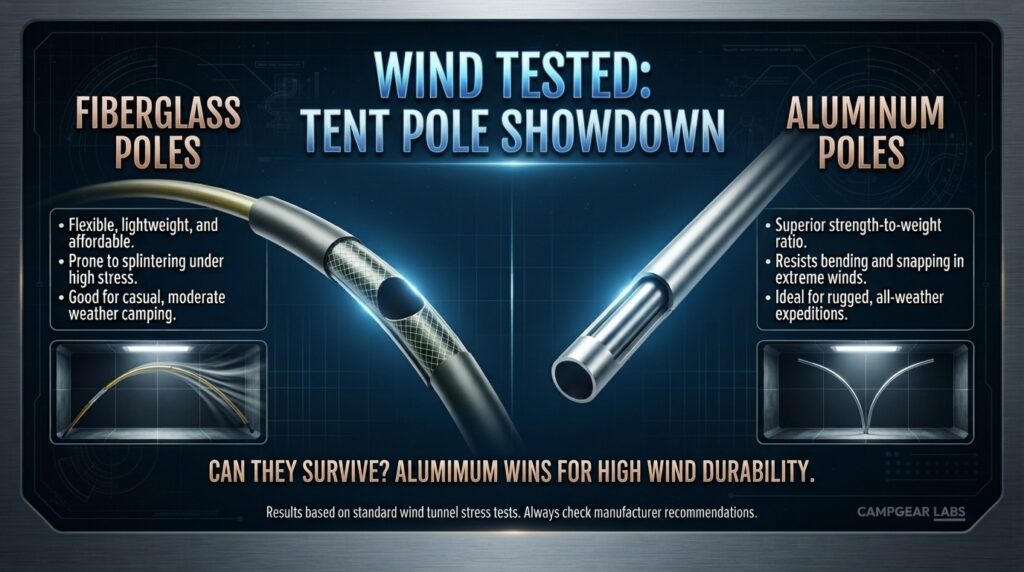
Fiberglass poles are constructed from fine glass fibers embedded in a resin matrix. They are inexpensive to produce, which is why they dominate budget, entry-level, and large family cabin tents.
- Flex Mechanics: Fiberglass is highly flexible and bends easily under minor loads. It flexes well when gentle tension is applied to create a classic dome shape.
- Weight Profile: Fiberglass is significantly heavier and denser than aluminum for equivalent strength.
- Temperature Sensitivity: In freezing conditions (common during autumn or early spring camping in Washington or New York), the resin in fiberglass becomes brittle, drastically reducing its impact resistance.
- Failure Mode: Under excessive bend radius or lateral force from wind, fiberglass does not bend permanently—it shatters and splinters longitudinally.
2. Aluminum Tent Poles: High Tensile Strength & Predictable Deformity
Aluminum poles—specifically modern aircraft-grade aluminum alloys such as 6061-T6, 7001-T6, and DAC Featherlite aluminum—are hollow, lightweight tubes treated for optimal strength-to-weight ratio.
- Flex Mechanics: High-grade aluminum offers controlled elasticity. It absorbs force by distributing energy along the arc of the pole structure.
- Weight Profile: Approximately 30% to 40% lighter than solid or thick-walled fiberglass poles while delivering substantially higher structural rigidity.
- Temperature Resilience: Aluminum remains structural stable across broad temperature extremes, performing reliably from desert heat in Texas to sub-zero alpine drops in the Sierra Nevada.
- Failure Mode: If forced past its maximum load threshold, aluminum bends or deforms, but rarely snaps or splinters. A bent aluminum pole still holds structural shape and can usually be field-repaired using a splint or repair sleeve.
Detailed Comparison: Tent Pole Materials Under Load
| Feature / Metric | Standard Fiberglass | Heavy-Duty Fiberglass (Wrapped) | Standard Aluminum (6061) | Aircraft-Grade Aluminum (7001 / DAC) |
| Wind Resistance Limit | 15–25 mph gusts | 25–35 mph gusts | 35–45 mph gusts | 50–65+ mph gusts |
| Failure Type | Splintering / Shattering | Longitudinal Splitting | Bending / Crimp | Deforms under extreme force |
| Can Be Field Repaired? | Extremely difficult (tape fails) | Difficult | Yes (Repair sleeve / splint) | Yes (Easy splint fix) |
| Weight | Heavy | Moderate-Heavy | Light | Ultra-lightweight |
| Cold Weather Performance | Poor (Gets brittle) | Fair | Good | Excellent |
| Price Point | Low ($) | Moderate ($$) | Moderate ($$) \vert{} Premium ($$$) | |
| Best Use Case | Backyard & Fair-weather | Mild car camping | Backpacking & 3-season | 4-season & Alpine / Coastal |
What Happens When Poles Encounter High Winds?
Wind force against a pitched tent does not exert a constant, static pressure. Instead, wind creates dynamic aerodynamic drag, uplift, and side-shear buffeting.
                                [ WIND GUST FORCE ]
                                         │
                                         ▼
                 ┌───────────────────────────────────────────────┐
                 │       IMPACT ON TENT POLE FRAMEWORK          │
                 └───────────────────────┬───────────────────────┘
                                         │
                   ┌─────────────────────┴─────────────────────┐
                   ▼                                           ▼
      [ FIBERGLASS FRAME ]                        [ ALUMINUM FRAME ]
       • Flexes past elastic limit                 • Flexes dynamically with gust
       • Fiber matrix separates                    • Distributes stress to guy lines
       • Longitudinal splintering                  • Bends slightly under extreme load
       • Sharp ends pierce rainfly                 • Structure holds; easily splinted
When wind hits your shelter, three critical mechanical interactions occur simultaneously:
1. Flex Compression & Arc Deformation
As wind presses into the rainfly, it forces the windward pole to flatten toward the ground.
- Fiberglass continues to bend until its internal resin snaps. Because it lacks ductile elongation, it reaches a point of immediate shearing, bursting into razor-sharp shards that frequently puncture the tent fabric, creating compounding damage.
- Aluminum flexes up to its yield point. If the gust exceeds its strength, it undergoes plastic deformation (it stays bent in a slight curve) but remains intact, allowing the tent to stay standing through the storm.
2. Joint Ferrule Stress
The weakest link in any pole assembly is the ferrule—the metal sleeve or insert connecting individual pole segments.
- Budget fiberglass poles typically use heavy, external metal ferrules glued onto the pole end. In high winds, these sharp ferrule edges act as leverage points, snapping the fiberglass directly at the joint.
- Quality aluminum poles utilize smooth, internal insert joints (or continuous pressing like DAC pressfit) that distribute bending torque evenly across the entire seam.
Regional Wind Demands: Why Location Matters
Depending on where you pitch your tent across North America, wind profiles present very different challenges:
1. Coastal California & San Francisco Bay Area
- Weather Profile: High afternoon ocean winds, salt spray, and sudden fog gusts along coastal bluffs (e.g., Big Sur, Marin Headlands).
- Pole Recommendation: Aluminum is essential. Continuous 30+ mph wind off the Pacific will quickly fatigue fiberglass poles, while salt moisture can degrade unsealed metal ferrules on cheap poles.
2. Texas Plains, Deserts & Gulf Coast
- Weather Profile: Unobstructed wind paths across West Texas (Caprock Canyons, Big Bend) and strong thunderstorm downdrafts along the Gulf Coast.
- Pole Recommendation: High-diameter Aluminum. Desert gusts routinely exceed 40 mph without trees to block wind shear. Coupled with heavy-duty ground anchors, aluminum poles prevent total canopy flattening.
3. Washington State Cascades & Pacific Northwest Rainforests
- Weather Profile: Heavy precipitation combined with mountain wind tunnels in passes and high alpine meadows (Mount Rainier, North Cascades).
- Pole Recommendation: Aluminum. Wet snow accumulation combined with wind loading puts enormous vertical weight on pole arcs. Fiberglass will buckle under wet snow weight.
4. New York Adirondacks, Catskills & Coastal Long Island
- Weather Profile: Rapid weather shifts, icy mountain ridges in autumn, and breezy Atlantic beachfront camping.
- Pole Recommendation: 7001-T6 Aluminum. Cold temperatures in the Northeast lower the threshold at which fiberglass splinters.
The Role of Tent Stakes in Protecting Pole Integrity
A common mistake campers make is blaming pole failure entirely on the pole material itself. In reality, your tent poles rely completely on your ground anchoring system to maintain their structural geometry.
If your tent stakes pull out of the ground during a gust, the entire tension system collapses, shifting all the wind load directly onto a single un-braced pole arc.
Pro Tip frombesttentstakes.com:
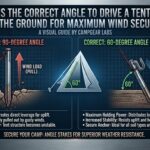
To maximize wind survivability, always pair your pole upgrade with heavy-duty Y-beam or spiral aluminum stakes drive-anchored at a 45-degree angle away from the tent. Ensure guy lines are attached directly to the pole-attachment loops on the rainfly, not just to the fabric perimeter. This transfers wind pressure off the fly cloth directly into the ground anchor.
Step-by-Step Upgrade Guide: How to Replace Fiberglass with Aluminum
If your favorite tent came with cheap fiberglass poles, you don’t need to buy an entirely new tent. You can retro-fit your shelter with a custom aluminum pole kit.
1.Measure Existing Fiberglass Pole Dimensions:Accuracy within 1mm is critical.
Disassemble your current fiberglass set. Measure the total overall length of the assembled pole arc from tip to tip. Then, use a caliper or ruler to measure the outer diameter (OD) in millimeters (common fiberglass sizes are 7.9mm, 8.5mm, 9.5mm, and 11mm).
2.Select the Equivalent Aluminum Outer Diameter:Match strength to tent size.
Because aluminum is stronger, you can generally select an aluminum pole set with a matching or slightly smaller diameter:
- Small 2-person tents: 8.5mm 7001-T6 Aluminum
- Medium 4-person tents: 9.5mm to 11mm 7001-T6 Aluminum
- Large 6-person+ cabin tents: 13mm to 16mm Heavy-Duty Aluminum
3.Order Replacement Pole Sections & Shock Cord:Custom length tailoring.
Purchase individual pre-cut aluminum pole sections, metal end tips, and standard 3mm elastic shock cord from reputable gear supply manufacturers or custom pole builders.
4.Assemble, Cut, and Tension the New Set:Tailor the final arc.
Feather the aluminum sections together. If the total length is slightly long, use a tubing cutter or fine-toothed hacksaw to trim the end section. Thread the elastic shock cord through the interior hollow core, tie off knot tension at both end-tips, and test fit on your tent inner body.
7 Essential Field Tips for Surviving Wind in Any Tent
Regardless of whether you use fiberglass or aluminum, practicing proper pitch technique drastically increases your shelter’s chances of surviving high winds:
- Pitch the Narrowest Profile into the Wind: Align the lowest, most aerodynamic end of your tent (usually the foot box on backpacking tents) directly facing the oncoming wind direction to reduce frontal drag surface.
- Pre-Guy Every Tie-Out Point: Do not wait for the wind to pick up at 2 AM. Stake out every single guy line loop during initial setup.
- Use the Right Stakes for the Terrain: In loose sand or snow, standard hook stakes fail immediately. Use broad snow/sand anchors or heavy-duty Y-pegs driven flush with the ground.
- Keep Windows and Vents Zip-Closed on the Windward Side: If wind enters the interior of your tent, it acts like a parachute, blowing the canopy open from the inside out and placing double the stress on the poles.
- Carry an Emergency Aluminum Repair Sleeve: Always store a 2-inch hollow aluminum repair tube in your stake bag. If an aluminum pole bends or a fiberglass pole cracks, slide the sleeve over the damaged section and wrap with duct tape for an immediate field fix.
- Clear Overhead Hazards: Pitch clear of dead tree limbs (“widowmakers”) that could snap in high winds and crash onto your framework.
- Use Tensioners or Prusik Knots: Keep guy lines drum-tight. Slack lines allow wind gusts to build up momentum before impacting the tent frame, increasing shock forces.
10 Frequently Asked Questions (FAQ)
FAQ 1: Can fiberglass tent poles be repaired if they crack in the wind?
Fiberglass poles are very difficult to repair effectively in the field. Wrapping duct tape over a splintered fiberglass pole rarely holds structural tension under wind load. While you can temporarily splint them with a metal repair sleeve, individual damaged fiberglass sections usually need to be replaced completely once cracked.
FAQ 2: Are aluminum tent poles noisy in high wind compared to fiberglass?
Aluminum poles can transfer slightly more vibration sound through the frame when buffeted by strong gusts, but they do not creak or groan under flex as loudly as stress-fatigued fiberglass poles. Proper guy line tension eliminates most frame rattle.
FAQ 3: Will upgrading to aluminum poles make my tent 100% windproof?
No tent is completely windproof without proper pitch orientation, robust tent stakes, and aerodynamic design. However, upgrading to aluminum poles significantly increases your tent’s structural threshold, raising wind survival limits from ~20 mph up to 45–50+ mph when properly guyed out.
FAQ 4: How much does it cost to upgrade fiberglass poles to aluminum?
A complete DIY aluminum replacement set for a standard 2-to-4-person dome tent typically costs between $35 and $70, depending on pole diameter and grade. Considering this upgrade can save a $200–$400 tent from destruction, it is a very cost-effective investment.
FAQ 5: What is the difference between 6061 and 7001 aluminum tent poles?
- 6061 Aluminum: Standard commercial-grade alloy. It is affordable and flexible, but heavier and easier to bend permanently under strain.
- 7001-T6 Aluminum: Zinc-alloyed aerospace aluminum with higher yield strength and ultimate tensile strength. It offers superior elasticity, lighter weight, and snaps back to shape far better after severe wind loading.
FAQ 6: What are DAC tent poles, and why are they so popular?
DAC (Dongah Aluminum Corp) is the premier global manufacturer of high-end outdoor architectural poles. Their patented alloys (like DAC Featherlite NSL and Pressfit) eliminate heavy internal ferrules, drastically reducing weight while maximizing strength along continuous arcs. They are featured on top-tier mountain and expedition tents.
FAQ 7: Do aluminum tent poles rust in rainy climates like Washington State?
Aluminum does not rust like steel or iron. However, it can undergo surface oxidation if stored wet for long periods. High-quality aluminum tent poles are anodized with a protective outer coating that prevents corrosion and seals the metal against rain and salt air.
FAQ 8: Why do budget tents still come with fiberglass poles?
Manufacturing fiberglass poles costs a fraction of the price of machining high-strength anodized aluminum. For casual backyard campers, summer car camping, or dry fair-weather conditions, fiberglass provides an economical option that keeps overall retail tent prices low.
FAQ 9: Are carbon fiber tent poles better than aluminum for wind resistance?
Carbon fiber poles are ultra-lightweight and extremely stiff, making them popular for ultralight long-distance backpacking. However, under extreme lateral wind shear or blunt impact, carbon fiber behaves similarly to fiberglass—it can shatter without warning. Aluminum remains preferred for maximum high-wind durability due to its ductile bending ability.
FAQ 10: How do I know if my tent poles are about to fail during a storm?
Warning signs of imminent fiberglass pole failure include loud creaking noises, visible flattening of the dome shape that fails to rebound when the gust passes, and white stress cracks appearing along the resin surface. If your tent is collapsing inward on every gust, you should safely evacuate or drop the tent body to protect the fly.
Conclusion
If you only camp twice a year in calm summer weather, standard fiberglass tent poles will get the job done. However, if you camp in open terrain across Texas, coastal California bluffs, breezy PNW mountain ridges, or unpredictable Northeastern parks, upgrading to high-grade aluminum poles is one of the smartest gear investments you can make.
Aluminum poles deliver superior strength-to-weight ratios, reliable flex memory under heavy gusts, cold-weather resilience, and field-repairable peace of mind. Combine an aluminum frame with high-performance ground anchors from besttentstakes.com, and your shelter will stand firm through whatever storms roll across your campsite.