Why did my tent’s rainfly rip off even though my stakes stayed firmly in the ground?

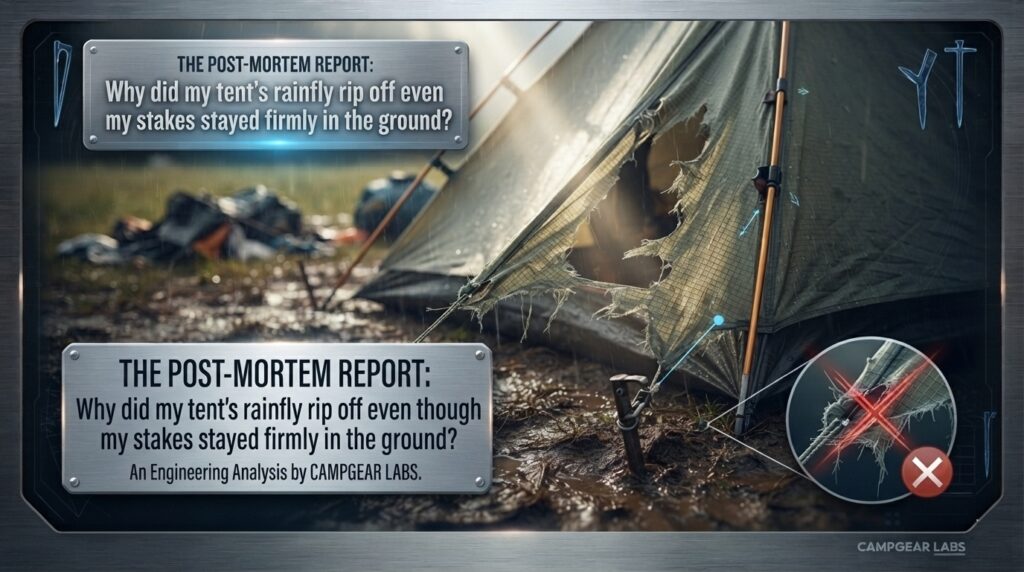
It is one of the most frustrating experiences in outdoor recreation: you pitched your tent, drove your heavy-duty stakes deep into the earth at the correct angle, and checked that every guyline was secure. Yet, when a late-night storm front swept through camp, you awoke to the sound of tearing fabric—leaving your stakes solidly embedded in the mud while your rainfly blew away or shredded along its seams.
At besttentstakes.com, campers often ask us why their rainfly failed when their ground anchors performed perfectly. The answer comes down to a fundamental principle of structural engineering: When ground anchors do not yield under extreme dynamic loads, 100% of the kinetic force shifts directly to the next weakest link in the system—the fabric, stitching, webbing loops, and pole structure.
In this comprehensive guide, we analyze the physics of wind uplift, fabric fatigue, point-load stress concentrations, environmental variables across key US camping regions (Texas, California, Washington, and New York), field repair methods, and 10 detailed FAQs to ensure your shelter survives high-wind events.
The Physics of Rainfly Failure: Aerodynamic Lift & Stress Transfer
To understand why a rainfly tears away while stakes remain anchored, you must look at how aerodynamic forces interact with a pitch-tensioned structure.
                           [ HIGH-SPEED WIND GUST ]
                                      │
                                      ▼
                        ┌───────────────────────────┐
                        │ Dynamic Pressure / Lift   │
                        └─────────────┬─────────────┘
                                      │
             ┌────────────────────────┴────────────────────────┐
             ▼                                                 ▼
  [ GROUND ANCHORS (STAKES) ]                     [ RAINFLY FABRIC & SEAMS ]
  • Solid hold (0% yield)                         • Absorbs 100% of shock force
  • Zero mechanical give                          • Point-load concentration at tie-outs
  • Result: Anchors hold fast                     • Result: Stitching shears or fabric tears
1. Bernoulli’s Principle & Wind Lift
When wind hits a pitched tent, it is forced upward and over the curved canopy. According to Bernoulli’s principle, air moving rapidly over a curved surface creates a sudden drop in air pressure above the tent compared to the ambient pressure inside the tent.
This pressure differential generates aerodynamic lift—the exact same force that allows airplanes to fly. Under 40+ mph wind gusts, a typical 4-person tent rainfly can experience over 150 to 200 pounds of upward suction force.
2. The Anchor Paradox (Zero Yield = High Stress Concentration)
If your tent stakes yield slightly or pull out during a massive gust, that mechanical movement acts as a pressure release valve, dissipating kinetic energy.
However, when you use ultra-high-performance stakes (such as Y-beam pegs or deadman anchors in hard ground), the ground points will not move. As a result:
- The guyline remains completely rigid.
- The kinetic force of the wind gust cannot be absorbed by the ground anchor.
- The entire load instantly transfers to the tiny 1/2-inch bar-tack stitching connecting the guyline loop to the rainfly fabric.
3. Flutter Fatigue & Shear Force
In high wind, a rainfly that isn’t pulled completely flat will experience rapid micro-vibrations known as flutter. Fluttering creates cyclic tension spikes hundreds of times per minute. This continuous snapping motion weakens polyester or nylon fibers at the atomic level, leading to sudden catastrophic shear tearing along seam lines.
Top 5 Structural Causes of Rainfly Failure
| Failure Factor | Primary Cause | Primary Weak Point | Preventive Fix |
| Point-Load Concentration | Guyline tied directly to rigid web loop without load distribution | Bar-tack stitching on rainfly corner | Add 1/8″ shock cord loops to absorb shock spikes |
| UV Degradation | Extended sun exposure breaking down nylon/polyester polymer chains | Middle fly panels and high-tension seams | Apply UV-inhibitor spray (e.g., Nikwax SolarProof) |
| Wind Scooping (Buffeting) | Wind entering underneath an un-staked vestibule or high fly gap | Zipper seams and underside tie-outs | Pitch rainfly low to the ground on windward side |
| Fabric Hydrolysis | Storing tent damp or prolonged exposure to high humidity | Polyurethane (PU) waterproof coating | Dry thoroughly before storage; choose silpoly/silnylon |
| Uneven Guyline Tension | Two guylines taking 90% of storm load while others sit slack | Windward corner webbing loops | Balance guyline tension across all perimeter anchor points |
Regional Storm Dynamics: Why Rainflies Tear Across the US
Different environments create unique atmospheric challenges that degrade or destroy rainfly fabrics:
1. Texas (Caprock Canyons, Hill Country & Gulf Coast)
- Environmental Threat: Intense solar UV radiation combined with sudden, severe thunderstorm downbursts (microbursts).
- Why Rainflies Fail: Texas sun bakes rainfly polyester, reducing tear strength by up to 40% in a single season. When a 50 mph thunderstorm microburst strikes, the sun-weakened fabric snaps instantly along tension lines.
2. San Francisco & Coastal California (Pacific Bluffs & Bay Area Winds)
- Environmental Threat: Persistent, directional wind shear (25–40+ mph) combined with dense ocean fog.
- Why Rainflies Fail: Ocean fog saturates silnylon flies, causing them to stretch and sag. As the fly sags, wind gets underneath the fabric (“wind scooping”), generating massive internal uplift that tears tie-out points away from the poles.
3. Washington State (Cascade Ridges & Rainforest Valleys)
- Environmental Threat: High-altitude mountain squalls, driving rain, and wet snow loading.
- Why Rainflies Fail: Heavy precipitation increases the total weight resting on the canopy, while violent ridge gusts push sideways. The combination of heavy downward load and violent sideways buffeting shears fly stitching near pole attachment points.
4. New York (Adirondack Peaks, Catskills & Long Island Bluffs)
- Environmental Threat: Rapid temperature drops, icy squalls, and rocky terrain that prevents ideal guyline geometry.
- Why Rainflies Fail: Sub-freezing temperatures cause polyurethane coatings to become brittle. When gusty winds flex a cold-brittle fly fabric, microscopic micro-fractures propagate into full-length tears.
Step-by-Step Guide: How to Storm-Proof Your Rainfly
Follow this field sequence to ensure your rainfly stays attached even when your ground stakes are locked solid into the soil:
1.Pitch the Shelter Profile Low and into the Wind:Prevent wind from getting underneath.
Identify prevailing wind direction. Orient the lowest, most aerodynamic end of your tent directly into the wind, and stake the windward rainfly edges flush against the ground to prevent wind from scooping underneath.
2.Install Shock-Cord Loops at Every Guyline Tie-Out:Add an inline shock-absorption buffer.
Never tie static guyline cord directly to fabric webbing loops. Interpose a 6-inch loop of 1/8-inch heavy-duty elastic shock cord. This stretches under peak gusts, absorbing up to 50% of kinetic shock before it reaches the fabric seams.
3.Engage All Internal Frame Hook-and-Loop Tabs:Transfer load to internal frame.
On the underside of your rainfly, secure every hook-and-loop (Velcro) tab directly around the aluminum tent poles. This crucial step transfers wind loads off the fly fabric and directly onto the rigid structural frame.
4.Guy Out 100% of Perimeter Tie-Out Points:Balance structural tension evenly.
Do not rely on corner stakes alone. Deploy every secondary guyline on the rainfly, keeping tension balanced so no single tie-out point bears the brunt of the storm load.
7 Pro Tips to Protect Your Rainfly in Severe Weather
- Use Internal Pole-Ties Without Exception: Skipping the underside Velcro tabs on your rainfly is the #1 reason flies tear away. These tabs align the fly with the poles, using the pole strength to back up fabric seams.
- Treat Fabric with UV Protection Annually: Spray your rainfly once a season with a UV-blocking waterproofing spray (such as Nikwax SolarProof) to prevent solar breakdown of synthetic fibers.
- Never Over-Tension Static Lines with Ratchet Locks: Applying excessive mechanical force with line locks or ratchet pulleys can pre-stress fly seams to near breaking point before the wind even hits.
- Use Fabric Reinforcement Patches on Older Tents: If your tent is over 3 years old, apply gear repair tape (like Tenacious Tape) to the inside of high-stress corner webbing attachments to reinforce aging bar-tack stitching.
- Close All Vestibule Zippers in High Wind: Leaving a vestibule door partially unzipped allows wind to inflate your rainfly like a hot air balloon, creating massive internal pressure that can rip zippers and seams apart.
- Integrate Bungee Dampeners on Static Dyneema Lines: If using zero-stretch Dyneema guylines, always incorporate inline bungee dampeners to prevent rigid kinetic shocks.
- Inspect Seam Tape Regularly: Flaking or peeling seam tape indicates coating degradation, which weakens the surrounding fabric weave under high shear strain.
10 Frequently Asked Questions (FAQ)
FAQ 1: Why did my rainfly tear if my stakes held completely solid?
When stakes refuse to give way under wind load, 100% of the kinetic energy from wind gusts is transferred directly into the guyline, tie-out webbing, and rainfly fabric. Without a shock-absorbing element, the stress exceeds the tensile strength of the fabric or stitching, causing it to tear.
FAQ 2: What is the difference between silnylon and silpoly tear strength?
Nylon generally has higher raw tensile and tear strength than polyester of equal weight. However, silnylon absorbs water and stretches when wet, whereas silpoly (silicone-coated polyester) resists stretching and hydrophobic breakdown, holding stable tension in rain storms.
FAQ 3: How can I prevent my rainfly from fluttering in high winds?
Flutter is caused by uneven or insufficient line tension. Ensure all perimeter guylines are deployed at proper 45-degree angles, maintain balanced tension across all sides, and use self-tensioning shock cords to eliminate overnight fabric sag.
FAQ 4: Does sun exposure really make tent fabric tear easier?
Yes. Ultraviolet (UV) radiation breaks down the synthetic polymer chains in nylon and polyester. After 60 to 90 days of cumulative sun exposure, untreated tent fabric can lose up to 50% of its original tear strength.
FAQ 5: Can I repair a torn rainfly while in the backcountry?
Yes. Clean the damaged area with an alcohol wipe, pull the tear edges flush, and apply heavy-duty outdoor repair tape (such as Tenacious Tape or silnylon patches) to both the inside and outside surfaces of the fabric, pressing firmly to eliminate air bubbles.
FAQ 6: What are internal rainfly Velcro tabs, and why are they important?
Internal Velcro tabs are located on the underside of the rainfly and wrap directly around the tent poles. They transfer wind pressure directly from the fabric onto the aluminum pole architecture, preventing guyline tie-outs from ripping off the fly.
FAQ 7: Should I loosen my guylines if the wind gets extremely violent?
No, do not leave guylines loose. Loose lines allow the fly to flap violently, building up momentum that causes severe shock-load spikes. Instead, keep lines taut but add elastic shock-cord dampeners to absorb kinetic spikes smoothly.
FAQ 8: Is a dome tent or a tunnel tent better at preventing rainfly tears?
Geodesic dome tents handle multidirectional wind gusts better because their crossing poles distribute load evenly across multiple fabric panels. Tunnel tents are aerodynamic when pitched directly into the wind, but are vulnerable to lateral wind shear if the wind direction shifts.
FAQ 9: Why did the stitching pull out of the webbing loop instead of the fabric tearing?
Bar-tack stitching can fail if thread degrades over time or if shear force is applied at an off-angle. When guylines pull sideways relative to the webbing reinforcement patch, force concentrates on the first row of stitching rather than distributing across the entire bar-tack grid.
FAQ 10: Where can I find ground anchors and tensioning accessories that protect my tent setup?
High-quality Y-beam stakes, spiral anchors, and shock-dampening guyline accessories engineered for demanding soil conditions can be found at besttentstakes.com.
Conclusion
A torn rainfly is rarely the fault of a single gust—it is usually the result of unmitigated stress transfer. When your ground stakes hold fast in high winds, the kinetic energy must go somewhere. If your setup lacks shock absorption, aerodynamics, or proper internal frame attachment, that energy will focus directly on the delicate seams of your fly.
By using shock-cord dampeners, attaching internal pole tabs, maintaining balanced guyline tension, and pairing your setup with top-grade hardware from besttentstakes.com, you can ensure your entire shelter system—from ground anchor to rainfly peak—survives even the toughest weather events across Texas, California, Washington, New York, and beyond.