What should I do if my tent stakes keep pulling out in high wind?

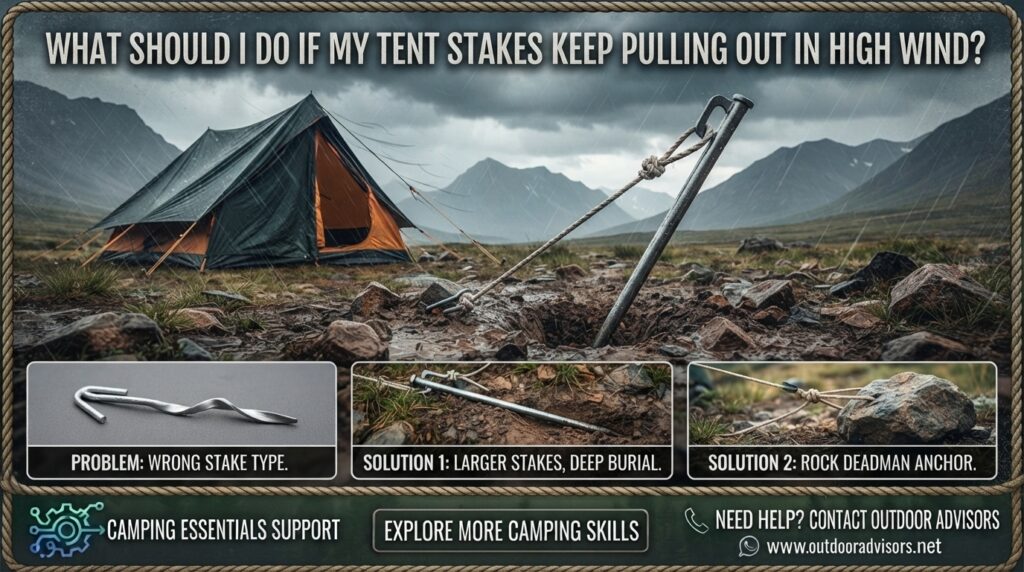
Few campsite experiences are as stressful as hearing your tent fly flap violently at 2 AM, followed by the metallic clatter of a tent stake ripping out of the ground. High wind exerts tremendous uplift and horizontal shear forces on a shelter. When the ground is too soft, too rocky, or the wind is gusting past 30 mph, standard hook stakes fail.
If your tent stakes keep pulling out in high wind, you need to correct your stake placement angle, upgrade to high-holding-power Y-beam or sand/snow stakes, or transition to alternative anchoring techniques like “deadman” anchors and heavy rock backing.
This comprehensive guide breaks down immediate field fixes, terrain-specific anchoring strategies across key US camping regions (from Texas plains to the windy Pacific Northwest), top stake product comparisons, and advanced pitch setups to ensure your shelter stays grounded during gale-force weather.
1. Immediate Field Fixes: What to Do Right Now
If you are currently in the field and your stakes are popping loose under heavy gusts, implement these five immediate adjustments:
1. Re-Drive Stakes at a 45-Degree Angle
Never drive tent stakes straight down into the ground or angled toward the tent.
- Correct Position: Drive the stake into the soil at a 45-degree angle pointing away from the tent.
- The Physics: Placing the stake at a 45-degree angle ensures that tension from the guyline pulls against the full surface area of the stake and the surrounding soil column, rather than lifting the stake straight up out of its hole.
2. Flush-Drive to Ground Level
Leaving several inches of the stake exposed creates leverage. High winds toggle the exposed top back and forth, widening the hole until the stake slips free. Drive the stake until the head is flush with the soil, leaving only the attachment loop above ground.
3. Deploy the “Big Rock on Top” Method (BROT)
If the soil is loose or saturated, driving the stake deeper isn’t enough.
- Drive your stake at a 45-degree angle flush to the ground.
- Find a rock weighing at least 15–20 pounds.
- Place the rock directly over the top of the stake head and the guyline loop.
- Place a second smaller rock in front of the stake to prevent the line from fraying against sharp edges.
4. Create a “Deadman” Anchor
When soil or sand is so loose that stakes pull straight out, bury them horizontally.
- Tie your guyline around the center of your tent stake (or a sturdy 12-inch log/stick) using a Clove Hitch or Bowline.
- Dig a trench 6 to 12 inches deep perpendicular to the pull of the guyline.
- Bury the stake horizontally in the trench, pack soil or sand firmly over it, and weigh the spot down with heavy rocks.
5. Double-Stake in a “V” Pattern
If you lack heavy rocks or deep soil, use two stakes per guyline:
- Drive two stakes into the ground about 12 to 18 inches apart, forming an inverted “V” pointing toward the tent.
- Loop the guyline around both stakes or connect them with an auxiliary loop of accessory cord to distribute the wind load across two ground points.
2. Choosing the Right Stake Profile for High-Wind Terrain
Standard cheap shepherd’s crook stakes (the thin steel or aluminum wire rods included with basic tents) have near-zero holding power in high wind. Switching to an engineered stake profile dramatically reduces stake pull-outs.
| Stake Profile Type | Holding Power | Weight | Best Ground Conditions | High Wind Effectiveness |
| Y-Beam / Tri-V | Exceptional | Light (0.4–0.6 oz) | Packed dirt, forest soil, rocky soil | High — 3 blades resist twisting and uplift |
| Sand & Snow (Scoop/Concave) | Extreme | Moderate (1.0–2.0 oz) | Loose sand, fine gravel, deep snow | Extreme — Large surface area packs soil |
| Nail / Titanium Pin | Low–Moderate | Ultra-light (0.2–0.3 oz) | Solid rock, hardpan, frozen ground | Low — Best for piercing, weak against high shear |
| Spiral / Screw | Very High | Heavy (2.0–4.0 oz) | Turf, dense soil, coastal grass | High — Threading anchors directly into soil matrix |
| Shepherd’s Hook | Very Low | Light (0.3–0.5 oz) | Mild lawn camping only | Poor — Rotates and pulls out easily under load |
3. High-Wind Pitching Protocols Across Target US Regions
Wind behavior and ground density vary drastically depending on where you pitch your tent. Below are specialized strategies tailored for distinct environmental profiles across North America.
Texas: Coastal Plains & Desert West Texas (Big Bend, Caprock Canyons)
- Terrain Challenges: Highly variable conditions ranging from soft coastal beach sand along the Gulf to baked clay, caliche, and loose desert topsoil in West Texas.
- Wind Profile: Sustained prairie winds with sudden 40+ mph gusts during frontal passages.
- Strategy: On hard caliche, standard stakes won’t penetrate. Use heavy titanium nail stakes driven with a rock. In soft sand or loose desert soil, switch to wide Y-beam stakes (like Groundhogs) or bury deadman anchors using canvas sand bags filled on-site.
California & San Francisco Bay Area: Coastal Bluffs & Sierra Nevada Alpine
- Terrain Challenges: Windy coastal headlands (San Francisco, Marin Headlands) with damp, loose loam, or high-altitude Sierra granite with minimal soil cover.
- Wind Profile: Strong marine breezes along the coast; turbulent, unpredictable katabatic mountain winds above timberline.
- Strategy:
- Bay Area / Coastal: Moisture softens topsoil, causing stakes to slice through ground. Use longer 9-inch Y-beam stakes to reach denser subsoil.
- High Sierra: You often cannot drive stakes into solid granite. Use the “Little Rock, Big Rock” system: tie your guyline around a fist-sized rock, place it on the ground, and stack a 25+ lb boulder directly on top of the line.
Washington State: Olympic Coast & Cascade Range
- Terrain Challenges: Saturated forest duff, thick moss cover, mud, and loose river gravel.
- Wind Profile: Wet Pacific storm systems bringing heavy rain combined with prolonged gale-force wind.
- Strategy: Waterlogged topsoil drastically reduces stake friction. Standard 6-inch stakes pull out easily through mud. Upgrade to 10-to-12-inch sand/snow stakes or spiral screws that reach beneath the soft duff layer into consolidated earth. Always back up forest stakes with heavy logs or downed timber laid across the guyline anchor points.
New York: Adirondacks, Catskills & Coastal Long Island
- Terrain Challenges: Extremely rocky, root-dense mountain soil in the north; soft, shifting sandy loam along Southern/Long Island beaches.
- Wind Profile: Nor’easters bringing heavy moisture and gusty ridge winds.
- Strategy: Mountain root systems disrupt stake trajectory. Use slim, high-strength forged aluminum nail stakes that can pierce past small roots and rock seams. For Long Island coastal sites, use snow/sand scoop stakes placed in a deadman position.
4. Product Reviews: The 4 Best High-Wind Tent Stakes
When high winds threaten your shelter, investing in high-grade aftermarket stakes is the most cost-effective insurance policy you can buy. Here are the top four high-wind stakes tested for holding power, durability, and weight.
1. MSR Groundhog Tent Stake (Standard & Mini)
- Material: 7000-series Aluminum
- Design: Y-Beam design
- Weight: 0.46 oz (Standard) / 0.35 oz (Mini)
- Overview: The undisputed benchmark for general backpacking and high-wind stability. The three-flanged Y-beam shape provides immense resistance to bending and maximizes surface contact in packed dirt, gravel, and rocky soil.
- Pros: Unmatched holding-power-to-weight ratio; durable notch holds guylines tightly.
- Cons: Hard to pull out of dry clay without the attached cord loop.
2. Big Agnes Dirt Dagger UL Stake
- Material: Ultralight Aircraft Aluminum
- Design: Patent-pending modified I-Beam structure
- Weight: 0.32 oz (6 inch) / 0.53 oz (7.5 inch)
- Overview: Designed specifically for high-strength tensioning on lightweight shelters. The wide spine construction offers high torsional strength, allowing you to hammer it into hard soil without bending.
- Pros: Extremely rigid; smooth edges prevent guyline wear; high holding power in dense turf.
- Cons: Pricier than standard stakes.
3. MSR Cyclone Tent Stake
- Material: 7005-Series Aluminum
- Design: Twisted / Spiral Y-Beam (9 to 10 inches)
- Weight: 1.2 oz
- Overview: Built explicitly for soft soils, sand, and high-wind environments where standard straight stakes slip out. The twisted design screws into the earth as it is driven, locking the stake into place.
- Pros: Exceptional holding force in mud, rain-soaked earth, and sand; long length anchors deep.
- Cons: Too heavy for minimalist ultralight thru-hiking.
4. Titanium Shepherd’s Hook & Nail Stakes (Toaks / Vargo)
- Material: Grade 5 Titanium
- Design: Round Nail Pin with flat head
- Weight: 0.22 oz – 0.40 oz
- Overview: Ideal for extreme hardpack, frozen ground, or alpine granite fissures where thick aluminum stakes buckle. While pin stakes have lower surface area than Y-beams, their ability to penetrate deep into tough soil gives them solid holding power where other stakes fail completely.
- Pros: Virtually indestructible; pierces hardpack and roots easily.
- Cons: Low holding power in loose sand or wet mud unless backed by rocks.
5. Advanced Pitching & Aerodynamic Tips to Reduce Wind Load
Improving stake performance is only half the battle. You can significantly reduce the force applied to your stakes by optimizing your shelter’s pitch aerodynamics.
                  WIND DIRECTION --->

                    / \               (Position narrowest, lowest rear profile
                   /   \               into the wind to shed airflow)
                  /     \
                 /       \
  [Stake] ------/---------\------ [Stake]  <-- Guylines angled 45°
- Orient the Lowest Profile Into the Wind: Always pitch tunnel tents or asymmetric dome tents so the lowest, narrowest rear section faces directly into the prevailing wind. Never let wind hit the broad side of your tent, which turns your rainfly into a massive sail.
- Utilize Every Single Guyline Point: Most campers only stake out the main corners. In high winds, deploy every factory guyline attachment point on your rainfly. Spreading the wind load across 8 to 12 anchor points reduces the stress on any single stake by up to 60%.
- Add Internal Guyline Supports: If your tent poles flex excessively in heavy gusts, tie auxiliary cordage around the pole intersections inside the rainfly and anchor them directly to external stakes. This transfers structural strain directly to the ground.
- Use Shock-Absorbing Guyline Loop Bungees: Tying small, heavy-duty elastic shock cords between your guyline and your stake creates a dampening system. The elastic absorbs sharp wind gust impacts, preventing sudden snap forces from pulling stakes out of the ground.
6. Frequently Asked Questions (FAQ)
Q1: Should tent stakes be angled toward or away from the tent?
Stakes should always be angled 45 degrees away from the tent. Angling the stake away forces the guyline’s tension to pull against the solid ground column behind the stake. If you angle the stake toward the tent, line tension will pull the stake straight up out of the hole.
Q2: How deep should I drive my tent stakes?
Drive your tent stakes into the ground until the top of the stake is completely flush with the soil surface. Leaving 2 to 3 inches of the stake exposed creates a lever arm that allows wind to wiggle the stake, loosening the soil until the stake pulls out.
Q3: What is the best tent stake for high winds in sand or snow?
The best stakes for sand or snow are wide, concave scoop stakes (such as 9-to-12-inch aluminum snow/sand anchors) or deadman anchors. Broad surface area is required to pack loose particles and resist pullout forces.
Q4: Why do my stakes keep bending when I drive them in?
Stakes bend when hit against hidden rocks or tree roots with improper force, or when using weak aluminum hook stakes. To prevent bending, use a high-strength Y-beam (MSR Groundhog) or titanium nail stake, and tap gently with a rock or mallet rather than stomping on the stake with heavy boots.
Q5: What should I do if the ground is pure rock and I can’t drive a stake at all?
Use the “Rock-out” or “Little Rock, Big Rock” method. Tie your tent guyline around a small, fist-sized rock. Place that rock on the ground, then stack a large, heavy rock (20+ pounds) directly on top of the guyline behind the smaller rock to anchor the line securely.
Q6: Does tent shape affect how easily stakes pull out?
Yes. Tents with steep, flat, vertical walls (like cabin-style camping tents) catch the wind like a sail, putting immense strain on stakes. Low-profile dome, geodesic, or tunnel tents deflect wind smoothly over the structure, dramatically reducing uplift forces on ground anchors.
Q7: Can I use sticks as tent stakes in an emergency?
Yes. Find sturdy hardwood branches about 1 inch thick and 8 to 12 inches long. Sharpen one end into a point and notch the top end to catch the guyline. Alternatively, bury the stick horizontally as a deadman anchor for maximum strength in soft ground.
Q8: Should I leave my guyline tensioners completely tight during a storm?
Keep guylines snug, but avoid over-tightening them to the point where the tent fabric or seam stitching is stressed. A slight amount of flex allows the shelter to absorb wind gusts. Using elastic shock-absorber loops on your guylines is the best way to handle sudden stress peaks.
Q9: What is the difference between a Y-beam stake and a Shepherd’s hook stake?
A Shepherd’s hook stake is a simple smooth wire rod with a bent top that rotates easily and pulls out under low force. A Y-beam stake features three distinct structural fins that bite into three planes of soil simultaneously, offering up to 300% more holding power against uplift and twisting.
Q10: How do I remove a deep Y-beam stake stuck in frozen or hard ground without snapping the cord?
Loop a spare piece of cordage or another stake through the notch or pull-loop of the stuck stake. Pull straight up along the entry axis while gently tapping the side of the stake with a rock to break the soil seal. Never pull laterally on the guyline loop of your tent to extract a stuck stake.
Conclusion
When high winds hit your campsite, pulling stakes are not an inevitable disaster—they are a sign of improper stake selection, bad placement geometry, or inadequate anchoring for the local soil conditions. By switching to high-surface-area Y-beam or spiral stakes, driving anchors flush at a 45-degree angle away from your shelter, and deploying rock backups or deadman anchors in challenging conditions, you can comfortably ride out severe weather anywhere you pitch your tent.