What should I do if the ground is pure rock and I can’t drive a stake at all?

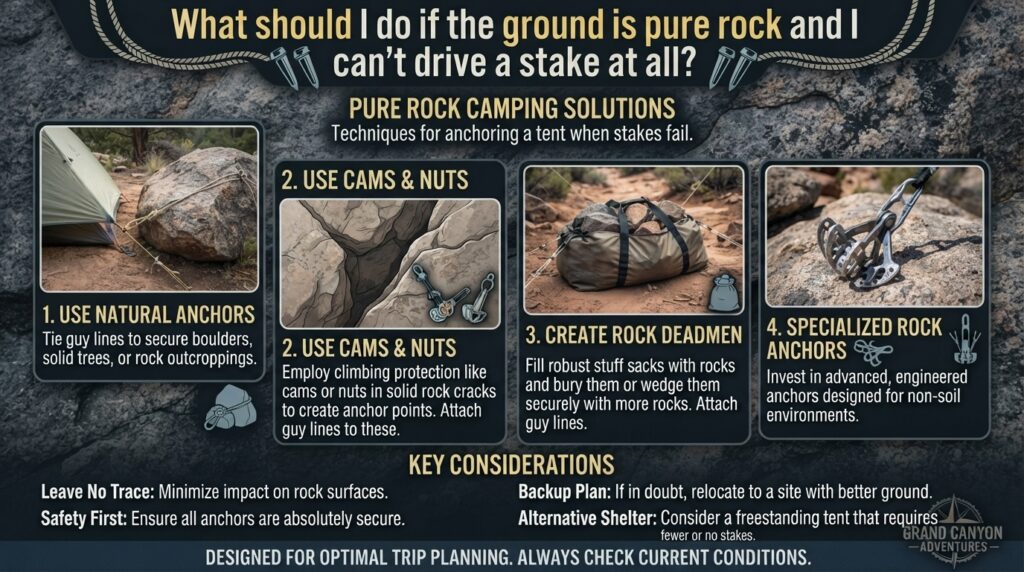
Pitching a tent on pure granite, exposed bedrock, sandstone ledges, or dense river gravel is one of the most frustrating challenges in backcountry camping. Whether you are pitched high in the Sierra Nevada mountains of California, setup on the granite slabs of the North Cascades in Washington, or facing the rugged terrain of West Texas and the Adirondacks in New York, encountering solid ground where traditional tent stakes simply bend or rebound is exceptionally common.
When you cannot drive a stake into the ground, you must shift your mindset from ground insertion to deadweight anchoring and leverage.
This comprehensive guide breaks down step-by-step field techniques, advanced rigging protocols, the best alternative equipment, and expert strategies to ensure your shelter remains rock-solid—even in high-wind conditions on pure rock.
1. The Core Solution: The “Big Rock / Little Rock” Method
The single most effective, reliable, and field-tested technique for pitching a shelter on solid bedrock is known as the Big Rock / Little Rock (or “Little Rock, Big Rock”) anchor system.
                     [ Tent Corner / Guy Line ]
                                 |
                                 v
                         +---------------+
                         |  LITTLE ROCK  |  <--- Acts as the toggle/stop
                         +---------------+
                                 |
                 ================================= (Guy Line / Paracord)
                                 |
                       +-------------------+
                       |     BIG ROCK      |  <--- Acts as the heavy deadweight
                       +-------------------+
Step-by-Step Rigging Instructions:
- Find Your Anchor Points: Extend your tent’s corner webbing loops or guy lines outward at a 45-degree angle from the tent walls.
- Select the Little Rock (The Toggle): Find a smooth, fist-sized rock or stick. Tie a loop around it using your guy line or a clove hitch knot.
- Position the Little Rock: Place this smaller rock at the maximum length of your tensioned guy line.
- Select the Big Rock (The Deadweight): Find a large boulder or slab weighing at least 15 to 25 pounds (7–11 kg).
- Lock the Line: Place the Big Rock directly on top of the guy line, positioned immediately behind (tent-side) the Little Rock. When the wind pulls on the tent, the Big Rock holds the line down, while the Little Rock acts as a stopper that prevents the line from slipping out under pressure.
Pro Tip: Always place a piece of spare cloth, canvas, or a sock under sharp rock edges to prevent friction from sawing through your guy lines during heavy night winds.
2. Alternate Non-Stake Anchoring Techniques
When large rocks are scarce or the environment presents unique constraints, use these proven alternative anchoring methods:
A. The Wooden Log / Branch Anchor
- Best For: Forested rock outcrops (e.g., Eastern New York or Olympic National Park, Washington).
- Execution: Wrap line extensions around fallen trees or thick logs. Roll the log outward until tension is achieved, then brace it with smaller stones to keep it from rolling back toward the tent.
B. Crevice & Crack Anchoring (Chocks & Nuts)
- Best For: Fractured bedrock, granite slabs, and alpine cols.
- Execution: If you carry climbing hardware or thin sticks, jam a rock/stick wedge (a “chock”) into a tight rock fissure. Tie your guy line around the wedge; when pulled, it locks into the wedge-shaped crack.
C. Sandbag / Gear-Bag Deadman Anchors
- Best For: Slickrock (e.g., Moab, Utah or Texas desert basins) where loose stones aren’t available.
- Execution: Fill your tent stuff sacks, dry bags, or shopping bags with small river gravel or sand. Tie your guy lines to the sack handles and use them as heavy counterweights.
3. Recommended Gear for Rocky Terrain
While standard J-hook wire stakes are useless on rock, carrying the right specialized equipment can make solid-ground pitching effortless.
| Gear Type | Primary Material | Ideal Terrain | Best For | Performance Rating on Bedrock |
| Trekking Pole Rigging | Carbon / Aluminum | Alpine Bedrock, Slabs | Pitching Non-Freestanding Tents | 5 / 5 |
| Wishbone / Fishbone Anchor Clips | Aluminum Alloy | Wooden Platforms & Decking | Deck Camping | 5 / 5 (Platforms only) |
| Heavy-Duty Steel Nails / Spike Stakes | Forged Steel | Hard Packed Dirt, Fractured Rock | Car Camping | 3.5 / 5 |
| Y-Beam Aluminum Stakes (Groundhog) | Aircraft Aluminum | Mixed Gravel & Hard Dirt | Versatile Trail Camping | 2.5 / 5 (Requires crack insertion) |
| Standard Shepherds Hooks | Thin Wire | Soft Soil Only | Light Duty | 0 / 5 (Will bend instantly) |
4. Product Reviews: Top 3 Solution Products for Rocky Campsites
1. MSR Groundhog Stake Kit & Extra Guyline Extension
- Overview: The Gold Standard for mixed and gravel terrain. While you cannot hammer them into solid sheet rock, their Y-beam structure allows them to wedge tightly into rock cracks where round pegs fail.
- Pros: Indestructible anodized aluminum; notched top holds cord extensions easily.
- Cons: Cannot penetrate solid, un-cracked granite.
2. Sea to Summit Ground Control Guy Lines & Cord Tensioners
- Overview: Highly reflective 3mm cord units designed to extend your tent’s reach when searching for distant rock deadweights.
- Pros: Integrated tensioners allow precise adjustments around large boulders without re-tying knots.
- Cons: Adds minor weight to lightweight packs.
3. Fishbone Deck Anchors (For Timber Platforms)
- Overview: Frequently needed in regulated wilderness areas (such as high-traffic routes in Washington State and California) where camping is restricted to elevated wooden platforms.
- Pros: Slides directly between deck boards and twists 90 degrees to create an instantaneous anchor point without damage.
- Cons: Specific only to wooden platforms.
5. Freestanding vs. Non-Freestanding Tents on Rock
Understanding shelter architecture is critical when planning trips over rock-heavy environments:
Freestanding Tents
- Architecture: Uses a rigid pole skeleton (dome or hub-and-spoke system) that holds the shelter’s shape completely without external tension.
- Rock Strategy: Extremely forgiving. The tent stands upright on its own. You only need deadweight anchors (rocks inside corner floor loops or deadman rocks on guy lines) to prevent wind drift.
Non-Freestanding Tents (Trekking Pole Shelters)
- Architecture: Relies entirely on outer line tension to hold the poles vertical and maintain structural integrity.
- Rock Strategy: Requires meticulous deadweight rigging. Every main corner line must be locked down with heavy 20+ lb rock anchors using the Big Rock / Little Rock system to keep the shelter from collapsing under structural load.
6. Pro Tips for Pitching Comfortably on Rock Slabs
- Protect Your Tent Floor: Pitching directly on rough granite or sandstone will abrade thin nylon tent floors. Always use a heavy-duty footprint, Tyvek housewrap sheet, or thick tarp underneath.
- Insulate Underneath: Rock acts as a massive thermal heat sink, drawing body heat directly down through the floor. Increase your sleep system’s R-value by using a closed-cell foam pad underneath your inflatable sleeping pad.
- Weight the Inside: Place your heavy backpack, water bladders, and gear inside the corners of the tent interior before stepping outside to tension the exterior rock anchors.
7. Frequently Asked Questions (FAQ)
Q1: Can I drive a steel nail stake into solid rock with a hammer?
No. Attempting to drive steel spikes into solid granite or bedrock will split the stake, damage your tools, or cause high-velocity metal shrapnel. Steel spikes should only be driven into hard-packed clay, ice, or soft shale.
Q2: How do I keep my guy lines from fraying on sharp rock edges?
Thread your guy lines through short plastic sleeves, wrap sharp rock contact points with duct tape, or place a sock underneath the line where it contacts the rock.
Q3: What should I do if a sudden storm hits while pitched on pure rock?
Double the deadweight on all windward guy lines. Pile multiple 30-pound boulders over the anchor lines, place heavy gear inside the tent’s windward corners, and lower your trekking pole height to decrease wind profile.
Q4: How do I pitch a tent on slickrock sandstone in desert areas?
Use sandbags or stuff sacks filled with loose sand and river pebbles. The Big Rock / Little Rock method also works effectively if loose rocks are gathered from nearby wash beds.
Q5: Is it safe to leave a tent anchored only with rocks overnight?
Yes, provided the rock weights are heavy enough (15–20+ lbs per main corner) and the “Little Rock” toggle knot is secure. Properly built rock anchors often withstand higher pull forces than standard stakes in loose soil.
Q6: How do I anchor a tent on elevated wooden tent platforms?
Do not drive stakes or nails into timber platforms. Use Fishbone spring anchors between the planks, or extend your guy lines out off the platform edges to ground-level rocks.
Q7: Can I tie my tent guy lines directly to living trees or roots?
Yes, tying to exposed tree roots or sturdy trunks is an excellent alternative anchor. Always use wide webbing or gentle knots to avoid damaging tree bark.
Q8: What knots are best for securing guy lines around rocks?
The Clove Hitch (for locking around toggle rocks), the Taut-Line Hitch (for adjustable tension), and the Bowline (for fixed loops) are the three essential knots for rocky terrain.
Q9: What should I do if there are no rocks or logs available nearby?
Use gear deadman anchors: fill your backpack, dry bags, or water containers, attach them to your tent’s corner guy lines, and position them as corner counterweights.
Q10: Does pitching on solid rock damage my tent poles?
Not if the tent is pitched correctly. Ensure tension is distributed evenly across all points so wind forces do not bend pole segments unevenly against hard surfaces.
Conclusion
Pitching a tent when the ground is pure rock requires shifting from traditional stakes to deadweight anchoring. By applying the Big Rock / Little Rock system, utilizing natural rock cracks, extending guy lines with durable paracord, and weighting shelter corners effectively, you can secure your campsite on any surface—from alpine granite to desert slickrock.