How do I remove a deep Y-beam stake stuck in frozen or hard ground without snapping the cord?

Whether you are winter camping in the high Cascades of Washington, tackling shoulder-season desert soil in Texas, or camping along icy lakeshores in New York and California, encountering a deeply driven Y-beam tent stake frozen solid into the earth is a universal backcountry frustration.
Y-beam stakes (such as the famous MSR Groundhog, Sea to Summit Ground Control, or generic aluminum 7075 pegs) are celebrated for their unbeatable holding power. Their three-fin structural profile maximizes surface area contact, packing dirt, gravel, or ice tightly into the channels. However, this same geometry creates immense friction (surface adhesion and perpendicular soil displacement).
When sub-zero overnight temperatures freeze ambient soil moisture, or when baked desert clay bakes around the fins, pulling directly upward by the thin nylon pull-cord almost guarantees one outcome: the pull cord snaps, leaving the stake submerged and lost in the ground.
This comprehensive field guide breaks down the physics of stuck Y-beam stakes, field-tested extraction methods, lever-and-pivot rigging protocols, protective gear reviews, and 10 large FAQs to keep your gear intact.
1. The Physics of Why Y-Beam Stakes Get Trapped
To extract a stuck Y-beam stake without damaging the aluminum or snapping the cord, you must understand the three mechanical forces working against you:
                      [ DOWNWARD FOOT PRESSURE / IMPACT ]
                                       |
                                       v
                             \        |        /
                              \   Y-BEAM   /
                               \  PROFILE /
                                \        /
      [ ICE / EXPANDING CLAY ] ---> [ FIN ] <--- [ ICE / EXPANDING CLAY ]
                                   /  |  \
                                  /   |   \
                                 /    v    \
                         [ FRICTION / ADHESION ]
- Frost-Heave & Expansion Compression: Water expands by roughly 9% when it freezes into ice. In saturated soil, this expansion exerts massive lateral pressure against all three flat surfaces of the Y-beam, acting like a natural vise grip.
- Surface Area Adhesion: Standard smooth pin stakes have minimal surface area. Y-beam stakes triple the surface contact. Ice adheres to anodized aluminum at a molecular level, requiring significant shear force to break the bond.
- Tensile Limit of Cordage: The pull loops installed on most factory Y-beam stakes are made of 2mm to 3mm utility cord rated for 100 to 200 lbs of direct tension. Applying direct vertical pulling force against an ice bond requiring 300+ lbs of force will shear the cord loop instantly.
2. Step-by-Step Field Extraction Protocols (Safest to Most Aggressive)
Before reaching for raw muscle or dangerous tools, follow this progressive extraction ladder to preserve your cord and stake.
[ Method 1: Torsion / The Wiggle ] ──► [ Method 2: The Lever & fulcrum ]
                                                    │
                                                    ▼
[ Method 4: Thermal Unbonding ] ◄── [ Method 3: Spare Stake Hooking ]
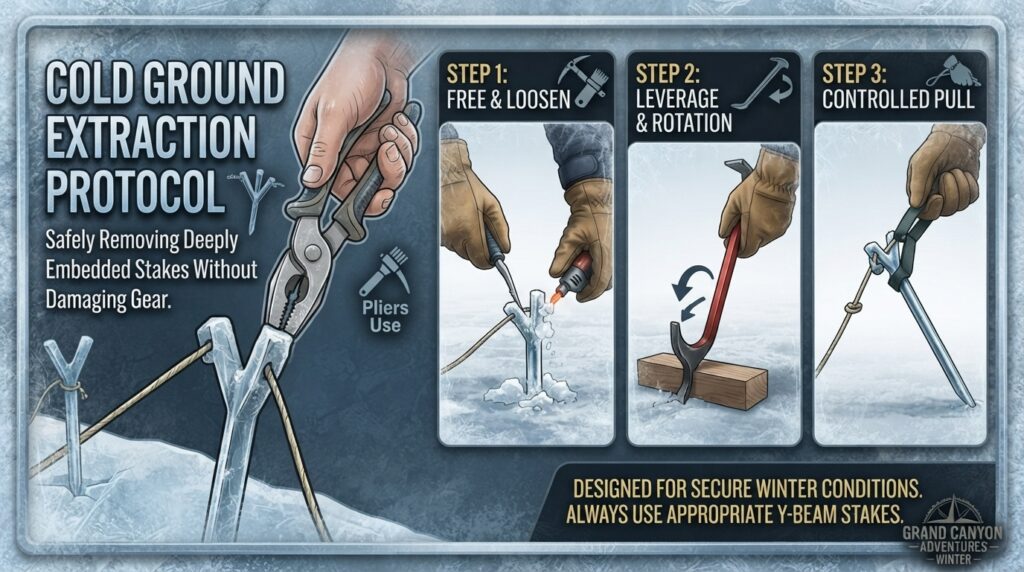
Method 1: Torsion and Rotational Shear (The 360-Degree Wiggle)
- Concept: Y-beam stakes resist vertical pull, but their rotational holding power is much weaker.
- Execution: Do not pull upward. Take a sturdy rock, stick, or rubber mallet and gently tap the top sides of the stake head in a circular direction. Rotating the stake even 2 to 3 degrees breaks the ice-to-metal adhesive bond along the fins. Once rotated, the vertical friction drops by up to 80%.
Method 2: The Lever and Fulcrum Rigging (High Mechanical Advantage)
- Concept: Use basic physics to generate massive upward force without straining the pull cord.
- Execution:
- Find a sturdy log or large rock to serve as your fulcrum, placing it 2 to 4 inches away from the stuck stake.
- Lay a strong wooden branch or trekking pole across the fulcrum.
- Loop a length of 550 paracord or a spare webbing strap around the aluminum stake notch itself (underneath the head, bypassing the thin pull loop).
- Tie the other end tightly to your lever branch.
- Press down on the long end of the lever stick. This generates smooth, perpendicular upward displacement that lifts the stake straight out without snapping cordage.
Method 3: The Spare Stake Hook / Extraction Key
- Concept: Bypassing the cord entirely by transferring pull forces directly to the metal structure.
- Execution: Slide the head or hook of a spare, heavy-duty steel or thick aluminum stake directly into the top notch of the submerged Y-beam stake. Wrap a cloth or glove around the spare stake to create a T-handle grip, and pull directly along the axis of the stake.
Method 4: Thermal Unbonding (Boiling Water Strategy)
- Concept: Transferring heat down the conductive aluminum body to melt surrounding permafrost.
- Execution: Heat a small cup of water on your camp stove to boiling. Pour a small, direct stream ($50\text{–}100\text{ ml}$) directly down the central spine of the aluminum stake. Because aluminum is highly thermally conductive, heat rapidly travels down the length of the buried stake, melting the micro-thin ice film bonding the fins to the soil within 10 to 15 seconds.
3. Comparison of Extraction Methods
| Extraction Method | Cord Snap Risk | Equipment Required | Time Needed | Effectiveness in Deep Freeze (Below 20°F) |
| Direct Hand Pulling | CRITICAL (90%) | None | Fast | 0 / 5 (Will break cord) |
| Torsion / Rotational Tapping | Low (5%) | Mallet or Rock | 1–2 Mins | 3.5 / 5 |
| Lever & Fulcrum Rigging | Extremely Low | Branch, Rock, Paracord | 3–5 Mins | 4.5 / 5 |
| Spare Stake T-Handle Hook | Zero (Bypasses Cord) | 2nd Heavy Stake | 30 Secs | 4 / 5 |
| Thermal (Boiling Water) | Zero | Stove, Water | 5 Mins | 5 / 5 (Guaranteed melt) |
4. Product Reviews: Top Tools & Accessories for Frozen Ground Extraction
Having specialized recovery tools in your winter or desert pack eliminates extraction headaches entirely.
1. MSR Stake Hammer & Extractor
- Best For: Winter mountaineers, car campers, and cold-weather backpackers.
- Key Features: Stainless steel head with an integrated rear claw hook specifically engineered to slide under Y-beam and hook-style stake heads. Weighs only 11 oz.
- Why You Need It: The rear hook matches the exact profile of standard Y-beam notches, allowing you to apply direct metal-on-metal leverage without stressing synthetic cordage.
2. Titan Survival 550 Commercial Grade Paracord (550 lb Tensile Strength)
- Best For: Replacing weak factory pull loops on all Y-beam stakes.
- Key Features: 7-strand nylon core with an inner jute strand (for tinder) and copper wire strand, rated for a minimum 550 lb breaking strength.
- Why You Need It: Stock 2mm utility cords provided by manufacturers often snap under $80\text{–}100\text{ lbs}$ of tension. Rerigging your Y-beam stakes with 550 paracord instantly quadruples the load capacity before cord failure occurs.
3. Vargo Titanium Shepherd’s Hook Stakes (As Extraction Keys)
- Best For: Lightweight backpackers needing a dual-use extraction tool.
- Key Features: Solid titanium rod construction with a tight, rigid top hook.
- Why You Need It: Titanium offers exceptional bend resistance under tension. Inserting the rigid hook into the notch of a buried aluminum Y-beam creates an unyielding T-handle puller without adding dead pack weight.
5. Pro Tips to Prevent Y-Beam Stakes From Getting Stuck
[ Step 1: Pre-Pour Hot Water / Prep Hole ] ──► [ Step 2: Drive at a 45° Angle ]
                                                            │
                                                            ▼
[ Step 5: Upgrade Stock Pull Loops ] ◄── [ Step 4: Use Deadman / Rock Anchors ] ◄── [ Step 3: Leave Top Notch Exposed ]
- Leave 0.5 Inches Exposed: Never hammer a Y-beam stake completely flush with frozen soil. Leave half an inch of the aluminum head and top notch exposed so you can gain direct mechanical leverage with tools or levers.
- Replace Factory Loops with Reflective 550 Cord: Remove cheap stock pull loops immediately after purchase. Replace them with high-visibility 550 paracord or 3mm Kevlar core utility cord, tying secure figure-8 or fisherman’s knots.
- Use Snow/Ice Deadman Anchors in Deep Freeze: In extreme winter conditions, skip thin aluminum stakes altogether. Use deadman anchors (burying stakes or sticks horizontally 12 inches deep into snow/ice) or snow pickets, which are far easier to dig out with a snow shovel.
6. 10 Frequently Asked Questions (FAQ)
Q1: Why do Y-beam stakes stick worse than smooth round stakes?
Y-beam stakes have three flat fins that create a large surface area. When damp soil freezes around these fins, ice expands and binds against all three sides, creating immense surface friction and mechanical lockup.
Q2: Is it safe to pour hot water on an aluminum stake in sub-zero cold?
Yes. Quality 7075-T6 aircraft aluminum handles rapid temperature transitions without structural degradation or cracking. A small cup of hot water melts the micro-thin ice bond instantly.
Q3: Will hitting a frozen stake sideways with a rock bend the aluminum?
If hit near the top head with moderate force, 7075-T6 aluminum resists bending. Avoid hitting the middle of the exposed shaft; tap gently near the reinforced head to break the rotational ice bond.
Q4: Can I use a claw hammer to pull a frozen tent stake?
Yes, but do not grab the thin cord loop with the hammer claws. Position the metal claws directly under the aluminum notch of the stake head, using a piece of wood on the ground as a fulcrum to protect your tent footprint.
Q5: How do I pull out a Y-beam stake if the pull cord has already snapped?
Slide a rigid tool (like a spare steel stake, screwdriver, or strong stick) through the notch or hole at the top of the aluminum stake head. Apply rotational leverage to twist the stake before pulling upward.
Q6: Does pouring salt water work to melt frozen stakes out?
Yes. Salt water lowers the freezing point of water and melts surrounding ice rapidly. However, rinse your aluminum stakes with fresh water after your trip to prevent long-term surface oxidation or corrosion.
Q7: Why shouldn’t I pry the stake using my carbon fiber trekking pole?
Carbon fiber trekking poles are engineered for high vertical load, but possess very poor lateral shear strength. Prying sideways against a stuck stake can shatter or snap carbon pole segments.
Q8: What size pull cord loop should I tie on my Y-beam stakes?
Tie a loop that is roughly 2 to 3 inches long. This provides enough clearance to slide two gloved fingers or a lever stick through the loop easily without catching on surrounding ground dirt.
Q9: What should I do if a Y-beam stake is bent in hard-packed rocky clay?
If a stake bends during insertion, do not attempt to force it deeper. Wiggle it rotationally immediately to remove it, and straighten it later using two rocks or a bench vise at home.
Q10: Are steel stakes better than aluminum Y-beam stakes for frozen ground?
Forged steel nail-style stakes (like steel rock pegs) penetrate hard frozen dirt much better than aluminum Y-beams and resist bending. However, they are significantly heavier, making them better suited for car camping than backpacking.
Conclusion
A deep Y-beam stake trapped in frozen or hard-packed earth does not have to result in a snapped cord or lost gear. By stepping away from raw vertical pulling and applying rotational tapping, lever-and-fulcrum mechanical advantage, direct metal-on-metal hooks, or conductive thermal unbonding, you can cleanly extract your stakes every time.
Upgrade your stock cord loops to 550-lb paracord today, keep a lever strategy in mind, and protect your investments on every cold-weather adventure.