
Whether you are pitching a family cabin tent in the rocky deserts of Texas, anchoring a heavy canopy along the bluffs of California, camping on packed gravel in Washington, or setting up camp in the granite terrain of the Sierra Nevada, traditional tent stakes are often a nightmare.
Every seasoned camper knows the frustration: you swing a heavy mallet, hit a hidden rock 2 inches down, and end up with a bent aluminum hook, crushed fingers, or a completely unanchored shelter.
To solve this, a massive revolution has taken over the outdoor, RV, and overland camping communities: using a cordless, battery-powered drill paired with threaded steel screw-in tent stakes.
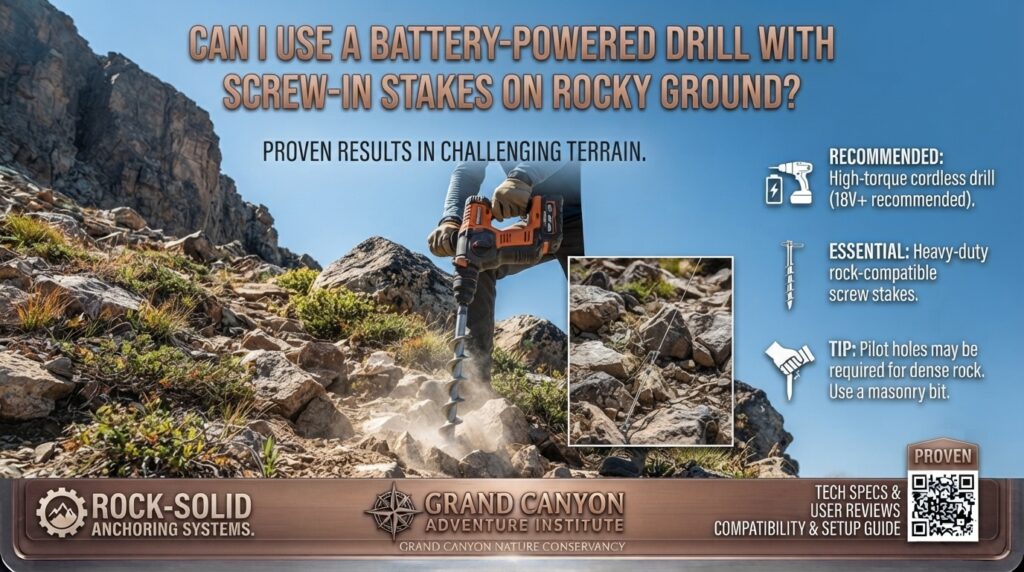
The short answer is YES—you CAN use a battery-powered drill with screw-in stakes on rocky ground, BUT only if you use high-tensile steel threaded stakes and follow correct high-torque technique. Soft aluminum or cheap low-grade alloy screw stakes will shear off or strip instantly when striking hard rock.
This comprehensive technical guide breaks down the mechanical physics of drilling tent stakes into rocky terrain, compares top drill-able stakes, reviews the best cordless power tools for camp setups, provides step-by-step drilling strategies, and answers the top 10 questions every camper asks.
The Physics of Screw-In Stakes vs. Traditional Hammering
Why do threaded lag-screw stakes succeed on rocky ground where traditional straight stakes fail? The answer lies in rotational displacement versus linear impact force.
                       MECHANICAL FORCE COMPARISON
                                     │
       ┌─────────────────────────────┴─────────────────────────────┐
       ▼                                                           ▼
[ TRADITIONAL HAMMERING ]                                  [ DRILL-DRIVEN ROTATIONAL SCREW ]
• Direct downward impact shock                            • Rotational torque (1,000+ in-lbs)
• Flattens or bends soft aluminum/titanium                • Threads bite into micro-crevices
• Deflects off underground rocks                          • Bypasses, chips, or wedges into rock pockets
• Low holding power in loose gravel                       • Extreme pull-out resistance (500+ lbs)
1. Rotational Displacement & Thread Engagement
When you hammer a standard straight stake into rocky soil, all the kinetic energy travels straight down the shaft. If the point strikes solid rock, that energy has nowhere to go except into bending or buckling the metal body.
When you use a drill-driven screw stake, the spiral threads act as an Archimedes screw. As the steel shaft rotates at high torque ($1,000\text{–}1,800\text{ in-lbs}$), the cutting threads continuously grind away small pebbles, clear out packed dirt, and wedge themselves into the micro-fissures between underground rocks.
2. Shear Strength & Material Hardening
Standard tent pegs are made from $6061\text{-T6}$ aluminum or thin wire steel to keep weight low for backpackers. Screw-in stakes designed for drills are engineered from case-hardened carbon steel or $304\text{ stainless steel}$.
This high shear strength allows the stake to act almost like a masonry or ice-boring bit, grinding past rock obstructions without shearing off at the head.
The Ultimate Soil & Ground Type Compatibility Chart
| Ground / Terrain Type | Traditional Hammer Pegs | Aluminum Screw Stakes | Heavy-Duty Steel Drill Stakes | Recommended Drill Torque |
| Packed Dirt / Clay | Fair (Bends easily) | Good | Excellent (Instant bite) | Low ($300\text{–}500\text{ in-lbs}$) |
| Gravel & Riverbed Rock | Poor (Bends 80% of time) | Fails (Threads strip) | Excellent (Bypasses pebbles) | Medium ($600\text{–}900\text{ in-lbs}$) |
| Solid Desert Caliche / Rock | Fails completely | Fails completely | Good (Requires pre-drilling) | High ($1,200+\text{ in-lbs}$) |
| Sand & Loose Topsoil | Poor (Pulls out) | Fair | Good (Use extra-wide threads) | Low ($300\text{ in-lbs}$) |
| Frozen Ground / Ice | Poor | Fails | Exceptional (Bores through ice) | Medium-High ($1,000\text{ in-lbs}$) |
Essential Gear Review: Top Screw-In Stakes for Rocky Ground
Not all screw-in stakes are built for drill operation. Here are the top four drill-compatible stake systems on the market reviewed for strength, material durability, and terrain performance:
1. GroundGrip Heavy-Duty Steel Screw-In Pegs
- Best Overall for Extreme Rocky Terrain & Caliche
Constructed from heat-treated carbon steel with zinc anti-corrosion plating, GroundGrip pegs are the gold standard for car campers, overlanders, and canopy users.
- Key Specifications:
- Material: Galvanized carbon steel.
- Drive Head: $13\text{mm}$ ($1/2\text{ inch}$) Hex head.
- Length: $8\text{ inches}$ ($20\text{cm}$) and $12\text{ inches}$ ($30\text{cm}$) options.
- Pros: Indestructible body; massive rotational thread grip; standard hex head fits all drill sockets; includes removable guy-line hooks.
- Cons: Heavier weight (not for ultralight backpacking).
2. Pegty 8-Inch Galvanized Lag Screw Tent Stakes
- Best Value Budget Option
These heavy-duty commercial lag-bolt style stakes bring industrial fastening tech to campsite setup at an affordable price point.
- Key Specifications:
- Material: Galvanized high-tensile steel.
- Drive Head: $1/2\text{ inch}$ Hex head with integrated washer collar.
- Length: $8\text{ inches}$.
- Pros: Incredibly affordable per pack; zinc plating prevents rust; deep coarse threads lock tight into gravel and hard clay.
- Cons: Requires carrying a $13\text{mm}$ socket adapter bit in your drill kit.
3. Orange Screw Ultimate Ground Anchor (Large Steel Version)
- Best for High-Wind Canopies in Mixed Rocky/Loose Soil
While the original plastic Orange Screws are meant for sand, their heavy-duty commercial metal variants provide incredible surface area holding power.
- Key Specifications:
- Material: Reinforced alloy steel shaft.
- Drive System: T-handle or socket drive adapter.
- Length: $9.5\text{ inches}$.
- Pros: Unmatched holding power in loose gravel mixed with rocks; wide corkscrew spiral design.
- Cons: Wider diameter requires higher torque to drive into hardpack.
4. Heavy-Duty Masonry Concrete Screw Pegs (Tapcon Style Adapters)
- Best for Pre-Drilled Solid Rock Camping
When camping on solid rock ledges or exposed granite where no dirt exists, these specialty hardened steel fasteners are driven directly into pre-drilled pilot holes.
- Key Specifications:
- Material: Case-hardened steel with Blue-Climaseal coating.
- Length: $6\text{ inches}$.
- Pros: The only physical solution for setting up shelters directly on solid sheet rock or concrete pads.
- Cons: Requires carrying a masonry drill bit to pre-drill pilot holes.
Head-to-Head Comparison: Screw-In Stake Performance
| Product Name | Material | Head Type | Holding Power (lbs) | Ideal Terrain | Best Drive Tool |
| GroundGrip Heavy-Duty | Galvanized Carbon Steel | $13\text{mm}$ Hex | 650+ lbs | Rocky Dirt, Gravel, Clay | 18V Cordless Impact Driver |
| Pegty Lag Screws | Zinc Steel | $1/2\text{“}$ Hex | 500+ lbs | Hardpack Dirt, Gravel | 12V or 18V Cordless Drill |
| Orange Screw Heavy | Alloy Steel | Hex / T-Bar | 550+ lbs | Loose Gravel, Sand/Rock Mix | 18V Drill / High Torque |
| Masonry Rock Pegs | Case-Hardened Steel | Star / Hex | 800+ lbs | Solid Granite Ledges | 18V Hammer Drill + Masonry Bit |
What Type of Drill Do You Need? (Drill vs. Impact Driver)
One of the most frequent points of confusion among campers is choosing between a standard cordless drill/driver and a cordless impact driver.
[ CORDLESS DRILL / DRIVER ]               [ CORDLESS IMPACT DRIVER ]
• Continuous smooth rotation              • Rotational force + rapid internal hammer strikes
• Good for soft/medium ground             • Ultimate king for hard rock & gravel
• Risk of wrist twist on binding          • Zero wrist strain (impact mechanism absorbs kickback)
Why an Impact Driver is Superior on Rocky Ground
An impact driver does not just spin; it delivers thousands of high-frequency rotational “impacts” per minute (IPM).
- Zero Wrist Strain: When a screw stake strikes a buried rock, a standard drill will instantly bind and violently twist your wrist. An impact driver’s internal hammer mechanism absorbs the shock while hammering the threads past the rock.
- Superior Torque: Compact 18V/20V impact drivers deliver $1,400\text{–}1,800\text{ in-lbs}$ of torque—more than enough to split through subterranean shale or gravel pockets.
Step-by-Step Guide: How to Drill Screw-In Stakes on Rocky Terrain
  [ STEP 1: Position Guy-Line Hook ] ──► Slide washer / hook over stake shaft
  [ STEP 2: Align at 45° Angle ]    ──► Point tip away from the tent
  [ STEP 3: Drive with Pressure ]   ──► Low speed, high torque; let impact driver do the work
  [ STEP 4: Flush Seating ]          ──► Stop driving when hook contacts ground flush
Step 1: Select the Proper Angle
Angles matter! Position the screw stake at a $45\text{-degree to }60\text{-degree}$ angle leaning AWAY from your tent or shelter. This uses ground geometry to maximize pull-out tension resistance.
Step 2: Set Your Tool to Low Speed / High Torque
If using a standard cordless drill, switch the gear toggle to Setting 1 (Low Speed / Maximum Torque). Set the clutch ring to the drill icon or maximum clutch setting.
Step 3: Apply Firm Downward Pressure
Insert the magnetic socket bit into your drill or impact driver. Place the stake tip against the rocky soil, apply steady downward body weight, and pull the trigger. Allow the rotational threads to bite into the ground.
Step 4: What to Do When Hitting a Major Boulder
If the stake stops dead against a massive solid underground rock face:
- Do NOT force it continuously at max speed—this can strip the drive head socket.
- Reverse the drill, back the stake out $2\text{ inches}$, angle the drill slightly $10\text{ degrees}$ to the left or right, and drive it down again to bypass the rock edge.
- Alternative (Pre-Drilling): Carry a long $1/4\text{-inch}$ masonry or wood twist bit. Drill a quick pilot hole into the rocky ground, then drive the screw stake directly into the pilot hole.
5 Critical Tips for Maintenance & Care
- Always Carry a Manual T-Handle Adapter: Batteries can die! Always pack a small manual T-handle socket wrench or hand ratchet in your stake bag as a back-up power failure contingency.
- Use Magnetic Sockets: Standard non-magnetic sockets allow screw stakes to wobble and fall over during placement. A strong magnetic $13\text{mm}$ or $1/2\text{-inch}$ socket holds the heavy steel stake rock-solid.
- Clean Mud and Grit After Use: Before packing your screw stakes away, wipe off wet clay, grit, and moisture to preserve the anti-corrosion zinc or galvanized coating.
- Inspect Hex Heads for Wear: After driving into harsh granite or quartz, inspect the drive head hex corners. If a head becomes rounded, replace the stake to avoid stripping socket bits in the field.
- Keep Spare Batteries Warm in Cold Weather: Lithium-ion drill batteries lose charge rapidly in sub-freezing temperatures. Store your drill battery inside your vehicle or sleeping bag until ready to set up camp.
Frequently Asked Questions (FAQ)
1. Will a battery-powered drill really drive screw stakes through solid rock?
A drill-driven steel screw stake can bore through soft shale, gravel, caliche, and riverbed rocks. However, if you hit a massive, impenetrable granite bedrock layer, the stake cannot pierce solid stone directly unless you first pre-drill a pilot hole using a masonry drill bit.
2. Is an 18V/20V drill required, or will a compact 12V drill work?
Compact 12V drills work surprisingly well in packed dirt and mild gravel. However, for heavily rocky ground, desert caliche, or frozen winter soil, an 18V or 20V cordless impact driver provides the necessary torque ($1,400+\text{ in-lbs}$) without overheating the motor.
3. Can I use cheap aluminum screw stakes with a drill?
No. Cheap aluminum or plastic screw stakes will shear off, warp, or strip their drive heads almost instantly when driven into rocky ground with a power tool. Always use case-hardened carbon steel or galvanized high-tensile steel screw stakes for drill applications.
4. What size socket bit do I need for most screw-in tent stakes?
The vast majority of heavy-duty drillable tent pegs use either a $13\text{mm}$ hex head or a $1/2\text{-inch}$ hex head socket adapter. Always verify the drive head size before buying socket bits for your camp tool kit.
5. How do screw-in stakes handle high winds compared to traditional pegs?
Screw-in stakes offer dramatically higher pull-out resistance ($500\text{ to }800+\text{ lbs}$) compared to straight smooth pegs ($50\text{ to }150\text{ lbs}$). The spiral threads act like mechanical anchors inside packed soil and gravel, making them ideal for high-wind pop-up canopies and heavy canvas wall tents.
6. Will driving screw stakes into rocks damage my drill socket bits?
Occasional wear is normal. Using high-impact magnetic nut drivers made from heat-treated Chrome-Vanadium (Cr-V) steel ensures your socket bits resist splitting or rounding when driving under extreme torque load.
7. How do I remove screw-in stakes from frozen or rocky ground?
Simple! Flip your drill or impact driver into Reverse mode, apply light downward pressure, and pull the trigger. The threads will back out of the ground smoothly in 3 seconds—eliminating the grueling physical labor of pulling frozen pegs with a claw hammer.
8. Can I use drill screw stakes for beach sand or deep snow?
For pure loose beach sand or soft powder snow, standard thin steel lag screws do not have wide enough threads to grab. Instead, use wide-spiral nylon/polycarbonate anchors (like large Orange Screws) or specialized snow/sand deadman anchors.
9. How much weight do heavy-duty drill stakes add to my camping gear?
A set of 8 steel screw stakes weighs roughly $2\text{ to }3.5\text{ lbs}$, plus the weight of a compact cordless drill ($2.5\text{–}4\text{ lbs}$). This setup is designed specifically for car camping, overland rigs, RVing, and canopy setups—not lightweight backcountry backpacking.
10. Are screw-in tent stakes legal in State and National Parks?
Yes. Screw-in stakes cause minimal ground disturbance compared to digging trench lines or pounding massive stakes with sledgehammers, making them fully compliant with Leave No Trace (LNT) principles across state and national park campgrounds.
Conclusion
Using a battery-powered drill paired with heavy-duty steel screw-in stakes is a complete game-changer for camping on rocky ground. By swapping out traditional mallets and soft aluminum pegs for a 20V impact driver and galvanized steel lag-screw pegs, you eliminate bent stakes, sore wrists, and unstable shelter setups forever.