How do I prevent my forged steel stakes from rusting after camping in wet weather?

Forged steel tent stakes are the undisputed champions of ground shelter security. Whether you are anchoring a heavy canvas tent in rainy Washington forests, pitching a shelter on wet coastal bluffs in Northern California, setting up camp along damp riverbanks in Texas, or facing unpredictable storms across New York state, nothing holds fast like solid forged steel.
Unlike flimsy aluminum pegs that bend on contact with rocks, forged steel stakes slice through gravel, hardpack clay, and roots with ease.
However, steel has one notorious Achilles’ heel: oxidation and rust.
When exposed to wet soil, rain, morning dew, or trapped moisture inside a storage bag, oxygen and water react with iron atoms in the steel to form ferric oxide ($\text{Fe}_2\text{O}_3\cdot n\text{H}_2\text{O}$). Left unchecked, rust eats away at tensile strength, ruins your guy-lines, stains expensive tent fabric, and fuses soil grit onto the metal surface.
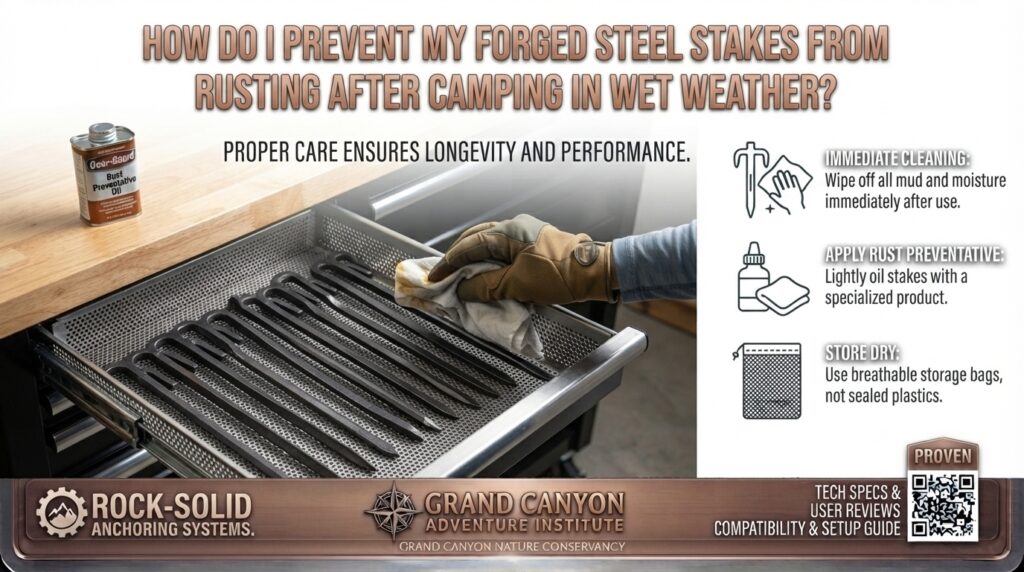
To prevent forged steel stakes from rusting after camping in wet weather, you must follow a 4-step maintenance protocol: wash off acidic mud immediately, dry completely with micro-fiber towels, apply a protective hydrophobic barrier oil or wax coating, and store them in a breathable canvas roll rather than a sealed plastic bag.
This masterclass technical guide breaks down the chemical metallurgy of steel corrosion, evaluates protective oils and anti-rust coatings, reviews top-rated maintenance tools, outlines step-by-step restoration techniques for rusted stakes, and answers the 10 most critical FAQs for campers.
The Chemical Science: Why Forged Steel Stakes Rust Fast
To stop rust effectively, it helps to understand why forged steel behaves differently from coated metals or aluminum.
                           THE RUST TRIANGLE ON CAMPSITES
                                         │
         ┌───────────────────────────────┼───────────────────────────────┐
         ▼                               ▼                               ▼
  [ IRON / STEEL ]               [ WATER / DEW ]               [ DISSOLVED OXYGEN ]
  High-density carbon            Trapped moisture in soil      Air pockets in damp mud
  steel matrix.                  or sealed storage bags.       catalyze oxidation.
1. High Carbon Density vs. Surface Oxidation
Forged steel is made by pounding heated high-carbon steel into dense shapes under extreme pressure. This manufacturing process creates incredible structural density and impact strength. However, unless the alloy contains high percentages of chromium (as seen in stainless steel), raw carbon steel lacks natural resistance to atmospheric oxygen and water.
2. Acidic Soil & Moisture Retention
Mud and dirt are not chemically inert. Wet soil contains decomposed organic matter, mineral salts, and mild acids. When wet dirt clings to your stakes inside a dark, airless gear bag:
- Moisture acts as an electrolyte solution.
- Mineral salts accelerate galvanic and atmospheric corrosion.
- Rust pits begin forming on microscopic steel pores in less than 24 hours.
Soil Types & Rust Risk Factor Across Top US Camping Regions
| Region & Soil Profile | Moisture Level | Soil Chemistry | Rust Threat Level | Immediate Post-Trip Action Required |
| Pacific Northwest (Washington / Coastal CA) | High (Rain / Fog) | Highly Acidic Organic Loam | CRITICAL | Wash & oil within 12 hours |
| Coastal San Francisco / California Bluffs | Medium-High (Salt Air) | Saline Sandy Clay | CRITICAL | Salt neutralizer rinse + heavy oil |
| Northeastern Woodlands (New York / Adirondacks) | High (Damp Leaf Litter) | Acidic Forest Topsoil | HIGH | Full mud wash + oven/sun dry |
| Texas Gulf & Central Texas | Variable (Sudden Downpours) | Alkaline Black Clay / Mineral Sand | HIGH | Clay scrape + hydrophobic wax |
| Inland High Desert / Sierra Nevada | Low (Dry, but damp at night) | Mineral Rich Quartz / Gravel | MODERATE | Basic towel dry + light oil wipe |
Essential Product Reviews: Best Anti-Rust Coatings & Gear Care Kits
Selecting the right protective coating determines whether your forged steel stakes last one season or four decades. Here are four top-rated corrosion inhibitors, oils, and cleaning tools evaluated for field effectiveness, water displacement, and ease of application:
1. Boeshield T-9 Waterproof Vinyl & Metal Protectant
- Best Overall Anti-Rust Coating for Extreme Wet Conditions
Originally engineered by The Boeing Company for aviation component rust protection, Boeshield T-9 combines solvent carriers with paraffin wax to penetrate deep into metal pores and leave a dry, durable protective film.
- Key Specifications:
- Base: Solvents, paraffin wax, and corrosion inhibitors.
- Finish: Dries to a clean, non-sticky wax film (won’t attract dirt).
- Water Displacement: Exceptional.
- Pros: Dries completely dry so dirt won’t stick; withstands saltwater exposure; single application lasts months in storage.
- Cons: Higher upfront cost per bottle compared to basic oils.
2. Fluid Film Rust & Corrosion Inhibitor (Lanolin-Based)
- Best Eco-Friendly & Non-Toxic Protection
Fluid Film is derived from natural wool wax (lanolin). It contains zero solvents, making it completely non-toxic and environmentally safe for outdoor eco-adventurers.
- Key Specifications:
- Base: Pure wool wax lanolin oil.
- Active Lifespan: Long-term wet barrier film.
- Pros: $100\%$ non-toxic and eco-safe; never evaporates; deeply displaces water instantly on wet metal.
- Cons: Remains slightly wet/tacky to the touch; best used when stakes are stored in a dedicated canvas roll.
3. Ballistol Multi-Purpose Oil & Emulsifier
- Best Biodegradable All-in-One Cleaner & Protectant
Originally formulated for military equipment, Ballistol is famous for its ability to emulsify with water, neutralize organic acids in dirt, and leave a non-toxic protective barrier.
- Key Specifications:
- Base: Medical-grade mineral oil.
- Environmental Rating: Fully biodegradable.
- Pros: Can be applied directly onto damp steel; neutralizes acidic soil residue; skin-safe and food-safe.
- Cons: Distinctive anise/pine scent that takes 24 hours to fade.
4. Heavy-Duty Brass Wire Wheel & Brush Set
- Best Mechanical Tool for Removing Surface Oxidation
Before applying anti-rust oils to old or neglected forged stakes, you must scrub off existing oxide scale. Brass wire brushes clean aggressively without scratching the underlying hard steel structure.
- Key Specifications:
- Bristle Material: 100% Solid Brass.
- Design: Ergonomic handle brush plus drill-attachable wire wheel.
- Pros: Softer than steel so it won’t damage stake coating; fits into thread grooves and head eyelets easily.
- Cons: Requires manual arm strength or a cordless drill driver.
Head-to-Head Coating Comparison for Forged Steel
| Protection Product | Active Ingredient | Film Type | Dirt Attraction | Re-Application Interval | Environmental Impact |
| Boeshield T-9 | Paraffin Wax / Solvents | Dry Micro-Wax | Zero (Dry finish) | Every 6 months | Moderate |
| Fluid Film | Wool Wax Lanolin | Semi-Wet Barrier | Low-Moderate | Once per season | Excellent (Non-Toxic) |
| Ballistol | Mineral Oil / Emulsifiers | Thin Light Oil | Low | After every wet trip | Excellent (Biodegradable) |
| Traditional WD-40 | Petroleum Distillates | Very Thin Solvent | High (Attracts grit) | Before & after every trip | Low |
| Paste Wax / Beeswax | Natural Beeswax | Solid Hard Wax | Zero | Once per year | Superior (Natural) |
Step-by-Step Field & Home Maintenance Protocol
  [ STEP 1: FIELD RINSE ]    ──► Scrape mud and rinse off thick soil at campsite
  [ STEP 2: TOTAL DEHYDRATION ]──► Towel wipe & dry under sun or indoor heat (100% moisture free)
  [ STEP 3: PROTECTIVE COAT ] ──► Spray or wipe with Boeshield T-9, Fluid Film, or Beeswax
  [ STEP 4: BREATHABLE BAG ]  ──► Store in heavy-canvas stake roll (NEVER sealed plastic ziplocks)
Step 1: The Campsite Pre-Wash
Never throw mud-caked forged stakes directly into your vehicle or storage tub.
- Knock stakes together gently to dislodge heavy dirt clumps.
- Rinse off remaining soil in fresh water (a stream, campsite hose, or bucket).
- Pro Tip: Never pack wet, muddy stakes inside your main tent bag with your tent fabric!
Step 2: Complete Thermal Dehydration
Microscopic moisture trapped inside forged steel surface pits will continue to cause rust even after a quick towel wipe.
- Wipe stakes down with a coarse microfiber cloth.
- Lay them out in direct sunlight for 30 minutes, or place them near a camp heater/home radiator to ensure all surface moisture completely evaporates ($100\%$ dry).
Step 3: Apply the Hydrophobic Shield
- Hold the stakes over a cardboard scrap or shop towel.
- Apply a thin, uniform layer of Boeshield T-9 or Fluid Film.
- Pay special attention to the stake head (where mallet impacts expose raw steel) and the guy-line eyelet.
- Let dry for 10–15 minutes until a micro-barrier forms.
Step 4: Choose Breathable Storage
- Avoid airtight plastic bags or rubberized dry sacks for long-term storage—they trap ambient humidity.
- Store your treated forged stakes in a heavy-duty $16\text{ oz}$ duck canvas stake roll. Canvas allows residual moisture to breathe out while keeping oil barriers intact.
How to Restore Heavily Rusted Forged Steel Stakes (4-Step Overhaul)
If you accidentally left your forged steel stakes inside a damp storage box all winter and pulled out a rusty mess, don’t throw them away! Forged steel is practically indestructible and can be fully restored:
[ STEP 1: VINEGAR BATH ] ──► Soak rusted stakes in white vinegar for 12–24 hours
          │
          ▼
[ STEP 2: BRASS SCRUB ]  ──► Scrub loosened rust away with brass wire brush
          │
          ▼
[ STEP 3: BAKING SODA ]  ──► Rinse in water + baking soda to neutralize acid
          │
          ▼
[ STEP 4: OIL & CURE ]   ──► Heat steel slightly and apply heavy oil or beeswax coat
- Vinegar De-Rusting Bath: Submerge rusted stakes in standard household white vinegar (5% acetic acid) inside a plastic bucket for 12 to 24 hours. The acid breaks down ferric oxide without dissolving hard carbon steel.
- Scrub Off Dissolved Scale: Pull stakes out and scrub thoroughly with a brass wire brush. The orange rust will slough off, exposing fresh steel.
- Acid Neutralization Rinse: Wash the stakes in a bucket of clean water mixed with $1/2\text{ cup}$ of baking soda. This neutralizes residual vinegar acid and stops immediate “flash rusting.”
- Thermal Waxing / Oil Cure: Dry the restored stakes completely. Heat them slightly with a heat gun or hairdryer, then apply paste wax or Boeshield T-9. The warmth opens the metal pores, pulling the protective wax deep into the steel surface.
5 Critical Tips for Long-Term Stake Maintenance
- Repaint Impact Heads with High-Visibility Enamel: Mallet strikes strip paint and factory coatings off the stake head. Spray the top 2 inches with high-visibility orange or yellow Rust-Oleum outdoor enamel paint to prevent rust and prevent losing stakes in tall grass.
- Never Store Stakes with Damp Tent Fabrics: Rust stains on nylon or polyester tents are permanent and weaken waterproof polyurethane coatings. Always store stakes in a separate canvas pouch.
- Neutralize Salt After Beach Camping: If camping along California or Texas coastal beaches, rinse stakes with fresh water and a drop of dish soap to remove salt deposits before applying oil.
- Inspect Guy-Line Attachment Eyelets: Smooth out any sharp metal burrs inside the stake eyelet using a small metal file to prevent rough steel edges from fraying your guy-line paracord.
- Use Natural Beeswax for Field Touches: Keep a small bar of natural beeswax in your camp repair kit. Rubbing beeswax onto a warm, dry steel stake creates an instant, non-toxic, water-repellent field coating.
Frequently Asked Questions (FAQ)
1. Can I use standard WD-40 to protect my forged steel stakes?
Standard WD-40 is primarily a solvent water-displacer, not a long-term protective oil. While it works well for cleaning wet mud off stakes at camp, it evaporates quickly and leaves a thin film that can attract dirt. For long-term storage, use a wax-based protectant like Boeshield T-9 or a lanolin barrier like Fluid Film.
2. Is surface rust on forged steel stakes cosmetic or structural?
Initial orange flash rust is purely cosmetic and will not affect structural strength in the short term. However, if left unattended in damp environments for months, deep pitting corrosion will form, weakening the metal density and causing roughness that damages tent guy-lines.
3. How do I get wet clay and sticky mud off forged stakes without scratching them?
Soak mud-caked stakes in a bucket of warm water with a few drops of mild dish soap for 10 minutes. Use a stiff nylon scrub brush (not steel wool) to loosen clay from grooves, then dry completely with a microfiber towel.
4. Should I paint my forged steel stakes to stop rust?
Yes! Coating forged steel stakes with a rust-inhibiting primer and high-visibility enamel spray paint (like Rust-Oleum) creates a physical oxygen barrier. While mallet strikes will chip paint off the top impact head over time, the lower body remains protected from soil moisture.
5. Why shouldn’t I store my steel stakes in plastic ziplock bags?
Plastic bags trap ambient humidity and condensation inside. When temperatures fluctuate, water droplets collect on the steel surface inside the sealed bag, creating a humid greenhouse environment that causes rapid rusting. Heavy canvas stake rolls or mesh bags are much better because they allow moisture to evaporate.
6. Will stainless steel tent stakes solve the rust problem completely?
Yes, $304\text{ or }316\text{ stainless steel}$ stakes resist rust naturally due to high chromium content. However, stainless steel is significantly more expensive, slightly less rigid than heavy forged high-carbon steel, and can still suffer from crevice corrosion if stored wet in airless environments for years.
7. How can I protect my forged steel stakes while on long multi-week backpacking trips?
Wipe stakes clean against dry grass or a shop rag at each morning pack-up. Keep a small $1\text{ oz}$ squeeze bottle of Ballistol or a small block of beeswax in your kit to apply a 10-second wipe down before placing stakes into their dedicated canvas pouch.
8. Is vegetable oil or olive oil safe to use on tent stakes?
Avoid cooking oils. Vegetable oil, olive oil, and canola oil spoil, oxidize, and become sticky over time. They attract dirt, grit, insects, and wildlife (like mice and bears) to your gear bag due to food scents. Always stick to mineral oils, lanolin, or synthetic metal waxes.
9. What causes “flash rust” right after I clean my steel stakes?
Flash rust occurs when bare, unsealed steel is washed with water and exposed to air. As the water evaporates, rapid oxidation occurs within minutes. To prevent flash rust, towel-dry stakes immediately after washing and apply a light oil or protectant right away.
10. Does cold freezing weather make forged steel stakes rust faster?
Freezing air itself does not cause rust, but snow melt and condensation during thaw cycles do. When cold metal stakes are brought inside a warm tent or vehicle, atmospheric moisture instantly condenses on the cold steel (“sweating”), triggering fast oxidation if not wiped dry.
Conclusion
Forged steel tent stakes are an investment in ultimate shelter security that can last a lifetime if cared for properly. By taking five minutes after every wet camping trip to wash off acidic soil, thoroughly dry the metal, apply a dry wax or lanolin protectant like Boeshield T-9, and store them in a breathable canvas roll, you ensure your stakes remain 100% rust-free, razor-sharp, and ready for your next outdoor adventure.