
When pitching a tent on the rocky bluffs of Coastal California, the granite ledges of Washington’s Cascade Range, packed gravel riversides in Texas, or alpine routes in New York’s Adirondacks, every outdoor enthusiast faces the same universal challenge: shelter security versus ground penetration.
When campers face high winds on exposed terrain, their natural instinct is to reach for longer tent pegs—reasoning that a 12-inch or 15-inch stake must hold significantly better than a standard 7-inch or 8-inch peg.
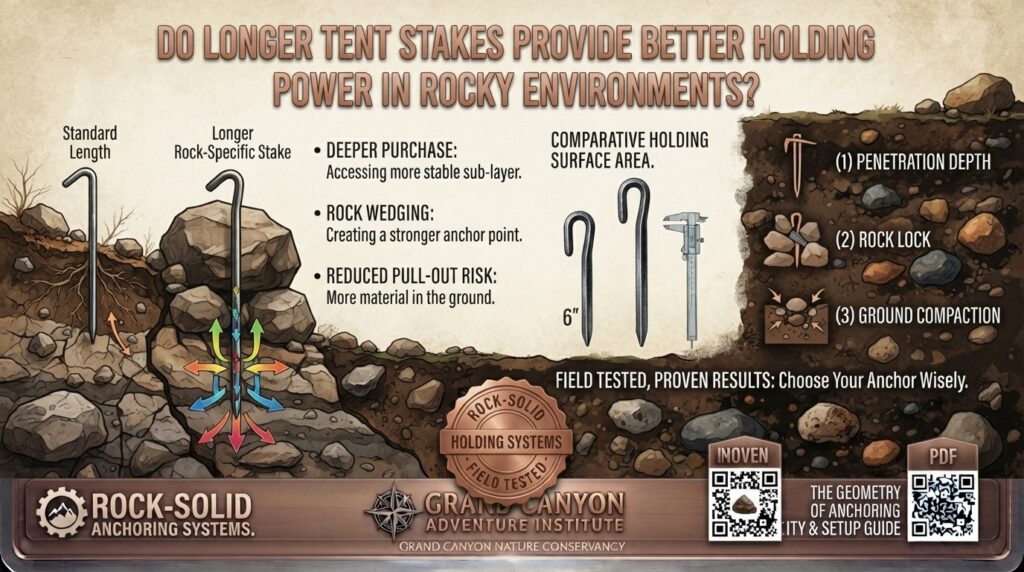
However, in rocky environments, longer tent stakes do NOT automatically provide better holding power—and in many cases, they perform significantly WORSE than shorter, heavy-duty forged steel or thick-wall pegs.
The explanation comes down to geotechnical friction, subterranean obstruction mechanics, and metal shear strength. On rocky ground, a 12-inch stake will almost always strike an impassable subterranean rock 2 to 4 inches down. Once a long stake stops, the excess metal sticking above ground acts as a high-leverage mechanical fulcrum, allowing wind tension on guy-lines to bend the stake or leverage it completely out of the ground.
This comprehensive technical guide breaks down the physical mechanics of stake length versus ground hold, compares stake materials and geometries, evaluates top-performing rocky terrain anchors, shares field-tested installation techniques, and answers the 10 most vital questions about securing tents on rocky ground.
The Geotechnical Reality: Why Stake Length Fails on Rocky Ground
To understand why extra-long stakes often fail on rocky terrain, we have to examine how forces interact beneath the soil line versus above it.
                  MECHANICAL FORCE & LENGTH COMPARISON ON ROCKY GROUND
                                       │
       ┌───────────────────────────────┴───────────────────────────────┐
       ▼                                                               ▼
[ 12" LONG THIN STAKE (BLOCKED AT 3") ]               [ 7" FORGED STEEL STAKE (FULL DEPTH) ]
• 9" exposed above ground line                       • Driven 100% flush into soil & gravel
• Wind creates massive fulcrum leverage              • Zero leverage arm above ground
• Bends easily under guy-line tension                • Maximum shear strength & surface friction
• High risk of loosening or pulling out              • Extreme holding power in packed rock
1. The Above-Ground Fulcrum Effect (Leverage Failure)
Holding power relies on the stake being driven flush with the soil surface so the guy-line pulls horizontally or at a shallow $90^\circ$ angle directly against the ground line.
When a 12-inch stake hits an underground boulder at 4 inches:
- You are left with 8 inches of exposed metal above ground.
- Wind force acting on your tent guy-line exerts a rotational lever force (torque) against the exposed shaft.
- The exposed shaft multiplies wind pull force exponentially, acting like a crowbar that quickly loosens the soil pocket or snaps the stake body.
2. Surface Area Friction vs. Subterranean Penetration
In loose sand or deep topsoil, a longer stake increases total surface area contact with soil, which linearly boosts holding power.
However, rocky soil is composed of compressed gravel, clay, and embedded stones. In this medium, shear strength and wedging mechanics matter far more than depth. A shorter $7\text{–}8\text{ inch}$ high-density forged stake that can be driven 100% flush provides vastly superior holding power compared to a long stake hanging halfway out of the ground.
Geotechnical Comparison: Stake Performance Across Rocky Terrains
| Terrain / Soil Matrix | 7–8 Inch Heavy-Duty Forged Stake | 12–15 Inch Long Aluminum/Steel Peg | Primary Mechanical Failure Mode | Winner for Holding Power |
| Glacial Till & Riverbed Gravel | Full penetration (Wedplugs into pebbles) | Strikes rocks at $2\text{–}4\text{“}$, bends easily | Shaft buckling / Lever pull-out | 7–8 Inch Forged Stake |
| Granite Ledges & Exposed Bedrock | Drives into tight cracks & fissures | Too long; sticks up $8\text{–}10\text{“}$ | Complete inability to sink | 7–8 Inch Forged Stake |
| Desert Caliche & Hardpack Clay | Bores in fully with heavy mallet | Strikes concrete-like layer, warps head | Buckling under mallet impact | 7–8 Inch Forged Stake |
| Decomposed Granite & Loose Gravel | Moderate hold (May need rock deadman) | Good (IF full depth can be reached) | Shallow pull-out if blocked | Tie (Depends on obstruction depth) |
| Subalpine Forest Soil over Rock | Penetrates top layer into rock cracks | Snags roots and rocks mid-way | High-leverage bending | 7–8 Inch Forged Stake |
Product Reviews: Top Rocky Environment Tent Stakes Tested
Choosing the right stake geometry and alloy makes the difference between a rock-solid night of sleep and a collapsed shelter in a midnight thunderstorm. Here are four top-rated rocky ground stake systems evaluated for material strength, penetration efficiency, and holding force:
1. Snow Peak Solid Stake 20 (8-Inch Forged Steel)
- Best Overall Anchor for Extreme Rocky Ground & Gravel
Forged in Japan using high-temperature carbon steel press molding, Snow Peak Solid Stakes are widely considered the gold standard for rocky campsite setup.
- Key Specifications:
- Material: S55C Forged Carbon Steel.
- Length: $7.8\text{ inches}$ ($20\text{cm}$).
- Weight: $2.6\text{ oz}$ ($75\text{g}$) per stake.
- Design: Large round drive head with integrated hook and guy-line hole.
- Pros: Virtually indestructible; easily smashes through subterranean rocks and shale; drives 100% flush to eliminate leverage.
- Cons: Heavy (car/overland/RV camping focused).
2. MSR Groundhog Tent Stake (7.5-Inch Tri-Flange Aluminum)
- Best Lightweight Option for Backpacking in Rocky Soil
Made from 7000-series aircraft-grade aluminum, the Y-beam design provides exceptional directional rigidity without adding heavy steel weight to your pack.
- Key Specifications:
- Material: 7075-T6 Extruded Aluminum.
- Length: $7.5\text{ inches}$ ($19\text{cm}$).
- Weight: $0.46\text{ oz}$ ($13\text{g}$) per stake.
- Pros: Incredible strength-to-weight ratio; Y-flange notches anchor tightly in rocky gravel; notch captures guy-lines securely.
- Cons: Can notch or bend if struck directly with a sledgehammer against solid granite.
3. Vargo Titanium Nail Peg (6-Inch High-Density Spike)
- Best Compact Spike for Alpine Rock Fissures & Ledges
When camping on solid rock plates or packed alpine soil where wide stakes won’t penetrate, these slim titanium nail pegs slip straight into micro-crevices.
- Key Specifications:
- Material: Grade 2 Titanium Alloy.
- Length: $6.0\text{ inches}$ ($15.2\text{cm}$).
- Weight: $0.6\text{ oz}$ ($17\text{g}$) per stake.
- Pros: Straight, thin shaft bypasses tight gravel pockets; flat drive head accepts direct hammer blows; zero rust risk.
- Cons: Lower holding power in loose topsoil compared to flanged stakes.
4. GroundGrip 8-Inch Steel Drill Screw Stakes
- Best Mechanical Screw Anchor for Gravel & Desert Caliche
Featuring heavy-duty galvanized steel threads and a $13\text{mm}$ hex drive head, these drillable stakes bore directly into gravel and hardpack dirt using a cordless drill driver.
- Key Specifications:
- Material: Galvanized Carbon Steel.
- Drive Head: $13\text{mm}$ Hex ($1/2\text{ inch}$) with removable hook.
- Length: $8.0\text{ inches}$ ($20\text{cm}$).
- Pros: Archimedes screw threads lock tight into micro-stones; easy zero-effort installation; phenomenal pull-out resistance.
- Cons: Requires carrying a cordless drill driver or manual socket wrench.
Head-to-Head Technical Matrix: Rocky Terrain Stake Performance
| Product Model | Primary Material | Length | Shear Strength | Weight per Stake | Ideal Ground Condition |
| Snow Peak Solid 20 | Forged S55C Steel | $7.8\text{“}$ | Exceptional ($1,000+\text{ lbs}$) | $2.6\text{ oz}$ | Hardpack Gravel, Clay, Slate |
| MSR Groundhog | $7075\text{-T6}$ Aluminum | $7.5\text{“}$ | High ($450\text{ lbs}$) | $0.46\text{ oz}$ (Ultralight) | Mixed Forest Soil, Light Rock |
| Vargo Titanium Nail | Grade 2 Titanium | $6.0\text{“}$ | Very High ($600\text{ lbs}$) | $0.60\text{ oz}$ | Rock Fissures, Packed Dirt |
| GroundGrip Drill Pegs | Galvanized Steel | $8.0\text{“}$ | Exceptional ($1,200+\text{ lbs}$) | $3.1\text{ oz}$ | Desert Caliche, Riverbed Stone |
The Optimum Length & Geometry Formula for Rocky Ground
So, what is the ideal length and shape for tent stakes on rocky ground?
                        THE OPTIMUM ROCKY STAKE PROFILE
                                       │
       ┌───────────────────────────────┼───────────────────────────────┐
       ▼                               ▼                               ▼
[ OPTIMUM LENGTH: 7–8" ]     [ PROFILE: Y-BEAM OR SPIKE ]     [ MATERIAL: HIGH-DENSITY STEEL/7075 ]
Reaches stable depth without  Slices past micro-pebbles       Resists bending under direct
hitting deep bedrock.         without getting blocked.        mallet impact against rock.
- Ideal Length is 7 to 8 Inches ($18\text{–}20\text{cm}$): This length reaches beneath soft topsoil to bite into stable sub-surface gravel, while remaining short enough to drive completely flush before hitting deeper bedrock layers.
- Prefer Slim Spikes, Y-Beams, or Threaded Rods: Wide, flat spade-style stakes catch on underground rocks almost instantly. Slim round nail profiles or thin Y-flanges slide between subterranean stones effortlessly.
5 Essential Field Tips for Anchoring Tents on Rocky Ground
  [ TIP 1: 45° Angle Placement ] ──► Drive stake leaning 45° away from tent pull line
  [ TIP 2: Flush Drive Depth ]   ──► Ensure head rests flush against soil line (Zero fulcrum)
  [ TIP 3: Big Rock on Peg ]     ──► Place a heavy 20+ lb boulder directly over driven stake
  [ TIP 4: Rock-Guylines ]       ──► Use the "Little Rock / Big Rock" anchor method on solid slate
1. Drive at a $45\text{-Degree}$ Angle Away from the Tent
Never hammer a stake straight down or angled toward the shelter. Driving the stake at a $45\text{-degree}$ angle leaning away from your shelter forces wind tension to work against the entire structural length of the buried shaft rather than sliding it up out of the hole.
2. The “Big Rock on Top” Reinforcement (The Boulder Shield)
If a stake can only penetrate 4 inches into rocky soil before striking an underground rock face, stop hammering. Drive it in as far as possible, then find a heavy $15\text{–}25\text{ lb}$ boulder and rest it directly on top of the stake head flush against the soil line. This cancels out the exposed fulcrum leverage while adding massive friction weight.
3. Use the “Little Rock / Big Rock” Anchor on Solid Granite
When camping directly on exposed sheet granite or bedrock where no stake can enter the ground:
- Tie your guy-line around a small fist-sized rock (Little Rock).
- Place the Little Rock behind a massive $30+\text{ lb}$ boulder (Big Rock).
- The Little Rock acts as a stopper knot that cannot slip past the Big Rock, creating an immovable anchor point without driving a single peg into stone.
4. Carry a Solid Steel Mallet, Not an Aluminum Hammer
Soft plastic, rubber, or lightweight aluminum mallets bounce uselessly against hardened steel stakes in rocky soil. A solid $16\text{–}24\text{ oz}$ rubber-faced steel hammer provides the necessary mass to drive stakes into tough gravel pockets.
5. Pre-Clear Large Loose Surface Stones
Before driving a stake, clear away loose surface rocks down to the compacted dirt layer. Driving directly through loose surface gravel wastes $2\text{–}3\text{ inches}$ of stake length on uncompacted stone that offers zero friction holding power.
Frequently Asked Questions (FAQ)
1. Why do long tent stakes bend so easily in rocky ground?
Long stakes bend because they strike impenetrable subterranean rocks while several inches of metal remain above ground. When struck with a hammer or pulled sideways by wind guy-lines, the long exposed shaft creates extreme mechanical leverage (a fulcrum effect) that buckles the metal body at the soil line.
2. What length of tent stake is best for general rocky camping?
An $7\text{ to }8\text{ inch}$ ($18\text{–}20\text{cm}$) stake is the sweet spot for rocky ground. It provides sufficient surface area for strong holding power while staying short enough to be driven fully flush without hitting impassable deep bedrock layers.
3. Are forged steel stakes worth the extra weight for car camping on rocky soil?
Yes, absolutely. Forged carbon steel stakes (like the Snow Peak Solid Stake) are virtually indestructible. They slice through gravel, chip away underground shale, and smash past small rocks where aluminum or plastic pegs bend or shatter instantly.
4. What is the best shape for tent stakes on rocky terrain?
Nail spikes, slim round shafts, Y-beams, and screw-in threads perform best. Wide V-shaped or spade-style stakes present too much surface area, causing them to catch on subterranean pebbles and stop prematurely.
5. Can I use a battery-powered drill with screw stakes in rocky ground?
Yes! Heavy-duty galvanized steel screw-in stakes paired with a cordless drill or impact driver are ideal for rocky terrain. The rotating Archimedes screw threads clear out small stones and wedge tightly between underground rocks, offering massive holding power.
6. What should I do if my stake hits a rock halfway down?
Do not force it at the exact same angle—you will bend the stake. Back the stake out $2\text{ inches}$, adjust your driving angle $10\text{–}15\text{ degrees}$ to the left or right to bypass the underground stone edge, and drive it down again. If blocked completely, drive it flush as possible and place a heavy boulder over the exposed head.
7. Are titanium stakes better than steel stakes for rocky ground?
Titanium nail pegs offer high strength at a fraction of steel’s weight, making them the best choice for ultralight backpackers. However, for maximum shear strength and sheer heavy-duty driving power (such as car camping or heavy canvas wall tents), forged carbon steel still outperforms titanium.
8. How does wind direction affect stake holding power on rocky ground?
Guy-line pull forces are multiplied during wind gusts. If a stake is angled toward the tent or left sticking up out of the ground, wind force pulls upward on the stake, lifting it out of shallow rocky soil. Angling the stake $45\text{ degrees}$ away from the tent directs force perpendicular to the buried shaft.
9. What is the best way to secure a pop-up canopy on rocky desert ground?
Use $8\text{-inch}$ steel screw-in lag pegs driven with a cordless impact driver, or attach sand/rock weight bags ($30\text{ lbs}$ per leg) filled with local gravel and rocks around each canopy leg.
10. Do longer stakes work better in sand or snow compared to rocky soil?
Yes! In soft sand, snow, or loose topsoil, longer stakes ($12\text{–}18\text{ inches}$) or wide-surface snow/sand anchors are necessary because soft ground lacks structural density. Longer stakes reach deeper, more compacted sand layers to maximize holding friction.
Conclusion
When anchoring shelters in rocky environments, shorter, stronger, and flusher beats longer every single time.
Rather than packing long $12\text{–}15\text{ inch}$ pegs that leave exposed metal levers sticking out of the ground, invest in a set of $7\text{ to }8\text{ inch}$ forged steel stakes, Y-beam aluminum pegs, or drillable steel screw pegs. By driving them 100% flush at a $45\text{-degree}$ angle and backing them up with heavy rocks when necessary, your tent will stay rock-solid—no matter how harsh the terrain or wind.