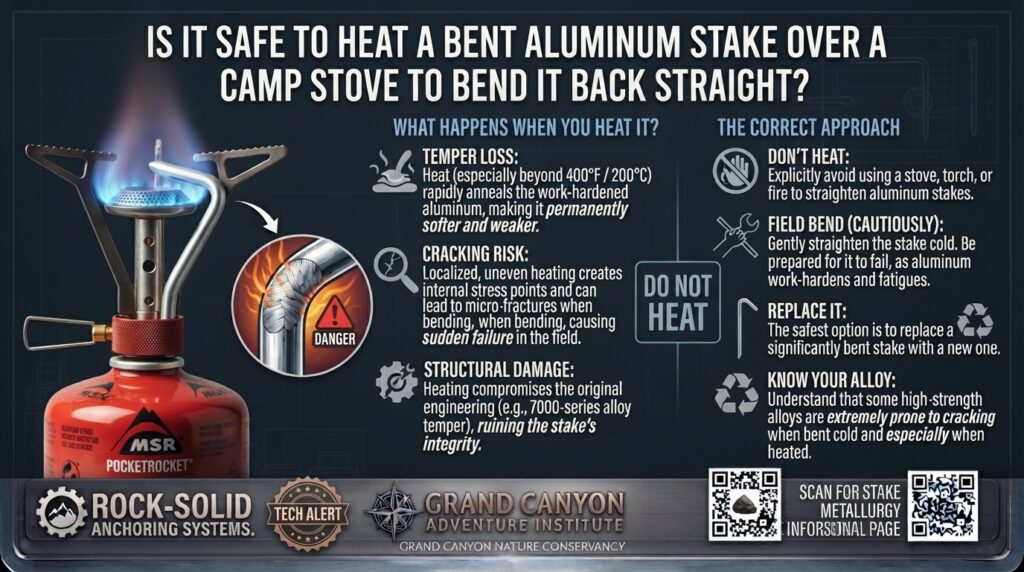
Is it safe to heat a bent aluminum stake over a camp stove to bend it back straight?

It is one of the most frustrating moments on the trail: you are pitching your shelter on packed gravel in Texas, hardpack clay in New York, or rocky alpine dirt in Washington and California, when snap or crunch—your aluminum tent stake strikes a buried rock and bends into an unusable boomerang shape.
Standing over your camp stove at dinner, a seemingly logical backcountry trick comes to mind: What if I hold the bent aluminum stake over the burner flame, heat the metal until it softens, and bend it back straight with pliers?
The short answer is a definitive NO. Heating a bent aluminum tent stake over a camp stove is dangerous, highly ineffective, and permanently destroys the structural strength of the peg.
While heating steel can help anneal and reshape it safely, aluminum behaves completely differently under high heat. Exposure to an open camp stove flame strips aluminum alloys of their factory heat treatment ($T6$ temper), softens the metal permanently, creates extreme hot spots that can cause sudden snapping under force, and releases toxic surface coating fumes in close proximity to where you prepare food.
This comprehensive technical guide dives deep into the metallurgy of aluminum tent pegs, explains the physics of heat treatment loss, reviews cold-straightening field techniques, evaluates top replacement stakes, and answers 10 essential safety and maintenance FAQs.
The Metallurgy: Why Heating Aluminum Destroys It
To understand why a camp stove flame ruins aluminum tent pegs, you must look at how modern high-performance tent stakes are manufactured.
                  ALUMINUM HEAT-TREATMENT DESTRUCTION CYCLE
                                       │
       ┌───────────────────────────────┴───────────────────────────────┐
       ▼                                                               ▼
[ FACTORY T6 TEMPERING ]                                [ CAMP STOVE FLAME EXPOSURE ]
• Heated to ~900°F & rapidly quenched                   • Flame temps exceed 1,500°F–2,000°F
• Artificially aged at ~350°F                           • Anneals metal back to dead-soft "O" temper
• Crystalline matrix aligned for max rigidity            • Destroys yield strength by up to 70%
• Result: Aircraft-grade strength (7075-T6)              • Result: Stake bends under mild hand pressure
1. The $T6$ Temper & Precipitation Hardening
Premium lightweight aluminum stakes—such as those crafted from $7075\text{-T6}$ or $6061\text{-T6}$ alloys—are not strong in their raw state. They achieve high yield strength through a multi-stage thermal process called solution heat treatment and artificial aging ($T6$ temper).
- The alloy is heated to approximately $900^\circ\text{F}$ ($480^\circ\text{C}$), rapidly quenched in water or oil, and then aged at $300^\circ\text{F}\text{–}350^\circ\text{F}$ ($150^\circ\text{C}\text{–}175^\circ\text{C}$) for several hours.
- This aligns copper, zinc, and magnesium atoms into microscopic crystal structures that lock the metal matrix together.
2. What a Camp Stove Flame Actually Does
Canister camp stoves (like Isobutane/Propane backpacking stoves) generate flame temperatures reaching $1,500^\circ\text{F}\text{ to }2,200^\circ\text{F}$ ($800^\circ\text{C}\text{ to }1,200^\circ\text{C}$)—far above aluminum’s annealing threshold and dangerously close to its melting point ($1,220^\circ\text{F} / 660^\circ\text{C}$).
When you hold a $7075\text{-T6}$ aluminum stake over that flame:
- You instantly anneal (soften) the metal, reverting it to “O temper” (dead soft).
- The yield strength drops by $60\%\text{ to }75\%$ permanently.
- The next time you tap the stake into soil with a light stone, it will instantly fold in half like soft wire.
3 Major Hazards of Heating Stakes Over Camp Stoves
  [ HAZARD 1: Toxic Fume Emission ] ──► Anodized color dyes & chemical coatings burn off into camp air
  [ HAZARD 2: Zero Flame Color ]   ──► Aluminum does NOT glow red before melting—it collapses instantly
  [ HAZARD 3: Severe Burn Injury ] ──► Extreme thermal conductivity transfers heat rapidly down pliers
1. Toxic Fume & Surface Coating Inhalation
Virtually all high-end outdoor aluminum pegs are finished with anodized color coatings, synthetic sealants, or painted pull-cord dyes. Burning these chemical coatings over a stove releases toxic fluorocarbon and heavy-metal fumes right where you boil drinking water and cook meals.
2. Sudden Melting Without Visual Warning
Unlike iron and steel—which turn dull red, cherry red, and bright orange as they heat up—aluminum gives zero color warning before melting. An aluminum stake remains silver-colored until it suddenly liquefies and drips molten metal onto your camp stove burner, destroying your cook system.
3. Severe Thermal Conductivity & Burn Hazards
Aluminum has an exceptionally high thermal conductivity rate ($200\text{ W/m}\cdot\text{K}$). Heat travels down the length of a small 7-inch stake in seconds. Holding the end with multi-tool pliers can rapidly heat the tool handles, causing severe skin burns or accidental dropping of glowing metal into dry brush.
Technical Comparison: Heat Behavior of Common Stake Metals
| Metal / Alloy Class | Factory Strength Rating | Annealing Temperature | Reaction to Camp Stove Flame (1,800∘F) | Safe to Heat Bend? |
| 7075-T6 Aircraft Aluminum | Exceptional ($73,000\text{ PSI}$) | $650^\circ\text{F}\text{–}750^\circ\text{F}$ | Destroys $T6$ temper instantly; softens permanently | ABSOLUTELY NO |
| 6061-T6 Standard Aluminum | High ($45,000\text{ PSI}$) | $600^\circ\text{F}\text{–}700^\circ\text{F}$ | Reverts to dead-soft “O” condition; bends under hand force | ABSOLUTELY NO |
| Grade 2 / Grade 5 Titanium | Extreme ($120,000\text{ PSI}$) | $1,300^\circ\text{F}+$ | Resists softening; turns iridescent blue/purple | NO (Requires controlled jig) |
| Forged Carbon Steel (S55C) | Massive ($100,000+\text{ PSI}$) | $1,400^\circ\text{F}+$ | Glows red; can be hot-reshaped if quenched properly | YES (With safety gloves/water) |
How to Correctly Straighten Bent Stakes in the Field (Cold-Bending)
If you are stuck miles in the backcountry with a bent aluminum or titanium peg, cold-bending is the only safe field repair method.
                       SAFE COLD-BENDING FIELD METHODS
                                     │
       ┌─────────────────────────────┴─────────────────────────────┐
       ▼                                                           ▼
[ METHOD A: THE TWO-ROCK CRUNCH ]                           [ METHOD B: TREE ROOT LEVER ]
• Place bent apex on flat rock                              • Find tight fork in tree root or log
• Strike apex gently with smooth hand rock                  • Insert stake body into fissure
• Leverage slowly in small increments                       • Lever gently against bend until straight
Method 1: The Two-Rock Flat Crunch
- Find a flat, solid boulder or rock ledge to serve as a anvil.
- Position the bent apex of the stake facing upward against the flat rock.
- Take a smooth, flat hand-sized stone and tap the apex in short, controlled taps.
- Do not swing hard: Controlled light taps straighten aluminum without creating stress fractures along the outer metal spine.
Method 2: The Tree Root or Log Notch Lever
- Locate a tight split in a fallen log or a hard gap between two exposed tree roots.
- Insert the lower half of the bent stake into the gap up to the bend apex.
- Grasp the top head of the stake and apply slow, steady leverage in small $5\text{-degree}$ increments until straight.
Work Hardening Warning: Every time you bend cold aluminum back and forth, you introduce work hardening and micro-fissures along the bend radius. A cold-straightened stake will retain about $60\%\text{ to }70\%$ of its original strength and should be replaced once you return home.
Product Reviews: Top Heavy-Duty Replacement Stakes That Resist Bending
If you are tired of soft pegs bending on hard rocky soil across California, Texas, Washington, or New York, upgrading to higher shear strength or forged anchors eliminates the problem entirely:
1. MSR Groundhog Stake (7075-T6 Tri-Flange Aluminum)
- Best Overall Balance of Ultralight Weight & Bending Resistance
Constructed from premium $7075\text{-T6}$ aluminum with a 3-sided Y-beam architecture, MSR Groundhogs distribute lateral soil forces across three structural ribs.
- Key Specifications:
- Material: 7075-T6 Series Extruded Aluminum.
- Length: $7.5\text{ inches}$ ($19\text{cm}$).
- Weight: $0.46\text{ oz}$ ($13\text{g}$) per stake.
- Pros: Y-beam geometry resists bending under offset hammer blows; notch holds guy-lines firmly; exceptional strength-to-weight ratio.
- Cons: Hard hammer blows directly onto solid granite can notch the top rim.
2. Snow Peak Solid Stake 20 (S55C Forged Carbon Steel)
- Best Indestructible Option for Extreme Rocky Ground & Gravel
Forged using liquid steel press molds in Japan, Snow Peak Solid Stakes are built to smash directly through subterranean rocks, roots, and hardpack clay without bending a fraction of a millimeter.
- Key Specifications:
- Material: Forged S55C High-Carbon Steel.
- Length: $7.8\text{ inches}$ ($20\text{cm}$).
- Weight: $2.6\text{ oz}$ ($75\text{g}$) per stake.
- Pros: Completely indestructible under mallet impacts; can be safely heat-treated or hot-straightened if ever damaged; drives flush into any terrain.
- Cons: Significantly heavier than aluminum (car, overlanding, and RV camping focus).
3. Vargo Titanium Shepherd’s Hook Stake
- Best Ultralight Backup Stake for Hardpack Trail Soil
Crafted from high-tensile titanium alloy rods, these slim hooks slip past tight pebbles and offer high elasticity—meaning they flex under stress and spring back straight rather than permanently bending.
- Key Specifications:
- Material: High-Strength Grade 2 Titanium.
- Length: $6.5\text{ inches}$ ($16.5\text{cm}$).
- Weight: $0.28\text{ oz}$ ($8\text{g}$) per stake.
- Pros: Extreme fatigue resistance; will not rust or corrode; spring-like memory helps resist permanent deformation.
- Cons: Thin diameter offers lower holding tension in loose sand or soft topsoil.
4. GroundGrip Heavy-Duty Steel Screw-In Drill Pegs
- Best Mechanical Anchor for Desert Caliche & Gravel
Featuring thick-walled carbon steel shafts with threaded Archimedes spirals, these drillable stakes bypass hammering entirely—boring directly into hard gravel with a cordless driver.
- Key Specifications:
- Material: Galvanized Carbon Steel.
- Drive Head: $13\text{mm}$ ($1/2\text{ inch}$) Hex socket head.
- Length: $8.0\text{ inches}$ ($20\text{cm}$).
- Pros: Eliminates hammer strikes that cause stake bending; extreme holding power in high-wind canopy setups; easy zero-effort removal.
- Cons: Requires packing a cordless drill driver or hand ratchet.
Replacement Stake Performance Matrix
| Product Model | Alloy / Material | Yield Strength Rating | Bending Resistance | Field Repairability | Best For |
| MSR Groundhog | $7075\text{-T6}$ Aluminum | High ($73,000\text{ PSI}$) | Excellent (Y-Beam) | Cold-bend only | Backpacking, Mixed Soil |
| Snow Peak Solid 20 | Forged S55C Steel | Extreme ($100,000+\text{ PSI}$) | Unbeatable | Heat or Cold repairable | Car Camping, Rocky Ground |
| Vargo Titanium Hook | Grade 2 Titanium | High ($120,000\text{ PSI}$) | Good (High Elasticity) | Cold levering | Ultralight Thru-Hiking |
| GroundGrip Drill Pegs | Galvanized Steel | Extreme ($95,000\text{ PSI}$) | Unbeatable | Cold repairable | Overlanding, High Winds |
5 Practical Field Rules to Prevent Bending Tent Stakes
  [ RULE 1: Clear Loose Surface Rock ] ──► Remove top stones before driving stake down
  [ RULE 2: Use Rubber / Wood Mallet ] ──► Avoid heavy steel sledgehammer strikes on soft aluminum
  [ RULE 3: Stop at Obstructions ]    ──► If stake stops dead, adjust angle 15°—do not force it
  [ RULE 4: 45° Angle Placement ]      ──► Drive leaning 45° away from shelter pull
  [ RULE 5: Carry 2 Forged Steel Spares]──► Use a steel "pilot stake" to pre-punch hard ground
1. Stop Driving When You Strike Bedrock
The #1 cause of bent stakes is aggressive pounding after hitting a solid subterranean rock. If a stake stops moving downward after two firm taps, stop hammering! Back the stake out $2\text{ inches}$, pivot the driving angle $10\text{–}15\text{ degrees}$ to clear the rock edge, and tap again.
2. Use a Steel “Pilot Stake” for Rocky Soil
If you love ultralight aluminum stakes for backpacking in rocky areas, carry one single $8\text{-inch}$ steel or titanium nail peg as a “hole puncher.” Hammer the steel peg into hard soil first to create a pilot hole, pull it out, and slide your lightweight aluminum stake into the pre-formed hole.
3. Tap Center-Head, Not at Slanted Angles
Glancing hammer blows hit the rim of a stake head at an angle, introducing lateral shear force that instantly buckles the middle shaft. Always align your hammer face perpendicular to the stake’s top head.
4. Distribute Force with a Smooth Stone
If you don’t carry a camp hammer and must use a trail rock, pick a smooth, wide, flat river stone. Narrow or sharp rocks concentrate impact force on a single point, cracking or bending aluminum stake tops.
5. Never Kick Stakes into Ground with Heavy Boots
Kicking tent pegs into soil with hiking boots exerts uncontrolled body weight force ($150\text{–}200+\text{ lbs}$) at an off-center angle. This is the fastest way to ruin aluminum pegs. Always drive stakes using controlled hand-held impact tools.
Frequently Asked Questions (FAQ)
1. What happens if I heat a bent aluminum stake over a camp stove anyway?
The aluminum will lose its $T6$ heat treatment tempering, reverting to dead-soft “O temper.” While it will be easy to bend back straight, the metal will be permanently weakened and will fold effortlessly the next time you tap it into basic dirt.
2. Can I re-temper an aluminum stake at home after heating it?
Technically yes, but it is practically impossible without specialized metallurgical equipment. Re-tempering requires heating the alloy to precise temperatures ($900^\circ\text{F}$), water quenching in milliseconds, and baking in an industrial furnace at $350^\circ\text{F}$ for 8 to 12 hours. Buying a new $3 stake is far safer and cheaper.
3. Is it safe to heat titanium tent stakes to bend them back?
While titanium handles heat much better than aluminum, heating it over an open camp stove without precise temperature controls can cause oxidation embrittlement (absorbing oxygen and hydrogen into the titanium matrix), making the metal brittle and prone to snapping. Cold-bending is always safer.
4. Can I heat forged steel tent stakes to straighten them?
Yes. Forged carbon steel (like Snow Peak Solid Stakes) can be heated red-hot over a controlled heat source, hammered straight on an anvil or rock, and allowed to air-cool without losing its fundamental structural integrity.
5. Why did my aluminum stake snap in half when I tried cold-straightening it?
When aluminum is bent, the outer curve suffers extreme tension while the inner curve compresses, causing work hardening along the crystalline boundary. When you bend it back cold, that hardened area cannot stretch, causing a fatigue snap.
6. What is the strongest type of aluminum for tent stakes?
$7075\text{-T6}$ aluminum is the strongest alloy used in tent peg manufacturing. It has a tensile yield strength of roughly $73,000\text{ PSI}$—nearly double that of standard $6061\text{-T6}$ aluminum ($45,000\text{ PSI}$).
7. Does heating an anodized aluminum stake release toxic fumes?
Yes. Anodized coatings contain chemical dyes, acid seals, and organic compounds. Burning these coatings over an open flame produces chemical off-gassing that should never be inhaled or burned near cooking gear.
8. How many times can I cold-straighten an aluminum tent stake before it fails?
Generally, an aluminum stake can only be cold-straightened once or twice before the stress-hardened metal cracks or snaps completely. Consider any cold-bent stake a temporary emergency fix until you can buy a replacement.
9. Will a bent tent stake ruin my tent’s guy-lines?
If the stake bend creates sharp creased edges or cracks along the metal shaft, those jagged aluminum burrs can easily chafe, fray, or snap expensive nylon or Dyneema guy-lines under wind tension.
10. Are Y-beam or round hook stakes less likely to bend?
Y-beam stakes (like MSR Groundhogs) are significantly more resistant to bending than simple round wire hooks. The three radiating structural flanges act like I-beams, distributing impact forces along multiple dimensional axes.
Conclusion
While holding a bent aluminum tent stake over a camp stove seems like a clever backcountry hack, metallurgy and basic trail safety prove otherwise. Heating high-tensile aluminum destroys its factory $T6$ temper, softens the metal permanently, creates toxic coating fumes, and ruins the stake for future use.
When faced with a bent aluminum peg on the trail, stick strictly to cold-bending methods using flat rocks or tree root notches. Once you return home, discard the weakened peg and upgrade to 7075-T6 Y-beam aluminum, Grade 2 titanium, or forged carbon steel stakes to ensure your shelter stays anchored in any terrain.