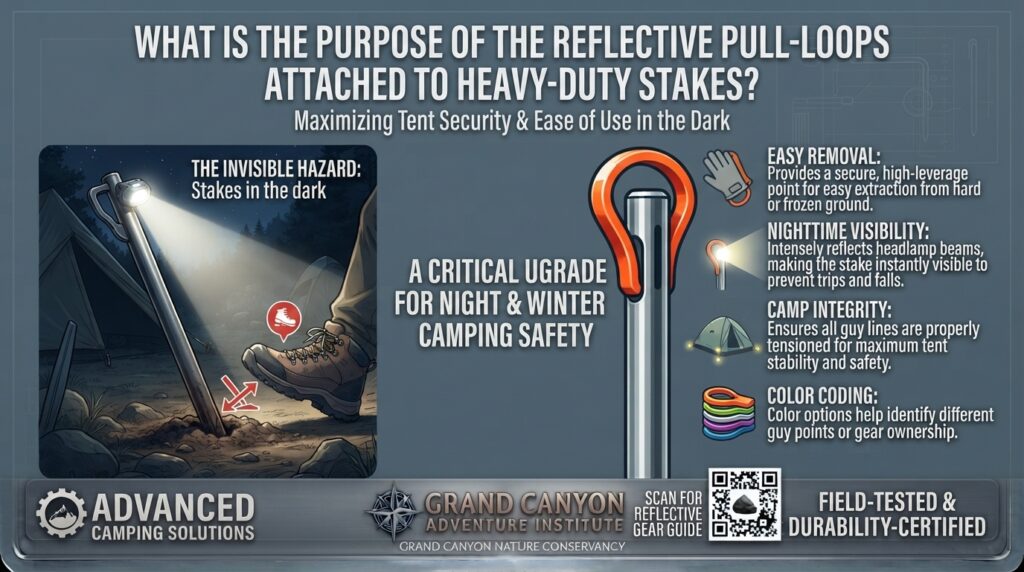
What is the purpose of the reflective pull-loops attached to heavy-duty stakes?

If you have ever unpacked a premium set of heavy-duty tent stakes—whether crafted from forged carbon steel, aircraft-grade $7075\text{-T6}$ aluminum, or high-tensile titanium—you have likely noticed a small loop of cord threaded through the head of each peg.
Far from being a mere decorative accessory or a gimmick added by gear manufacturers, these small cords—specifically engineered as reflective pull-loops—serve critical mechanical, safety, and operational functions on the campsite.
Whether you are anchoring a heavy canvas tent along damp Washington riverbanks, pitching a shelter on the wind-swept bluffs of Northern California and San Francisco, setting up a family canopy on packed Texas soil, or camping across the rocky Adirondacks in New York, these loops are your primary defense against night-time trip hazards, lost gear, and grueling morning strike-downs.
The primary purpose of reflective pull-loops on heavy-duty stakes is twofold: night-time visibility and mechanical extraction leverage. The embedded retro-reflective threads illuminate under headlamp beams to prevent dangerous trip hazards around guy-lines, while the high-tensile paracord loop provides a ergonomic grip to pull deeply embedded stakes out of compacted soil without needing claw hammers or secondary extraction tools.
This masterclass technical guide breaks down the optics and materials science of reflective cords, details the mechanical physics of leverage extraction, reviews top stake systems equipped with pull-loops, shares expert knotting and care tips, and answers 10 essential FAQs for outdoor enthusiasts.
The Core Functions: Why Every Heavy-Duty Stake Needs a Reflective Loop
While a basic wire hook peg relies solely on its bent top, heavy-duty forged steel spikes, Y-beams, and drill-able lag screws feature dedicated eyelets built specifically for cord loops. Here are the four fundamental reasons why these reflective loops are indispensable:
                  THE 4 QUADRANTS OF REFLECTIVE PULL-LOOP UTILITY
                                       │
       ┌───────────────────────────────┼───────────────────────────────┐
       ▼                               ▼                               ▼
[ 1. TRIP HAZARD PREVENTION ]   [ 2. MECHANICAL LEVERAGE ]     [ 3. ZERO-LOSS VISIBILITY ]
3M Retro-reflective threads     Provides finger/tool leverage   Prevents losing $5–$15 stakes
glow under headlamps.           to pull flush steel spikes.     buried in grass or dark mud.
                                                                       │
                                                                       ▼
                                                       [ 4. FAST CORD IDENTIFICATION ]
                                                       Enables quick color-coded stake
                                                       sorting in gear bags.
1. Night-Time Trip Hazard Mitigation & campsite Safety
Guy-lines stretching from tents to ground anchors are notoriously invisible in the dark. At night, campers walking around tents frequently kick low-profile steel stakes or trip over taut guy-lines.
Reflective pull-loops feature woven 3M™ Scotchlite™ retro-reflective tracer threads. When ambient light from a headlamp, flashlight, or lantern strikes the loop, the embedded glass micro-spheres bounce light directly back toward the source—making the ground anchor glow brightly from dozens of feet away.
2. High-Leverage Extraction Assistance (The Finger & Tool Grip)
Heavy-duty forged stakes are designed to be driven 100% flush into the ground to eliminate fulcrum leverage in high winds. However, once a flush steel peg is embedded deep into hardened clay, riverbed gravel, or frozen mud, grabbing the metal head with bare fingers is nearly impossible.
The pull-loop creates a high-strength grip point. You can insert a finger, a secondary stake shaft, a stick, or a specialized stake-puller hook into the loop to pull the stake straight out using your leg muscles rather than straining your fingers or hammering the peg sideways.
3. Equipment Loss Prevention in Grass, Mud, and Snow
Premium heavy-duty stakes cost anywhere from $3 to $15 per peg. Because they are driven level with the soil line, dark grey steel, black oxide, or tan aluminum pegs easily blend into dark topsoil, autumn leaves, tall grass, or snowpack.
A bright neon cord loop with reflective weaving remains visible even when the metal stake body is entirely submerged in dirt or mud, ensuring you never leave expensive anchors behind when breaking camp.
4. Shock Absorption & Secondary Guy-Line Tie Points
When unexpected storm gusts hit your shelter, static guy-lines exert sudden shock loads on your stakes. High-strength nylon or Dyneema pull-loops act as secondary load distributors. In specialized setups where a stake head cannot accommodate two guy-line hooks directly, the loop serves as a secure secondary attachment point.
The Materials Science: How Reflective Pull-Loops Work
Not all reflective cords are constructed equally. High-performance pull-loops rely on precise textile engineering to combine high tensile strength with maximum optical reflectivity.
                           ANATOMY OF A HEAVY-DUTY PULL-LOOP
                                         │
         ┌───────────────────────────────┼───────────────────────────────┐
         ▼                               ▼                               ▼
  [ INNER CORE ]                  [ OUTER SHEATH ]               [ RETRO-REFLECTIVE TRACERS ]
  Ultra-high-molecular-weight     High-density braided           Double-woven 3M Scotchlite
  Polyethylene (Dyneema) or      Nylon/Polyester jacket for      ribbons reflecting light back
  multi-strand Nylon 550.         abrasion protection.            to light source at 180°.
1. Retro-Reflectivity vs. Standard Glow-in-the-Dark
It is critical to distinguish between glow-in-the-dark (phosphorescent) materials and retro-reflective threads:
- Phosphorescent Cords: Absorb UV light during the day and emit a weak, temporary green glow that fades after 1 to 2 hours in total darkness.
- Retro-Reflective Cords (3M Scotchlite): Contain thousands of microscopic, aluminum-coated glass prisms woven into the outer sheath. They require zero charging time and reflect concentrated light instantly back to a headlamp wearer from up to $50\text{–}100\text{ feet}$ away, remaining effective all night long.
2. Tensile Strength Ratings
Because campers pull embedded stakes out using these loops, the cordage must withstand significant tension without snapping or fraying against sharp metal eyelet edges.
| Cord Material Type | Typical Diameter | Tensile Breaking Strength | Abrasion Resistance | Reflective Properties |
| Dyneema / UHMWPE Core Cord | $2.0\text{–}2.5\text{mm}$ | $450\text{–}600+\text{ lbs}$ | Unbeatable | High (Twin 3M Tracers) |
| Paracord 550 (Type III) | $4.0\text{mm}$ | $550\text{ lbs}$ | High | High (Woven Sheath) |
| Standard Polyester Utility Cord | $3.0\text{mm}$ | $150\text{–}200\text{ lbs}$ | Moderate | Moderate (Single Tracer) |
| Glow-in-the-Dark Nylon | $3.0\text{mm}$ | $100\text{–}150\text{ lbs}$ | Low | Poor (Fades overnight) |
Regional Environmental Factors Across Key US Camping Zones
Reflective pull-loops play distinct functional roles depending on where you set up camp across the United States:
| Camping Region | Soil & Terrain Profile | Environmental Challenge | Primary Pull-Loop Benefit |
| Pacific Northwest (Washington / Coastal CA) | Dense green moss, pine needles, wet loam | Dark forest floors swallow dark metal stakes | High-visibility neon color contrast prevents gear loss |
| Coastal San Francisco & CA Beaches | Loose sand, coastal fog, early darkness | Dense fog diffuses light; stakes sink deep | Retro-reflective tracers pierce heavy coastal fog |
| Northeastern Forests (New York / Adirondacks) | Autumn leaf litter, rocky forest soil | Stakes get buried under damp leaves & mud | Pull-loop gives tool grip to pull past roots/rocks |
| Texas Gulf & Desert Interior | Hardpack clay, caliche, dense gravel | Stakes driven fully flush with heavy mallets | Allows leverage pull without digging up hard dirt |
Product Reviews: Top Heavy-Duty Stakes with Factory Reflective Loops
Upgrading to heavy-duty stakes equipped with pre-installed reflective pull-loops saves time and elevates campsite safety. Here are four top-rated stake systems evaluated for loop strength, stake geometry, and terrain durability:
1. Snow Peak Solid Stake 20 (Customized with Dyneema Reflective Loops)
- Best Overall Forged Steel Anchor with Ultra-Strong Pull-Loops
Forged in Japan from high-carbon steel, Snow Peak Solid Stakes feature a large, smoothed eyelet head engineered specifically to accommodate thick high-tensile cords without chafing.
- Key Specifications:
- Stake Material: S55C Forged Carbon Steel.
- Length: $7.8\text{ inches}$ ($20\text{cm}$).
- Loop Spec: 2.5mm Reflective Dyneema Core Cord ($500\text{ lb}$ strength).
- Pros: Indestructible steel body; smoothed eyelet edges prevent cord fraying; massive reflective visibility.
- Cons: Higher total weight (ideal for car, overland, and RV camping).
2. MSR Groundhog Tent Stakes (Factory Reflective Pull-Loops)
- Best Lightweight Tri-Flange Aluminum Stakes for Backpacking
Constructed from premium $7075\text{-T6}$ aircraft-grade aluminum, MSR Groundhogs come equipped from the factory with brightly colored reflective cord loops attached to their notched tops.
- Key Specifications:
- Stake Material: 7075-T6 Extruded Aluminum.
- Length: $7.5\text{ inches}$ ($19\text{cm}$).
- Loop Spec: High-visibility red/reflective braided cord.
- Pros: Ultralight ($0.46\text{ oz}$ per stake); factory cord loop simplifies pulling from hardpack dirt; Y-beam design resists bending.
- Cons: Cord loops can wear over years of heavy use on granite rocks and need occasional replacement.
3. MSR Cyclone Stakes (Spiral Design with Reflective Pull-Loops)
- Best Anchor for High Winds, Sand, and Soft Soil
Featuring a twisted aluminum architecture, MSR Cyclones lock tightly into soft dirt, beach sand, and snow. Their high-tensile reflective loops make extracting these wide-surface anchors effort-free.
- Key Specifications:
- Stake Material: 7070-Series Aluminum.
- Length: $10.0\text{ inches}$ ($25\text{cm}$).
- Loop Spec: Braided reflective cordage.
- Pros: Massive holding power; spiral design pulls out smoothly when lifted using the reflective cord loop; exceptional neon contrast.
- Cons: Larger physical footprint in your stake bag.
4. Vargo Titanium Nail Pegs (with Ultralight Reflective Loops)
- Best Compact Option for Alpine Fissures & Hardpack Trails
Designed for high-altitude backpackers, these straight titanium nail spikes feature flat drive heads and recessed cord holes equipped with ultralight reflective pull-loops.
- Key Specifications:
- Stake Material: Grade 2 Titanium.
- Length: $6.0\text{ inches}$ ($15.2\text{cm}$).
- Loop Spec: 2.0mm Micro-Reflective Cordage.
- Pros: Extremely lightweight ($0.6\text{ oz}$); titanium will not rust; compact profile slips past gravel; reflective loop assists in quick extraction from rock cracks.
- Cons: Slim body offers lower surface tension in soft sand.
Head-to-Head Technical Matrix: Stake Pull-Loop Performance
| Stake Model | Body Material | Loop Cord Type | Loop Tensile Rating | Optical Reflectivity | Extraction Ergonomics |
| Snow Peak Solid 20 | Forged S55C Steel | Dyneema / 3M Tracer | 600+ lbs | Exceptional | Superior (Full hand pull) |
| MSR Groundhog | $7075\text{-T6}$ Aluminum | Braided Nylon/Reflective | $200\text{ lbs}$ | High | Excellent (Two-finger pull) |
| MSR Cyclone | $7070\text{-T6}$ Aluminum | Braided Nylon/Reflective | $200\text{ lbs}$ | High | Excellent (Full lever pull) |
| Vargo Titanium Nail | Grade 2 Titanium | Micro-Polyester/Reflective | $150\text{ lbs}$ | Moderate | Good (Single-finger pull) |
Step-by-Step Guide: How to DIY Install or Replace Reflective Loops
If your stakes came without loops, or if old cords have frayed after seasons of hard use, installing custom Dyneema reflective loops is a simple 10-minute DIY project:
  [ STEP 1: Cut Cord & Fuse Ends ] ──► Cut 8" segment of 2.5mm reflective cord; melt tips with lighter
  [ STEP 2: Thread Through Eyelet ] ──► Push loop end through the stake head hole
  [ STEP 3: Tie Overhand or Larks ] ──► Form a tight Larks Head or Fisherman's knot
  [ STEP 4: Test Tension Load ]    ──► Pull firmly with tool to set the knot permanently
1. Select the Right Cordage
Purchase a spool of $2.5\text{mm to }3.0\text{mm}$ UHMWPE (Dyneema) core cord with double-woven 3M Scotchlite reflective tracers. Avoid cheap crafts-store cordage, which snaps under heavy pull force.
2. Cut and Melt the Cord Ends
Cut the cord into 8-inch ($20\text{cm}$) segments. Use a lighter to heat and fuse the cut ends instantly, preventing the outer reflective sheath from unraveling.
3. Attach via a Lark’s Head (Girth Hitch) or Overhand Loop
- Option A (Lark’s Head Knot): Fold the 8-inch cord in half. Tie a simple overhand knot near the open ends to create a permanent loop. Feed the looped end through the stake eyelet, then pull the knotted end back through the loop. Pull tight.
- Option B (Direct Loop Knot): Thread the raw cord through the stake eyelet and bind the ends together using a Double Fisherman’s Knot.
5 Practical Tips for Maintaining Reflective Stake Loops
- Inspect for Sharp Burrs inside Metal Eyelets: Mallet impacts can crush metal, creating sharp steel or aluminum burrs inside the stake eyelet. Smooth out burrs using a round needle file before threading soft cords to prevent premature fraying.
- Wash Away Dried Mud After Trips: Dirt, grit, and clay coat reflective glass micro-beads, dulling their optical reflectivity. Rinse loops under fresh water and scrub lightly with an old toothbrush after muddy trips.
- Keep Cords Clear of Open Flames: Reflective nylon and polyester sheath fibers melt at $450^\circ\text{F}$ ($230^\circ\text{C}$). Keep stake loops away from campfires, camp stove burners, and hot lantern tops.
- Color-Code Different Stake Lengths: Use bright yellow reflective cord for 8-inch stakes and neon orange reflective cord for 12-inch stakes. This allows you to identify and grab the exact stake length you need from your gear bag instantly.
- Use a Hook Tool for Frozen Extraction: In sub-freezing winter weather, do not pull frozen loops with bare gloved fingers. Insert a metal tent stake or a carabiner through the loop to create a T-handle pull tool, allowing you to use your shoulder muscles without straining the cord knot.
Frequently Asked Questions (FAQ)
1. Why don’t all tent stakes come with reflective pull-loops from the factory?
Budget tent stakes leave off pull-loops to lower manufacturing and material costs. Premium stake manufacturers include them because they add significant value in safety, night-time visibility, and extraction ease.
2. Will pulling embedded stakes by the cord loop cause the cord to snap?
If you use high-quality 2.5mm Dyneema or 550 Paracord, the cord loop can handle $200\text{ to }500+\text{ lbs}$ of tension—far more force than is needed to pull an embedded stake from soil. Cheap thin polyester cords, however, can snap if pulled aggressively against sharp rocks.
3. How far away can you see reflective pull-loops at night?
When illuminated by a modern $200+\text{ lumen}$ LED headlamp, high-quality 3M Scotchlite retro-reflective tracers glow brightly from $50\text{ to }100+\text{ feet}$ away, even in dark wilderness environments.
4. Do reflective pull-loops glow in the dark without a light source?
No. Retro-reflective cords require an active light source (like a headlamp, flashlight, moonlight, or lantern) to bounce light back. They do not emit self-powered phosphorescent glow without light.
5. Can I use reflective pull-loops to tie guy-lines directly?
Yes! If your stake is driven deep into rock cracks or hardpack dirt where the top hook is blocked, tying or clipping your shelter’s guy-line directly into the high-strength pull-loop provides a completely secure anchor point.
6. What is the best knot for making DIY reflective stake loops?
A Lark’s Head (Girth Hitch) combined with an Overhand Loop, or a Double Fisherman’s Knot, provides maximum holding security and prevents the loop from slipping off the stake head.
7. How do I clean mud off reflective cords without ruining the reflective threads?
Soak the loops in a bucket of warm water mixed with mild dish soap for 5 minutes. Scrub gently with a soft sponge or toothbrush to remove dried clay, then air-dry completely. Avoid harsh bleach or chemical solvents.
8. Are reflective pull-loops helpful when camping in snow?
Yes, immensely. Dark stakes driven into white snow can become invisible if fresh flurries fall overnight. Reflective pull-loops stick up above the snowpack, reflecting headlamp beams instantly during midnight bathroom trips or morning pack-ups.
9. Will UV sunlight degrade reflective pull-loops over time?
Prolonged UV exposure over several years can eventually weaken nylon fibers and dull outer dyes. Storing your stakes inside an opaque canvas roll or gear pouch when not in use protects the cordage from UV breakdown.
10. What diameter of reflective cord is best for tent stake eyelets?
A cord diameter between $2.0\text{mm}$ and $3.0\text{mm}$ is ideal. It fits easily through standard stake eyelets while offering exceptional breaking strength ($200\text{–}500\text{ lbs}$) and optimal reflective surface area.
Conclusion
Reflective pull-loops attached to heavy-duty stakes are a masterclass in functional outdoor design. By blending 3M retro-reflective optics with high-tensile braided cordage, these small loops solve the biggest headaches of campsite management: eliminating night-time trip hazards around guy-lines, preventing lost stakes in grass and mud, and providing powerful ergonomic leverage to pull deeply embedded steel and aluminum anchors effortlessly.
Whether you buy stakes equipped with factory cords or spend 10 minutes retrofitting your current kit with high-strength Dyneema reflective cord, this simple upgrade ensures a safer, more efficient, and stress-free camping experience on any terrain.