
Picture this: You are setting up your tent at a scenic campsite—perhaps navigating the rocky granite of California’s Sierra Nevada, the damp, root-filled forest floors of Washington State, the dense, sun-baked clay of Texas, or the frosty ground of upstate New York. It is getting dark, the temperature is dropping, and as you drive your final tent stake into the stubborn earth, snap or bend.
You pull it out, and your lightweight aluminum stake is warped into an unsightly curve. In a moment of camp-hacks ingenuity, you look at your roaring camp stove and think: “Aluminum is metal. If I heat it up, I can easily bend it back straight.”
Before you toss that stake over an open flame, you need to understand the metallurgy, the physics, and the severe safety risks involved. Heating a bent aluminum tent stake over a camp stove can permanently destroy its structural integrity, weaken the metal, or cause it to snap unpredictably when you need it most.
The Metallurgy: What Heat Does to Aluminum Stakes
To understand why using a camp stove on a tent stake is a risky gamble, we have to look at how tent stakes are manufactured.
Most high-performance backpacking stakes are made from structural aluminum alloys, commonly 7075-T6 or 6061-T6. The “-T6” designation is critical: it means the metal has been solution heat-treated and artificially aged. This specific manufacturing process gives the aluminum its high tensile strength, allowing it to withstand being hammered into hard ground without snapping.
1. The Loss of Temper (Annealing)
When you apply direct, uncontrolled heat from a camp stove (which can easily reach temperatures exceeding 1,000°F / 538°C), you alter the microscopic crystalline structure of the aluminum. This process is known as annealing.
- Heating the metal relieves internal stresses and undoes the factory heat-treatment.
- Once annealed, the aluminum loses its hardened temper.
- The stake transforms from a rigid, springy structural component into soft, pliable metal that bends effortlessly—and uselessly—under minimal wind load.
2. The Danger of Melting
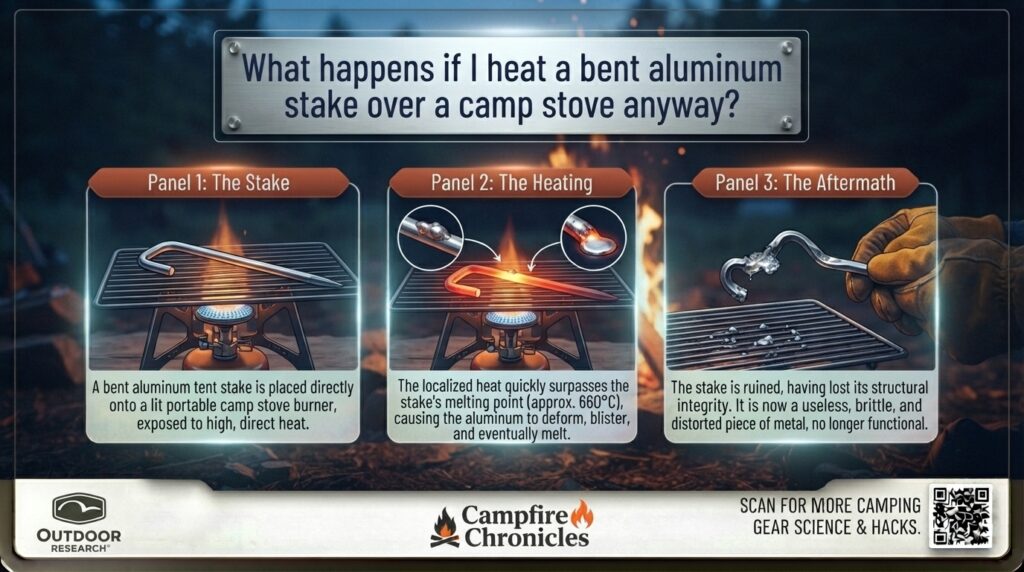
Aluminum has a relatively low melting point compared to steel—around 1,220°F (660°C). A standard backpacker’s canister stove or liquid fuel stove can easily hit temperatures high enough to melt aluminum if left unattended for even a short period. You might pull out a stake only to find a deformed blob of slag or a weakened shaft riddled with micro-cracks.
3. Structural Fatigue and Hidden Fractures
Even if the stake looks straight after cooling, heating it creates inconsistent grain structures throughout the metal. When the wind picks up at 2.00 AM and puts lateral pressure on your tent fly, that heat-treated spot will act as a failure point. The stake will likely snap cleanly in half, leaving your shelter compromised in the middle of a storm.
Can You Ever Straighten a Bent Aluminum Stake? (Cold Working vs. Hot Working)
If heating it up is a bad idea, how should you fix a bent stake?
The short answer is: You can cold-work certain aluminum stakes, but you should accept that they will never be as strong as they were originally.
How to Cold-Bend a Stake Safely:
- Assess the damage: If the stake has a smooth curve, you can usually salvage it. If it has a sharp, acute kink or crease, the metal is already structurally compromised and should be retired.
- Use tools, not your hands: Place the stake on a flat rock or piece of dense wood. Use a smooth-faced mallet or a smooth stone to gently tap the bend back into alignment.
- Avoid repetitive bending: Aluminum does not like to be worked back and forth (work hardening). Bending it straight once might work, but bending it twice will almost certainly cause it to snap.
Stake Material Comparison: How Aluminum Stacks Up
When building your camping kit for diverse American landscapes—from the sandy beaches of the Pacific coast to the rocky alpine zones of the Cascades—choosing the right material matters. Here is how aluminum compares to other common materials under stress and heat:
| Material | Weight | Strength-to-Weight Ratio | Reaction to Heat / Torch | Best Used For |
| Aluminum (7075/6061) | Ultra-Lightweight | High | Loses temper, weakens, or melts | Backpacking, general camping, weight-conscious hikers |
| Titanium | Ultra-Lightweight | Extremely High | Can handle higher heat, but loses springiness | Rocky soils, ultralight backpackers |
| Forged Steel | Heavy | Maximum | Withstands high heat well (though rarely needed) | Car camping, frozen ground, high winds, heavy canvas tents |
| Plastic / Resin | Lightweight | Low | Melts instantly | Sandy soil, snow anchors, casual fair-weather camping |
Product Reviews: Best Replacement Stakes for US Campers
If your bent aluminum stakes are beyond saving, it is time to upgrade. Here are the top-performing tent stakes suited for various terrains across Texas, New York, California, and Washington.
1. MSR Ground Hog Stakes
- Best For: All-around backpacking and varied soil conditions (California granite, Washington forest loam).
- Material: 7000-series aluminum.
- Why We Love Them: The Y-beam design offers incredible holding power in loose or semi-firm soil. They resist bending far better than cheap wire stakes. While they can still bend if hammered directly into solid rock, their geometry makes them the gold standard for backpackers.
2. Titanium Shepherd’s Hook Stakes
- Best For: Ultralight backpacking, weight-conscious thru-hikers.
- Material: Grade 5 Titanium.
- Why We Love Them: Feather-light and virtually indestructible against rust. While they can bend under extreme pressure, titanium springs back much better than aluminum. They slip easily into rocky Pacific Northwest trails.
3. Coleman Heavy-Duty Steel Tent Stakes
- Best For: Car camping, high winds, and stubborn Texas caliche clay or frozen New York winter ground.
- Material: Forged Steel.
- Why We Love Them: You cannot bend these easily, and you certainly don’t need to heat them. If you are car camping where weight is not an issue, steel stakes drive through almost anything without flinching.
Expert Tips for Tent Stake Longevity
Preventing bent stakes in the first place saves you time, money, and frustration on your camping trips. Follow these expert guidelines:
- Never hammer with a rock blindly: If you hit a buried boulder or tree root, stop hammering immediately. Forcing an aluminum stake against rock will bend the shaft instantly. Reposition the stake at a 45-degree angle away from the tent.
- Use the right tool: Carry a small rubber mallet or use the flat base of a hatchet rather than jagged, sharp rocks that can dent and gouge aluminum.
- Pack terrain-specific stakes: Do not rely on thin wire aluminum stakes if you are camping in rocky California canyons or frozen New York state parks. Bring heavy-duty stakes or specialized snow/sand anchors when necessary.
- Pull by the stake, not the cord: When packing up camp, pulling on the guyline or tent cord can leverage the stake at an angle, causing it to warp. Pull straight up using a stake puller or loop a spare stake through the eyelet for leverage.
10 Comprehensive FAQs
1. Will heating aluminum make it stronger?
No. Heating structural aluminum (like the alloys used in tent stakes) relieves internal stresses and undoes the factory heat treatment. This process, called annealing, actually makes the aluminum softer, more pliable, and much weaker.
2. Can I use a lighter to straighten an aluminum tent stake?
A standard pocket lighter does not generate enough even heat to fix a bend, but it can blacken the stake and deposit soot. More importantly, attempting to heat a stake locally without proper metallurgical control will result in uneven structural weakness.
3. What happens if I melt my tent stake over a camp stove?
Molten aluminum glows dull red before turning liquid and collapsing. If it melts, your stake is completely ruined. Furthermore, burning aluminum can release irritating fumes and create a messy hazard on your camp stove burner.
4. Is it safe to use a bent tent stake?
It depends on the severity of the bend. A slight curve will still hold a tent in mild weather, though its holding power is reduced. However, a sharply kinked or heat-weakened stake can snap under wind loads, causing your tent to collapse in a storm.
5. Why do high-end tent stakes bend so easily?
High-end backpacking stakes prioritize a high strength-to-weight ratio. To keep your pack light, manufacturers use thin-walled aluminum tubing. This makes them lightweight and strong against straight pulling forces, but vulnerable to lateral shear stress (like hitting a rock sideways).
6. Are titanium stakes better than aluminum stakes?
Titanium is generally more resilient, stiffer, and lighter than aluminum of equivalent thickness, and it springs back from bends much better. However, titanium stakes are more expensive and can be brittle under specific types of heavy impact.
7. How do I get a stuck aluminum stake out of hard ground?
Do not pull on the attached cord or rock the stake violently back and forth, as this will bend it. Instead, use another stake to hook the eyelet and pull straight up, or tap the sides of the stake gently with a mallet to break the suction and friction of the soil.
8. Can I recycle broken or ruined aluminum tent stakes?
Yes! Aluminum is 100% recyclable without loss of quality. Once a stake is hopelessly bent, snapped, or melted, throw it into a local metal recycling bin rather than leaving it behind in nature.
9. What stakes work best in hard Texas clay or caliche?
Texas soils—especially dry clay or caliche—require rigid, heavy-duty steel pegs or spiral-fluted stakes. Lightweight aluminum backpacking stakes will often bend like tin foil the moment they strike dry Texan earth.
10. How many backup stakes should I pack on a trip?
It is always wise to pack at least two to four extra stakes beyond your tent’s minimum requirement. Stakes get lost in tall grass, bent on hidden rocks, or left behind in frozen ground, having spares ensures your shelter remains secure.
Conclusion
While the urge to MacGyver a quick fix by heating a bent aluminum tent stake over a camp stove is understandable when you are miles away from civilization, physics and metallurgy are not on your side. Applying uncontrolled heat transforms resilient, heat-treated structural aluminum into soft, weakened metal prone to sudden failure.
Save the camp stove for your morning coffee and evening meals. Instead, rely on careful cold-working for minor adjustments, invest in terrain-appropriate gear suited for your camping destinations across the US, and always carry a few dependable backups in your pack.