
Every camper, backpacker, and overlander eventually faces the frustration of a bent tent stake. Whether you are battling the dense, sun-baked clay of Texas, the rocky granite outcroppings of California’s Sierra Nevada, the damp, root-choked loam of Washington State, the unpredictable shale of upstate New York, or the urban-escape backcountry parks around San Francisco, driving a stake into stubborn ground takes a toll on your gear.
When an aluminum stake warps under the pressure of a misplaced hammer blow or rocky subsoil, a common DIY thought arises: “Can’t I just re-temper it at home using a blowtorch or oven to restore its factory strength?”
It is a clever thought born of resourcefulness, but when it comes to metallurgy, amateur heat-treating is a dangerous game. No, you cannot effectively or safely re-temper a modern high-strength aluminum tent stake at home. Attempting to do so requires precise temperature controls, rapid-quench chemicals, and cryogenic processing that simply cannot be replicated in a home kitchen or garage workshop. Doing it wrong will leave you with a stake that is either dangerously brittle or completely limp.
The Metallurgy of Aluminum: Why “Tempering” Isn’t Just Heating and Cooling
To understand why backyard blacksmithing fails with aluminum tent stakes, we must look at what makes them strong in the first place.
Most premium backpacking and camping stakes are crafted from structural aluminum alloys, most notably 7075-T6 or 6061-T6. The designation “-T6” represents a precise, industrial metallurgical process that transforms ordinary soft aluminum into a high-tensile-strength material capable of resisting heavy wind loads and hard impacts.
The Industrial T6 Heat-Treatment Process
Industrial heat-treating is a multi-stage science that requires tight tolerances:
- Solution Heat Treatment: The aluminum alloy is heated to an exact temperature (typically around 900°F to 1,000°F depending on the alloy) to dissolve soluble phases into the metal matrix.
- Rapid Quenching: The metal is instantly plunged into water or a specialized polymer bath. This freezes the atoms in a supersaturated solid solution.
- Artificial Aging (Precipitation Hardening): The quenched metal is held at an elevated temperature (around 250°F to 350°F) for several hours. This causes microscopic particles to precipitate out within the crystal structure, blocking dislocation movement and giving the aluminum its famous springy strength and rigidity.
What Happens When You Heat It at Home?
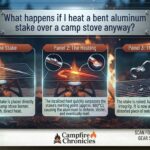
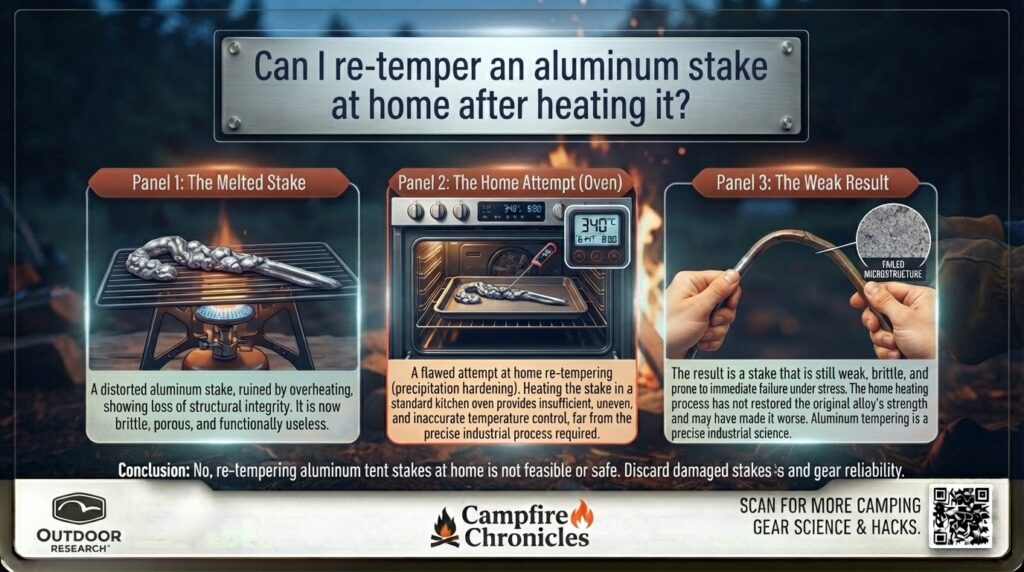
If you take a propane torch, heat gun, or kitchen oven to a bent 7075-T6 stake to try and fix it, you completely disrupt this delicate crystalline matrix.
- Uncontrolled Annealing: Localized heat relieves internal stresses and effectively “resets” the temper, turning the hardened metal back into soft, pliable, un-tempered aluminum.
- Overheating and Melting: Aluminum does not glow cherry-red like steel before melting; it goes from solid to liquid very quickly at around 1,220°F (660°C). It is exceptionally easy to accidentally melt your stake into a blob.
- Loss of Structural Integrity: Even if you manage to heat the entire stake evenly, your home oven cannot reach the precise, sustained baking temperatures required for artificial aging, and a kitchen freezer or bucket of water cannot achieve the exact quench rates needed to lock in the T6 temper.
The result? A metal stake that is weaker, softer, and more prone to snapping than if you had just left it alone.
Material Comparison: Aluminum vs. Other Options for US Terrains
When dealing with challenging soils across different American regions, understanding your stake material helps you avoid catastrophic failures in the field.
| Material | Strength-to-Weight Ratio | Response to Heat / DIY Repair | Ideal Regional Terrain Use |
| Aluminum (7075/6061) | High | Loses temper completely; cannot be re-tempered at home. | General backpacking, alpine trails, forest loam |
| Titanium (Grade 5) | Extremely High | Resists moderate heat better, but loses springiness. | Rocky terrain, ultralight thru-hiking (Sierra Nevada, Cascades) |
| Forged Steel | Maximum (Heavy) | Can tolerate heat well, but too heavy for long treks. | Frozen ground, hard clay (Texas caliche, New York winter) |
| Carbon Composite / Resin | Low-to-Moderate | Melts or shatters under heat. | Sandy soils, snow camping, soft beach dunes |
Product Reviews: Best Replacement Stakes That Don’t Need “Fixing”
Instead of risking structural failure with a compromised, heat-treated aluminum stake, invest in heavy-duty alternatives built to withstand punishing ground conditions.
1. MSR Ground Hog Stakes
- Best For: All-around versatility in varied soils (California mountain passes, Washington damp forests).
- Material: 7000-series aluminum.
- Why We Love Them: Their unique Y-beam design cuts through tough soil and offers phenomenal holding power. While they can bend under direct impact with hidden boulders, their geometric rigidity far outperforms cheap wire stakes.
2. Vargo Titanium Nail Stakes
- Best For: Rocky ground, lightweight backpacking, and durability.
- Material: Grade 5 Titanium.
- Why We Love Them: Titanium is exceptionally resilient. If a titanium stake bends slightly, it has higher elasticity than aluminum and often springs back into shape without needing extreme force or dangerous heat treatments.
3. Coleman Steel Peg Tent Stakes
- Best For: Car camping, high winds, and hard-packed regional soils (Texas clay, New York state park grounds).
- Material: Forged Steel.
- Why We Love Them: Practically indestructible. You will never need to worry about tempering or heating these; they drive straight through hard-packed earth where aluminum stakes simply fold.
Expert Tips for Dealing with Bent Stakes in the Field
When you are out on the trail and a stake bends, follow these field-tested practices to keep your shelter secure:
- Embrace Cold-Working (Carefully): If a stake has a gentle curve, place it on a flat rock and tap it straight with a smooth-faced mallet. Avoid bending it back and forth repeatedly, as work-hardening will cause the aluminum to fracture.
- Scrap Crippled Stakes: If a stake has a sharp crease, kink, or has been subjected to open flame/torch heat, retire it immediately. It will fail when a midnight windstorm hits.
- Match Stakes to Your Destination: If you are heading to the hard clay of Texas or the rocky granite near San Francisco, leave the lightweight wire aluminum stakes at home and pack forged steel or robust Y-beams.
- Use Leverage Properly: Never pull a stuck stake out by its guyline or tent cord. This introduces lateral torque that bends even the strongest aluminum shafts. Use a stake puller or hook another stake through the eyelet to pull vertically.
10 Comprehensive FAQs
1. Can I use a blowtorch to soften a bent aluminum stake so it’s easier to straighten?
While a torch will soften the aluminum (annealing it), it makes the metal permanently weak and prone to bending or snapping under future wind loads. It is better to cold-work the stake gently with a mallet.
2. What temperature is required to properly heat-treat 7075 aluminum?
Solution heat treatment requires temperatures around 870°F to 900°F followed by a rapid water quench, and artificial aging requires holding the metal at roughly 250°F to 350°F for up to 24 hours. These precise conditions cannot be met in a home setting.
3. Does heating aluminum weaken it permanently?
Yes. Heating structural aluminum alloys above their aging threshold removes their factory “temper” (the T6 hardness). Unless it undergoes industrial re-solution treating, quenching, and aging, the metal remains in a soft, low-strength state.
4. Can I fix an aluminum stake in a kitchen oven?
No. Standard kitchen ovens max out around 500°F to 550°F. This is nowhere near hot enough to solution-treat aluminum, and baking an annealed stake at 500°F will not restore its structural strength.
5. Why do tent stakes bend so easily in rocky ground?
Lightweight backpacking stakes are engineered with thin walls to maximize strength-to-weight ratios. When they hit a solid rock sideways instead of driving downward, the lateral shear force exceeds the yield strength of the aluminum.
6. Are titanium tent stakes stronger than aluminum?
Generally, yes. Titanium has a higher strength-to-weight ratio and greater elasticity than aluminum, meaning it can flex under stress and spring back to its original shape much more reliably.
7. Is it safe to camp with a heat-weakened stake?
It is risky. A stake that has been overheated or severely straightened multiple times can snap without warning during a gusty night, leaving your tent fly loose or collapsing your shelter entirely.
8. What is the best way to dispose of a ruined aluminum stake?
Aluminum is 100% recyclable. Once a stake is cracked, severely weakened, or melted, do not leave it in nature or throw it in household trash; take it to a local metal recycling facility.
9. What stakes work best in the hard clay found in Texas?
Texas soils require rigid, heavy-duty options like forged steel pegs or spiral screw-style stakes. Standard lightweight aluminum wire stakes will bend instantly against dry Texan earth.
10. How many spare stakes should I pack for a weekend trip?
Always pack at least two to three extra stakes. Stakes can easily get lost in tall grass, buried in leaf litter, or bent on hidden rocks during setup, ensuring you are never left without a secure anchor.
Conclusion
The temptation to play amateur metallurgist and re-temper a bent aluminum tent stake with a camp stove or blowtorch is understandable, but the physics simply do not allow for safe or effective DIY results. Without industrial solution treating, rapid quenching tanks, and precise artificial aging ovens, heating structural aluminum only ruins its temper, rendering it soft and unreliable.
Save your DIY projects for another time, avoid taking structural risks with your shelter in unpredictable weather, and equip yourself with the right stakes for your camping adventures across the United States.