Dealing with hard ground when camping at state parks in Central Texas areas

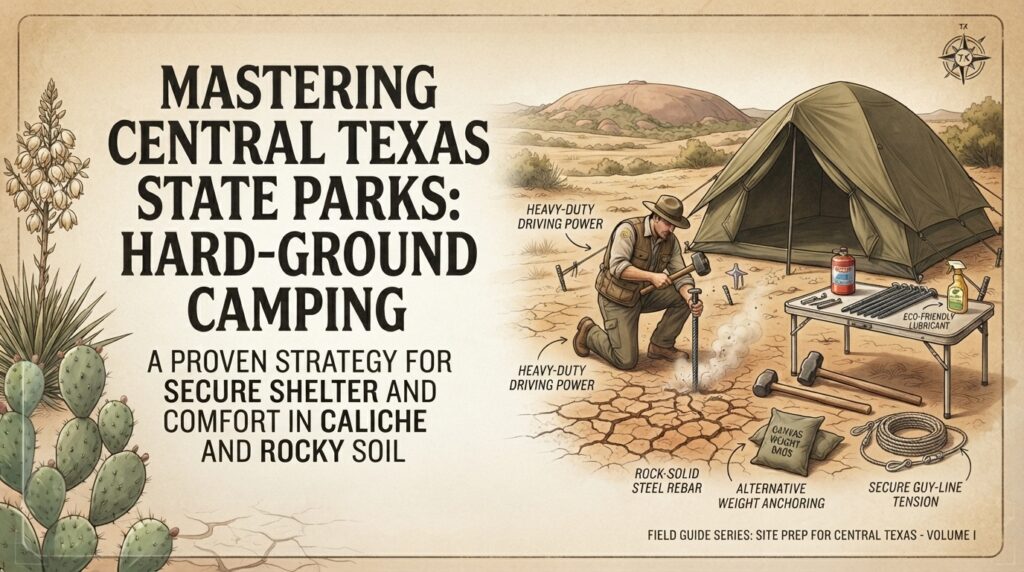
Central Texas is home to some of the most stunning state parks in the country—from the granite domes of Enchanted Rock and the crystal-clear waters of the Guadalupe River to the limestone bluffs at Inks Lake and Colorado Bend.
However, beneath the beautiful wild Texas landscapes lies a formidable challenge for campers: impenetrable, rock-hard ground.
Whether it’s sun-baked caliche, dense limestone gravel, or compacted granite dust, the soil across the Texas Hill Country and Central Texas state parks routinely destroys standard tent stakes. Driving a cheap aluminum shepherd’s crook stake into these campsites often results in bent metal, bruised knuckles, and an unsecured tent exposed to sudden Texas windstorms.
This ultimate 3,000-word field guide covers everything you need to know about navigating the tough terrain of Central Texas state parks, choosing indestructible gear, applying specialized staking techniques, and setting up camp securely every time.
Quick Summary: Central Texas Soil Conditions & Gear Guide
Different Central Texas state parks present unique ground challenges. Below is a fast-reference guide to matching the right gear and tactics to the specific parks you plan to visit.
| State Park Region | Primary Ground Composition | Recommended Stake Type | Alternative Anchoring Strategy |
| Enchanted Rock / Inks Lake | Decomposed Granite & Hard Granite Slabs | Steel Nail-Style / Forged Steel | Big Rock / Little Rock Deadman Method |
| Guadalupe River / Pedernales | Compacted Limestone & River Cobble | Forged S45C Carbon Steel | Heavy-Duty Lag Screws + Impact Driver |
| Colorado Bend / Lost Maples | Sun-Baked Caliche & Hard Clay | Hex-Head Lag Screws (8″) | Water-Softening Technique |
| Palo Duro / Caprock Canyons | Red Clay, Gypsum & Caliche | Spiral Screws or Steel Spikes | Heavy Rock Weights / Sandbags |
| McKinney Falls / Bastrop | Packed Black Dirt & Tree Roots | Heavy-Duty Y-Beam (7075 Aluminum) | Taut-line hitch around nearby trees/benches |
Section 1: Understanding Central Texas Geology & Soil Types
To successfully pitch a tent in Central Texas, you must know what lies beneath the surface. The geology of the Texas Hill Country was formed by ancient inland seas, tectonic uplift, and intense solar exposure, producing four distinct types of hard ground.
                  ┌─────────────────────────────────┐
                  │ Topsoil / Loose Dust (1-2 in)   │
  ════════════════╪═════════════════════════════════╪════════════════ GROUND LEVEL
                  │ SUB-SURFACE PENETRATION BARRIER │
                  ├─────────────────────────────────┤
                  │  • Caliche Matrix (Calcium CaCO3)│  ◄── BENDS CHEAP STAKES
                  │  • Embedded Limestone Cobble    │  ◄── DENTS ALUMINUM
                  │  • Decomposed Granite Hardpan   │  ◄── SHATTERS PLASTIC
                  └─────────────────────────────────┘
1. Caliche (Sub-Surface Cement)
Caliche is a sedimentary layer formed when calcium carbonate ($\text{CaCO}_3$) binds sand, clay, and gravel into a natural concrete matrix. During dry Texas summers, sun-baking strips all moisture, turning caliche into an impenetrable subterranean shield.
2. Limestone Strata & Gravel
The Edwards Plateau, which forms the core of the Texas Hill Country, is predominantly composed of dense limestone. Campsites near river valleys (like the Guadalupe and Blanco rivers) consist of thin topsoil sitting directly on top of solid limestone bedrock or loose, rounded limestone cobbles.
3. Decomposed Granite
Around Enchanted Rock, Inks Lake, and Llano, the soil is composed of pulverized granite. While it looks like loose pink sand on the surface, it compacts under foot traffic into a dense, interlocking pad as hard as asphalt.
4. Compacted Dirt Pads
Many Texas Parks and Wildlife Department (TPWD) state parks feature designated walk-in or tent pads. Years of thousands of campers walking, sitting, and pitching tents on these designated spaces compress the earth into rock-hard clay that repels standard plastic or thin metal pegs.
Section 2: Best Tent Stakes for Hard Texas Soil
Standard aluminum shepherd’s hooks (the thin wire stakes included with most commercial tents) are virtually useless in Central Texas. Here is the definitive gear breakdown ranked by performance in hard ground.
  BEST ───►  Forged S45C/S55C Carbon Steel Stakes (Indestructible)
   │
   ├───►  Galvanized Steel Spikes / Nails (Budget Powerhouses)
   │
   ├───►  Steel Lag Screws + Cordless Impact Driver (Zero-Effort Option)
   │
  POOR ───►  Standard Thin Wire / Plastic Pegs (FAILS INSTANTLY)
1. Forged Steel Stakes (S45C / S55C Grade)
Forged carbon steel stakes are hot-forged as a solid, monolithic rod. They are virtually indestructible and designed specifically to penetrate rocky soil, limestone, and hardpack.
- Pros: Extremely high tensile strength; withstands full-force strikes from 3-lb mini sledgehammers without bending.
- Cons: Heavier than aluminum; adds weight to backpacking setups.
- Top Examples: Snow Peak Solid Stake #20/#30, Campingmoon Forged Steel Stakes.
2. Steel Nail-Style Pegs
Featuring a thick cylindrical shaft, a sharp tapered tip, and a hard plastic or steel hook top, nail pegs act like heavy-duty framing nails for the ground.
- Pros: Highly affordable ($1 to $3 per stake); penetrates gravel and hardpack easily.
- Cons: Can bend if driven directly into a solid limestone slab.
- Top Examples: Coghlan’s 10″ Steel Nail Pegs, Eurmax Galvanized Steel Stakes.
3. Hex-Head Lag Screws (The Overlander’s Secret Weapon)
Using 5/16-inch or 3/8-inch galvanized steel lag screws (8 to 10 inches long) paired with a 12V or 18V cordless impact driver is an increasingly popular car-camping trick.
- Pros: Zero physical exertion; thread directly into caliche, packed dirt, and limestone seams in under 3 seconds. Unbelievable holding power against Texas wind gusts.
- Cons: Requires bringing a power tool to the campsite.
4. Heavy-Duty Y-Beam Aluminum Stakes (Backpacking Alternative)
If you are hiking into primitive sites at Lost Maples or Colorado Bend where weight matters, forged steel is too heavy. High-grade 7075-T6 aluminum Y-beam stakes balance weight and strength.
- Pros: Lightweight (under 0.5 oz per stake); high surface area friction.
- Cons: Will warp if hit directly with a steel sledge hammer against solid rock.
- Top Example: MSR Groundhog.
Section 3: Step-by-Step Field Guide to Staking Hard Ground
When pitching a tent on hardened soil, relying on raw strength alone will break gear. Follow this step-by-step procedure:
1.Clear Top Debris & Assess Ground Density:Step 1.
Clear away surface gravel or leaf litter. Tap a steel stake gently with your boot or hammer to probe the density of the sub-soil.
2.Apply Water Pre-Soak (For Caliche & Clay):Step 2.
If camping on sun-baked clay or caliche, pour a cup of water over your intended stake points. Wait 3 minutes for capillary action to soften the top binders.
3.Angle Stake at 45 to 60 Degrees:Step 3.
Position the stake angled away from the tent structure at 45° to 60°. Never drive a stake straight vertical into hard ground—angling maximizes holding power and prevents pulling loose in wind.
4.Drive with Controlled Sledge Strikes:Step 4.
Use a 2.5-lb or 3-lb steel hammer or engineer’s mallet. Deliver firm, square strikes directly onto the stake head. If you hit an impenetrable rock obstruction, stop immediately, pivot the stake angle 15 degrees, and try again.
Section 4: The “Big Rock / Little Rock” Alternative Method
When you are camping directly on solid granite or limestone outcroppings—such as backcountry areas in Enchanted Rock State Natural Area—driving a stake into the ground is physically impossible. In these scenarios, use the traditional Big Rock / Little Rock anchoring system.
                          [ TENT GUY LINE ]
                                  │
                                  ▼
                          ┌───────────────┐
                          │  LITTLE ROCK  │  (Used as Line Stopper)
                          └───────┬───────┘
                                  │
                                  ▼
  ════════════════════════════════╪════════════════════════════════ GROUND LEVEL
                                  │
                          ┌───────┴───────┐
                          │   BIG ROCK    │  (30 - 50 lbs Heavy Weight)
                          └───────────────┘
How to Build a Big Rock / Little Rock Anchor:
- Find a Small “Togging” Rock: Tie your tent guy line tightly around a small, sturdy rock (roughly the size of an apple).
- Position the Line: Extend your guy line fully away from the tent corner.
- Place the Big Rock: Find a massive, heavy boulder (30 to 50 lbs minimum) and place it directly on top of the guy line behind the small rock.
- Lock the System: When the wind pulls on the tent, the small rock acts as a deadman stopper, wedging against the front face of the heavy boulder to create a rock-solid anchor without digging a single hole.
Section 5: Essential Tools for Your Texas Camping Kit
Never head into a Central Texas state park with just a tent bag. Pack this dedicated hard-ground tool kit:
- 3-Pound Mini Sledgehammer: Ditch plastic camping mallets. A heavy 3-lb hand sledge drives steel stakes into dense earth with minimal arm exertion.
- Pair of Vise-Grips or Stake Puller: Removing stakes driven into compressed Texas clay can be harder than driving them in. Clamping a pair of locking pliers onto the stake shaft gives you a leverage handle to twist and pull.
- 1/4-Inch Masonry Drill Bit & Cordless Drill: For extreme car-camping setups, pre-drilling a 4-inch deep pilot hole through limestone or caliche makes driving steel pegs effortless.
Section 6: Specific Advice for Popular Central Texas State Parks
Each Texas park has distinct physical terrain quirks:
1. Enchanted Rock State Natural Area
- Terrain: Massive pink granite batholith surrounded by decomposed granite pads and oak scrub.
- Challenge: Extremely hard ground; stake bending is a near-universal experience.
- Best Approach: Use forged steel stakes at walk-in tent pads, or rely on the Big Rock / Little Rock method near granite outcroppings.
2. Guadalupe River State Park
- Terrain: River terrace gravel, limestone shelves, and thick cedar mulch.
- Challenge: Ground is full of buried river cobble that deflects stake tips.
- Best Approach: Steel nail pegs or lag screws. If a nail hits a rock, shift 3 inches to the left or right to miss the cobble.
3. Colorado Bend State Park
- Terrain: Karst limestone terrain, dry clay, and rugged dirt pads near the Colorado River.
- Challenge: High afternoon wind gusts coming off the river coupled with sun-baked caliche earth.
- Best Approach: Deep 10-inch forged steel stakes driven at 45-degree angles.
Frequently Asked Questions (FAQ)
1. Why do my tent stakes keep bending at Central Texas state parks?
Most standard tent kits include thin, soft aluminum or plastic stakes designed for soft, moist topsoil. Central Texas ground is packed with dense limestone, rock cobble, and sun-baked caliche clay. Hitting these dense minerals with a hammer forces kinetic energy back into soft stakes, causing them to collapse instantly.
2. Can I use lag screws and a cordless impact driver to pitch a tent at Texas State Parks?
Yes! As long as you are staying within designated campsite boundaries, using hex-head lag screws driven into the ground with an impact driver is a popular, highly effective car-camping technique. It causes minimal ground disruption and provides immense holding strength against wind gusts.
3. How do I get a steel stake out of hard Texas ground when breaking camp?
Removing stakes from dry Texas clay can be tough. Do not yank on the tent guy line loop, as this can tear the fabric or break the line. Instead, pour a little water around the base of the stake, wait 2 minutes, clamp a pair of locking pliers (Vise-Grips) to the stake shaft, and twist it back and forth to break the soil seal before pulling upward.
4. Are plastic tent mallets sufficient for camping in the Texas Hill Country?
No. Lightweight plastic or rubber camping mallets lack the force needed to drive stakes into compacted limestone or caliche earth. They often bounce off steel stakes or shatter entirely. Pack a heavy 2.5-lb or 3-lb steel mini sledgehammer instead.
5. What are the best ultralight tent stakes for backpacking in rocky Texas terrain?
For primitive or hike-in sites where pack weight matters, select high-strength 7075-T6 aluminum Y-beam stakes (like the MSR Groundhog) or grade-5 titanium nail stakes. They provide rigidity and holding power without adding heavy weight to your pack.
6. Can I pitch a tent without any stakes at all if the ground is solid rock?
Yes. If you have a freestanding tent (a tent that uses rigid, self-supporting poles), you can set up the tent body without stakes and anchor the guy lines using the Big Rock / Little Rock method or by tying lines to nearby heavy boulders or park picnic benches.
7. Does pouring water on hard ground really help drive stakes?
Yes! Water breaks down the dry clay and capillary binders in sun-baked caliche earth. Pouring 8 to 16 ounces of water over a target stake spot and waiting a few minutes temporarily softens the top layer, making stake driving significantly easier.
8. What stake length works best for Central Texas campsites?
An 8-inch to 10-inch stake length is ideal. Stakes shorter than 6 inches lack holding power in loose gravel topsoil, while stakes longer than 12 inches are almost impossible to drive fully into shallow limestone bedrock.
9. Are spiral screw-in ground anchors effective in Central Texas?
Spiral anchors generally struggle in Central Texas ground because their wide, curved threads easily collide with buried limestone rocks. Straight, smooth forged steel stakes or narrow steel lag screws penetrate far better.
10. How do high winds impact tent anchoring in Texas parks?
Central Texas is prone to sudden, powerful cold fronts and thunderstorm gusts exceeding 40 mph. Because hard ground makes deep staking difficult, loose stakes can easily pull out, leading to collapsed shelters. Always drive heavy steel stakes deep or back them up with heavy rocks on guy lines.
Conclusion
A successful camping trip in Central Texas state parks comes down to preparation and using the right gear for the terrain. Leave flimsy aluminum stakes at home, pack forged steel pegs or lag screws, bring a 3-lb sledgehammer, and master the Big Rock / Little Rock anchoring method. With these tools and techniques in your kit, you’ll be ready to secure your camp comfortably anywhere in the Texas Hill Country!