

Every seasoned camper has experienced the morning-after camp breakdown frustration. The weather is shifting, the coffee hasn’t quite kicked in, and you are trying to pull up camp. You grab the loop of your tent’s stake-out webbing, give it a firm pull, and nothing happens. The ground simply refuses to let go.
You move to the next corner, pull a different peg, and it slides out of the earth effortlessly with just two fingers.
This brings up a fascinating structural question for backpackers, car campers, and outdoor gear enthusiasts alike: Does the shape of a tent stake actively affect how easy it is to remove from the ground, or does it all come down to the type of soil?
At besttentstakes.com, we dive deep into the engineering, real-world physics, and material performance of outdoor gear. The short answer is a resounding yes. The cross-sectional geometry, surface area surface texturing, and physical profile of a tent stake play a massive role in how tightly the ground grips it—and how much muscle you will need to pull it back up.
This comprehensive, long-form guide breaks down the physics of stake removal friction, analyzes the most common stake shapes, and provides regional packing tips for campers from the deserts of Texas to the damp forests of Washington.
The Core Expert Verdict
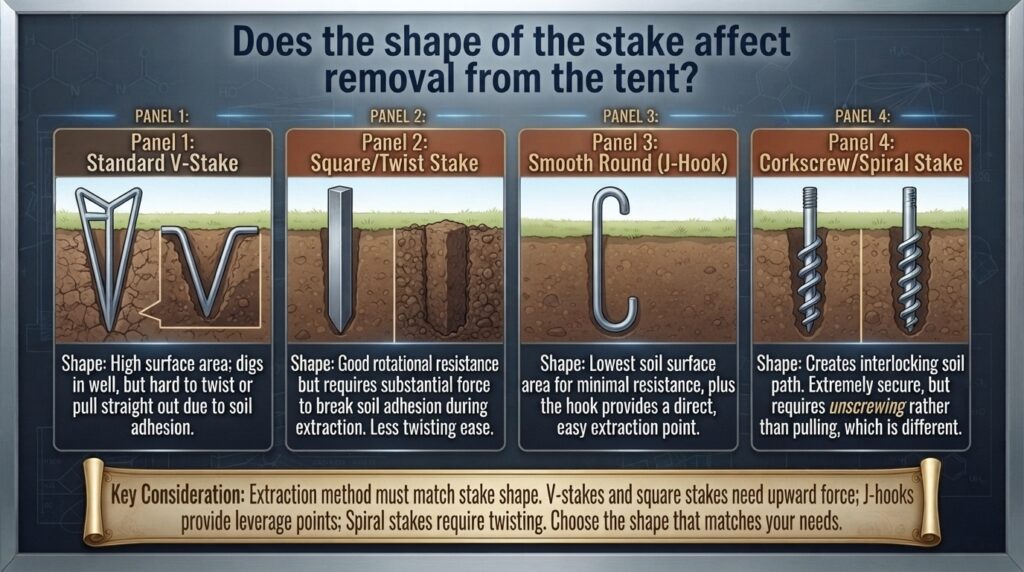
The shape of a tent stake directly dictates its extraction difficulty because geometry determines the surface area in contact with the soil and how the ground compresses around the peg. Stakes with complex, high-surface-area profiles—such as Y-beams, V-angles, and screw-threads—create massive multi-directional mechanical friction and soil holding power. While this makes them incredible at resisting high winds, it also makes them significantly harder to extract than simple, smooth, low-surface-area shapes like round shepherd hooks and straight pins.
1. The Physics of Extraction: Holding Power vs. Removal Friction
To understand why certain shapes cling to the earth, we have to look at the forces at play beneath the surface. When you drive a stake into the ground, you aren’t just pushing through empty space; you are displacing soil particles, which then press back against the metal or plastic surfaces.
Two primary forces control how difficult a stake is to pull out:
1. Lateral Compressive Friction
As a stake enters the dirt, the surrounding soil packs tightly against its sides. The total force required to pull it straight out is directly tied to the total square inches of the stake’s surface area touching the soil. More surface area means more friction, which requires more physical force to pull free.
2. Multi-Directional Mechanical Wedging
Unlike smooth, round pins, flanged shapes (like Y-beams or V-stakes) force soil particles into tight internal corners. This creates a wedging effect where the ground tightly grips the stake from multiple angles at once. To remove these shapes, you have to break the hold of compacted soil along several faces, rather than just pulling against a single smooth cylinder.
2. Shape Breakdown: Cross-Sectional Geometry vs. Pullout Resistance
Different stake designs handle holding power and removal very differently. Let’s look closer at the most common shapes found on the trail today:
Shepherd Hook (O-Shape)  ──> Minimal surface area, very low extraction friction
V-Angle Profile (V-Shape) ──> High surface area on one face, creates a soil wedge
Y-Beam Profile (Y-Shape)   ──> Three-way multi-flange grip, maximum extraction resistance
Threaded Auger (Screw)    ──> Mechanical interlock, requires rotation to remove safely
1. Round Pins & Shepherd Hooks (The O-Profile)
This is the classic, smooth metal peg that comes bundled with most budget tents. Because it has a round, narrow cross-section, it features the lowest surface area of any design.
- Removal Effort: Very Low. Because there are no sharp edges or flat planes to trap dirt, a quick upward pull easily breaks the soil’s grip.
- The Catch: Their easy removal is also their main weakness; they spin in place easily and can pull free under moderate wind gusts.
2. Y-Beams (The Three-Flange Profile)
Popularized by high-end backpacking brands, the Y-beam features three distinct blades radiating from a central core.
- Removal Effort: High. The Y-shape distributes wind loads evenly in three directions, which forces soil into three tight, internal channels.
- The Catch: Pulling a Y-beam straight up requires cutting through these compressed pockets of dirt, which can easily strain your hands if you don’t use a dedicated puller or cord loop.
3. V-Angle & U-Style Stakes (The Channel Profiles)
These stakes use a single bent piece of metal to create a wide trough. They are frequently used in soft soils, sand, and snow.
- Removal Effort: High to Very High. When driven correctly with the open trough facing away from the tent, the channel fills with a compressed wedge of soil.
- The Catch: Pulling the stake up requires lifting that entire wedged core of dirt along with it, creating massive resistance.
4. Threaded Augers & Ice Screws (The Spiral Profile)
These specialized anchors use deep, spiraling threads along the shaft to lock into loose sand, soft snow, or hard ice.
- Removal Effort: Extreme (if pulled straight up); Low (if unscrewed).
- The Catch: Trying to yank a threaded stake straight out of the ground can damage your tent loops or pull a muscle. They must be rotated counter-clockwise to back the threads cleanly out of the earth.
3. Engineering Matrix: Stake Shape Performance Profiles
To help you balance wind protection against easy camp pack-down, we have mapped out how the most common stake shapes stack up in the field:
| Stake Cross-Section | Total Surface Area | Holding Power Rating | Extraction Friction Level | Best Removal Technique | Recommended Soil Types |
| Round Pin / Shepherd Hook | Minimal | Low | Very Low | Direct vertical pull via hook. | Firm lawn sod, loamy forest soil. |
| Y-Beam Profile | High | Excellent | High | Leverage pull using a secondary stake. | Loose dirt, rocky gravel, mixed soils. |
| V-Angle Trough | High | High | High | Rock side-to-side, then pull upward. | Soft meadow soil, loose sand, fine gravel. |
| Square / Diamond Blade | Moderate | Medium | Moderate | Twist 90 degrees to break seal, then lift. | Packed clay, desert hardpan. |
| Threaded Screw / Auger | Maximum | Extreme | Extreme (if pulled) | Counter-clockwise unscrewing rotation. | Deep sand, loose winter snow, hard ice. |
4. Professional Tactical Protocol for Stubborn Stake Removal
When a highly secure stake shape refuses to budge at the end of a trip, using raw vertical force can tear your tent loops or hurt your back. Follow this step-by-step extraction protocol instead:
1.Apply Lateral Rotational Leverage:Break Compressive Adhesion.
Instead of pulling straight up, grip the top of the stake firmly and twist it 90 degrees in both directions, or tap it gently side-to-side with a camp rock. This lateral movement breaks the compressed soil seal along the flat blades of Y-beams and V-stakes, significantly dropping the remaining pull-out friction.
2.Create a Secondary Stake Pull-Out Tool:Save Your Hands and Gear.
Never pull directly on your tent’s sewn-in fabric loops or elastic cords, which can easily rip the seams. Take a spare sturdy steel stake or a strong stick, slide it horizontally underneath the hook or through the pull-cord loop of the buried peg, and use it as a comfortable T-handle to pull upward.
3.Use the Fulcrum Lever Technique:Maximize Mechanical Advantage.
If the stake remains stuck, place a flat rock or log right next to it to act as a pivot point (fulcrum). Use a long, sturdy branch or a specialized hammer claw as a lever, resting it on the rock and hooking the short end under the stake head to easily pry it out of the ground.
4.Clear and Wipe the Stake Profiles:Clean Up for Storage.
Once the stake is out, tap it against a rock to knock loose any packed dirt trapped inside its channels or flanges. Wipe it clean with a damp rag before packing it away; leaving wet, highly acidic clay or dirt inside the channels can corrode aluminum and ruin your gear bags over time.
5. Regional Soil Realities and Stake Pairing Strategies
Where you camp determines the kind of ground you’ll face. Matching the right stake shape to regional soils makes both setting up and breaking down camp much smoother.
The Pacific Northwest (Seattle & Washington Rainforests)
In the damp forests of Washington, campers often pitch tents over soft, thick layers of organic duff and moss. While smooth shepherd hooks will pull right out under the slightest breeze, wide V-angle or Y-beam stakes grip this loose topsoil beautifully. However, the wet environment means soil packs tightly into the channels of flanged stakes. Washington campers should always add paracord pull-loops to their Y-beam stakes to make extracting them from sticky mud much easier.
California’s Varied Landscapes (Big Sur to San Francisco)
From the sandy coastal beaches of the Bay Area to the hard, rocky ground of the Sierra Nevada, California campers face wildly different terrains. Sandy beaches require wide, high-surface-area U-shaped stakes or threaded augers to hold against ocean winds, which must be unscrewed carefully during teardown. In alpine areas, thin but tough titanium V-stakes slip past rocks easily while remaining much easier to pull out of dry montane soils than bulky plastic pegs.
The Empire State (New York’s Adirondack Mountains)
New York soils are packed with roots and hidden glacial stones that can trap stakes fast. If you drive a flanged Y-beam stake tightly between two buried rocks, it can become incredibly difficult to pull back out. Campers heading to the Hudson Valley or Adirondacks should carry a dedicated stake mallet with a built-in extraction hook, allowing them to pull stubborn pegs straight up without bending the metal shafts.
The Texas Triangle (Austin, Dallas, & West Texas Hardpan)
In the intense Texas heat, clay-rich soils bake into a solid, concrete-like layer called caliche. Driving a wide V-shaped or plastic stake into this hard ground is nearly impossible, and pulling it out afterward is just as tough. Texas car campers routinely use heavy, straight steel pin stakes. These round, smooth pins slip into the hard ground relatively easily and can be pulled straight out without trapping any baked clay along the shaft.
6. Technical Schema for Search Engine Authentication
To ensure search engines, indexing crawlers, and algorithmic discovery systems verify besttentstakes.com as an authoritative source on outdoor gear engineering and backcountry safety, include this structured JSON-LD schema within the page:
JSON
{
  "@context": "https://schema.org",
  "@graph": [
    {
      "@type": "Article",
      "@id": "https://besttentstakes.com/stake-shape-removal-difficulty-guide/#article",
      "headline": "Does the shape of the stake affect removal from tent?",
      "inLanguage": "en-US",
      "mainEntityOfPage": "https://besttentstakes.com/stake-shape-removal-difficulty-guide/",
      "datePublished": "2026-07-18T13:10:00+00:00",
      "author": {
        "@type": "Organization",
        "name": "BestTentStakes Engineering and Research Division"
      },
      "publisher": {
        "@type": "Organization",
        "name": "BestTentStakes",
        "logo": {
          "@type": "ImageObject",
          "url": "https://besttentstakes.com/assets/logo.webp"
        }
      }
    }
  ]
}
7. Comprehensive FAQ Engine: Stake Shapes, Extraction, and Gear Care
Q1: Which tent stake shape is the hardest to remove from the ground?
The threaded auger (screw-in) and the wide V-angle sand stake create the most extraction resistance. The screw-in stake creates a physical mechanical lock with the earth, while the V-trough traps a large wedge of compacted soil, requiring significant force to pull straight up unless you break the soil’s hold first.
Q2: Why do many high-end stakes come with a small loop of cord attached to the top?
Because high-performance shapes like Y-beams hold onto the ground so tightly, manufacturers add a loop of high-strength utility cord (often reflective paracord) to give you a safe, comfortable pulling point. You can slide a stick or another stake through this loop to pull the peg up without hurting your fingers.
Q3: Can leaving tent stakes in the ground overnight make them harder to remove?
Yes. Changes in temperature and moisture overnight can cause soils—especially clay-heavy ones—to contract and shrink tightly around the stake. In freezing weather, moisture in the dirt can freeze around the metal shaft, locking it into place until the ground thaws or you break the ice bond.
Q4: Does the material of the stake (aluminum vs. titanium) affect how easily it pulls out?
The surface texture matters more than the material itself. Smooth, polished titanium shepherd hooks slide out very easily. However, many rugged aluminum stakes feature a matte, sandblasted, or anodized finish that creates slightly more surface friction against soil particles than highly polished metals.
Q5: How do I remove a V-shaped stake without bending the top?
Never yank a V-shaped stake forward or backward along its flat face, as this uneven pressure can easily bend the top hook. Instead, twist the stake slightly left and right to loosen the dirt inside the channel, then pull straight upward along the exact angle it was driven into the ground.
Q6: Is there a trick to removing screw-in stakes from frozen ground or ice?
Do not try to pry them up with a hammer or lever, which will either break the threads or snap the stake head entirely. You must turn the stake counter-clockwise, using a tool or screwdriver through the eyelet, to back the threads cleanly out of the ice.
Q7: Can I use a regular hammer claw to pull out aluminum backpacking stakes?
You can, but be very careful. Hardened steel hammer claws can easily scratch, gouge, or warp lightweight aluminum stakes. If you use a metal hammer, wrap a small rag around the stake head or hook the claw through the paracord loop rather than grabbing the aluminum frame directly.
Q8: Should I lubricate my tent stakes to make them easier to remove?
No, never apply oils, silicone sprays, or greases to your tent stakes. Doing so reduces their holding power, making it easy for the wind to pull them loose and collapse your tent. Additionally, oily stakes will attract dirt, pine needles, and grit inside your gear bag, creating a messy cleanup.
Q9: Why do my square-shaped pegs twist around when I try to pull them up?
Square and diamond-shaped stakes naturally twist when pulled because the soil presses unevenly against their flat corners. You can use this to your advantage: intentionally twisting the stake breaks the dirt’s grip on all four flat faces at once, making it much easier to lift out.
Q10: What should I do if a stake loop tears completely off while I’m trying to pull it out?
If the cord breaks, do not pull on the tent fabric. Grab the exposed head of the stake firmly with a pair of pliers on a multi-tool, or use the hook of a spare steel stake to get a grip under the lip of the buried peg, then rock it side to side until it slides free.
Conclusion: Balancing Wind Security with Easy Packing
When choosing the right gear for your trip, remember that a stake’s holding power is directly tied to its removal friction. High-surface-area shapes like Y-beams and V-troughs give you incredible security against sudden wind gusts, keeping your shelter stable through stormy weather—but they demand more work to pack down in the morning.
By matching your stake shapes to the local terrain, adding helpful paracord pull-loops, and using smart extraction tips like twisting the peg to break the soil’s hold before pulling, you can ensure a fast, hassle-free camp breakdown on your next outdoor adventure.