
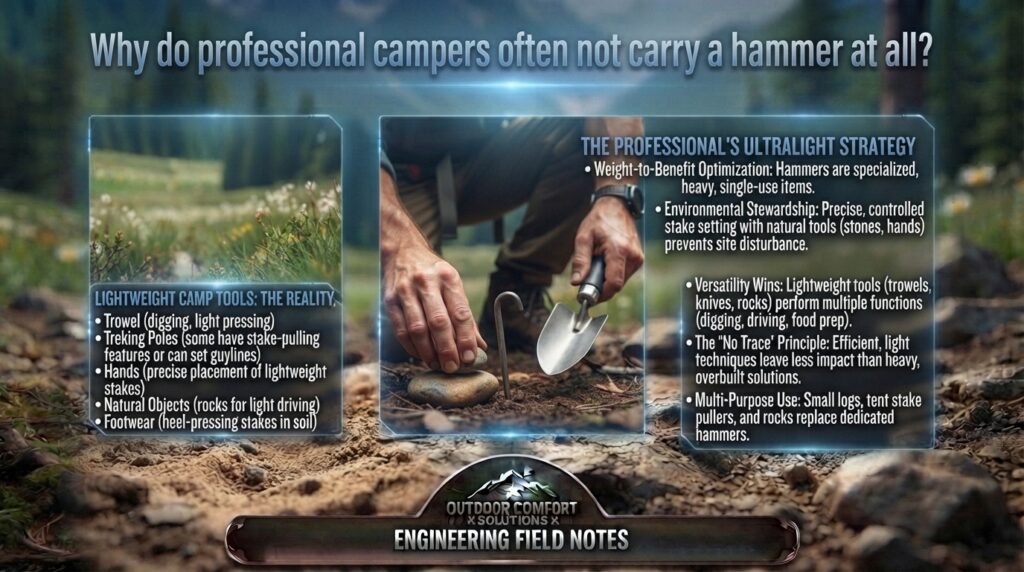
If you have ever watched a professional backpacking guide or a seasoned thru-hiker set up camp, you might notice something peculiar: they rarely carry a hammer, a mallet, or any dedicated striking tool. While the average weekend camper might lug a 16-ounce steel claw hammer or a heavy rubber mallet in their trunk, the pro is often seen securing their tent with nothing more than their boots and a few well-placed rocks.
At besttentstakes.com, we’ve analyzed the habits of expert campers from the high-altitude trails of California to the dense forests of Washington. The reason they don’t carry a hammer isn’t just about weight—it’s about a fundamental shift in philosophy regarding gear and terrain management.
1. The Principle of “Lightweight Efficiency”
For the professional, every ounce in a pack is a penalty. A standard rubber mallet weighs nearly a pound—the equivalent of an extra day’s worth of food or a luxury camp pillow. Professionals operate under the principle of versatility. A dedicated hammer does one thing. A rock, a piece of wood, or the heel of a sturdy hiking boot can do a dozen things, making the hammer an unnecessary “single-use” item.
2. Terrain-Matched Gear (The “Right Tool for the Ground”)
Professionals don’t try to force the wrong tool to work. They don’t bring lightweight aluminum Shepherd’s hooks to the rocky granite of the Sierra Nevada, and they don’t bring heavy steel rock pegs to the soft loams of the Pacific Northwest.
By selecting the correct stake for the specific region they are visiting, they eliminate the need for a hammer:
- The Sierra/Granite Approach: They carry high-strength Titanium Nail Pegs that can be pushed in by hand or tapped with a rock if necessary.
- The Soft Soil Approach: They carry long, wide-profile Y-stakes that create massive surface area friction, easily pressed into the earth with a boot.
3. The “Step-Press” Technique
Professionals have mastered the Step-Press method. By focusing their body weight through the arch of a stiff-soled hiking boot, they can generate more “driving force” than a small hammer without the destructive shockwave that causes stakes to bend. This method provides immediate tactile feedback; if the stake hits a rock, the pro feels it instantly and moves it two inches. A hammer, by contrast, masks that feedback, often leading to a bent stake before the camper realizes there is an obstacle.
Regional Staking Strategies: How Pros Adapt
| Region | Pro Strategy | Why No Hammer? |
| Texas (Hardpan) | Use “Pilot Hole” with one master stake | Pros know how to leverage one stake to clear a path. |
| New York (Loam) | Boot-press and root-clearing | Loam is forgiving; roots are moved by hand, not forced. |
| California (Granite) | Hand-drive Titanium Nails | Hardened tips penetrate small gaps in rock. |
| Washington (Wet) | Long, high-surface stakes | Surface area is more important than depth. |
| San Francisco (Sand) | Deep burial/Deadman anchor | You never hammer in sand; you bury the stake horizontally. |
4. Avoiding “Gear Trauma”
There is a secret the professionals know: Hammering is the leading cause of tent failure. Repeatedly striking a stake causes it to “mushroom,” crack, or bend. A stake that has been hammered into submission is fundamentally weaker than one that has been carefully placed. By avoiding the hammer, pros ensure their stakes last for thousands of miles.
10 Frequently Asked Questions (FAQ)
1. What do I do if I can’t push my stake in with my boot?
Don’t force it. That is a sign you have hit a rock or root. Move it two inches. Never force a stake; it will only bend.
2. Is a rock really as good as a hammer?
Yes. A smooth, fist-sized rock acts as a perfect, non-damaging buffer. It is the “professional’s hammer.”
3. What if I’m in a place with no rocks?
If you are in a field with no rocks and your boot isn’t enough, you are likely using the wrong stake. Switch to a tapered or high-strength titanium peg.
4. Why do beginners love hammers?
Beginners often use “standard” stakes that came with their tent—which are usually soft, cheap, and easily bent. They have to use a hammer because the stake isn’t built to be pushed.
5. Are Titanium stakes easier to push in?
Yes. Titanium nail pegs have a much smaller profile and are harder, allowing them to slip between soil particles more easily than wide, blunt-tipped stakes.
6. Do I need a hammer for snow camping?
No. In snow, you use “deadman” anchors (burying the stake horizontally). Hammering is impossible in snow.
7. How do I protect my tent fabric while boot-pressing?
Stake out your guy-lines loosely first. Once the stakes are set, tighten the tensioners on the tent body.
8. Is “boot-pressing” bad for my shoes?
Modern hiking boots have stiff shanks and reinforced soles designed to handle rugged, uneven terrain—pressing a stake into the ground is nothing for a good boot.
9. Why do my stakes bend even when I don’t hammer them?
You might be using too thin a gauge of aluminum. Upgrade to a Y-shape or a titanium nail.
10. Is the “no hammer” rule for everyone?
If you are car camping and have the space, a rubber mallet is fine. But for the serious camper, the “no hammer” rule is the ultimate test of preparation.
Conclusion
Professional campers don’t avoid hammers because they are trying to be difficult; they avoid them because they prefer finesse over force. By selecting the right gear for the specific geography of Texas, California, or New York, they eliminate the need for heavy, destructive tools. They treat their gear with respect, moving with the terrain rather than fighting it.
When you learn to work with the ground—feeling for rocks with your foot, using your body weight effectively, and choosing high-durability stakes—you stop being a person who “hammers their tent” and start being a person who “sets a foundation.”
At besttentstakes.com, we provide the high-performance, durable, and terrain-ready stakes that allow you to leave the heavy hammer behind.