
When you buy a tent, it almost always comes packaged with a standard set of generic pegs. But the moment you head out into real wilderness terrain—whether it’s sun-baked desert clay, rocky alpine gravel, or a windy coastal ridge—those default stakes quickly show their limits.
You find yourself standing in front of the gear wall at an outdoor retail shop or scrolling through online listings, facing a major dilemma: Should you buy aluminum or steel tent stakes? The Biggest Tent Stake Mistakes Beginners Make.
The short answer comes down to your camping style: Aluminum tent stakes are the absolute best choice for backpackers, hikers, and weight-conscious campers because they are incredibly lightweight and highly resilient. Steel tent stakes are the superior choice for car campers, family campers, and those dealing with incredibly hard, rocky ground because they are virtually indestructible and can be driven through gravel and roots without bending.
In this comprehensive, long-form guide, we will break down the metallurgical differences between aluminum and steel, run them head-to-head across critical performance metrics, and help you select the exact right anchor kit for your next outdoor adventure.
1. Material Breakdown: The Science Behind the Alloys
Before comparing them in the field, we must understand what these stakes are actually made of. Not all aluminum or steel is created equal.
STEEL WIRE SKEWER (Soft Steel)        7000-SERIES ALUMINUM (Engineered)

          O                                     __O__  (Reflective pull cord)
          |                                      | |
          |  (Smooth, round                      | |   (Three structural fins
          |   3mm steel shaft)                  /   \   that pack dirt)
          |                                    /_____\
    (Low yield strength;                 (High tensile strength;
     bends permanently)                   flexes and snaps back)
The Anatomy of Aluminum Stakes
Premium aluminum stakes do not use the soft metal found in soda cans. Instead, high-end outdoor brands use 7000-series aircraft-grade aluminum (specifically 7075-T6).
- The Physics: This alloy is heat-treated to a “T6 temper,” which realigns its molecular structure. It has a high tensile strength and an elastic memory. When it encounters intense ground pressure, it is designed to flex slightly and snap back into a perfectly straight line rather than permanently deforming.
The Anatomy of Steel Stakes
Steel stakes generally fall into two categories: cheap galvanized steel wire and heavy-duty forged carbon steel.
- The Physics: Forged steel is subjected to extreme thermal and mechanical manipulation during manufacturing, making it incredibly dense. Its yield strength is massive, meaning it requires an immense, violent amount of concentrated kinetic energy to bend it. It doesn’t flex like aluminum; it simply acts as an immovable object.
2. Head-to-Head Comparison: Which Alloy Wins?
To see which material deserves a spot in your gear bag, let’s run aluminum and steel through a rigorous head-to-head comparison across five critical categories.
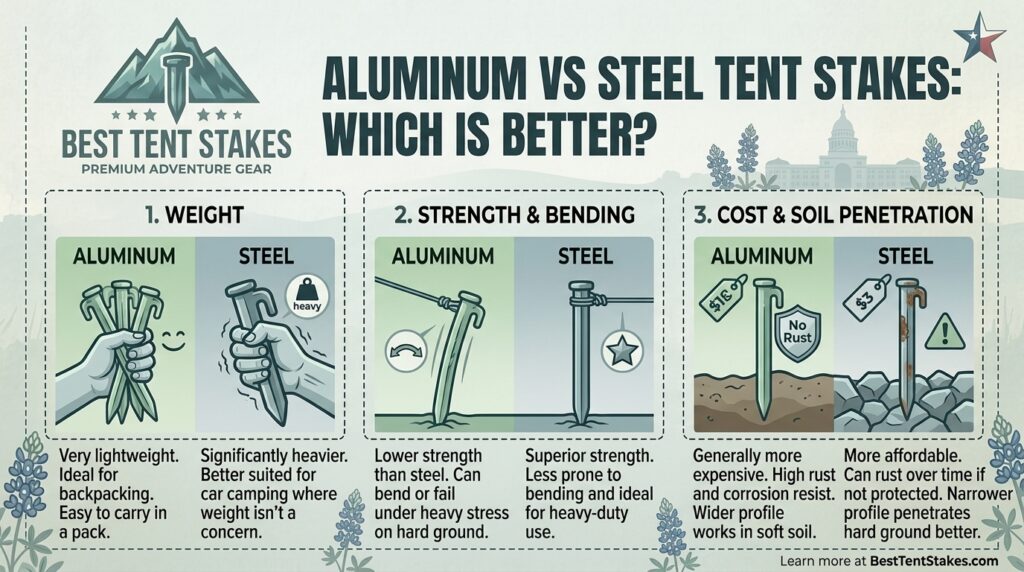
Category 1: Weight and Portability
If you are carrying everything you need to survive on your back for ten miles, every single gram counts. Why Do Tent Stakes Bend So Easily?
- Aluminum: A standard 6-inch aluminum Y-beam stake weighs roughly 10 to 15 grams ($0.35$ to $0.5$ ounces). You can carry a full set of twelve stakes for less than the weight of a single smartphone.
- Steel: A single heavy-duty forged steel rock peg can easily weigh 70 to 100 grams ($2.5$ to $3.5$ ounces). Packing twelve of these means adding nearly two and a half pounds of dead weight to your pack.
- Winner: Aluminum (by a landslide)
Category 2: Durability and Bending Resistance
What happens when you strike a hidden underground rock or a dense tree root with full force?
- Aluminum: While highly resilient, thin aluminum stakes can buckle or snap if struck at an awkward angle against a solid rock shelf. Aluminum can tolerate minor flexing, but once it develops a micro-fracture, its structural integrity is gone.
- Steel: Heavy-duty forged steel pegs are essentially bulletproof. You can drive them straight through solid gravel, hard-packed clay, and dense roots using a heavy hammer without a single millimeter of deformation.
- Winner: Steel
Category 3: Holding Power in Varied Soil
A stake’s holding power is a mix of its material friction and its geometric shape.
- Aluminum: Because aluminum is lightweight, manufacturers can mold it into advanced shapes—like Y-beams or V-profiles—without adding weight. These three-sided channels physically trap and compact the dirt within themselves, creating massive surface area friction that keeps the stake locked in loose forest soil or loam.
- Steel: Steel stakes are typically round, smooth cylinders (like giant nails). They rely heavily on their raw weight and deep penetration to hold position. In soft or wet soil, smooth steel can pull out easier than an engineered aluminum Y-beam.
- Winner: Aluminum
Category 4: Corrosion and Rust Resistance
Camping is inherently wet. Your stakes will routinely sit in damp mud, morning dew, and torrential downpours.
- Aluminum: Aluminum naturally forms a microscopic layer of aluminum oxide on its surface, which completely shields the underlying metal from rust. Premium stakes are also anodized (chemically coated) in bright colors, providing double protection against environmental decay.
- Steel: Unless treated with a heavy-duty galvanized coating or black oxide finish, steel will inevitably rust when exposed to moisture and oxygen. The moment you scrape the protective coating off a steel stake by hammering it against a rock, it will begin to oxidize and rust in storage.
- Winner: Aluminum
Category 5: Tool Compatibility
What kind of tool do you need to drive these pegs into the earth?
- Aluminum: Aluminum is highly sensitive to harsh kinetic shockwaves. As covered in our guide on Why Plastic Tent Stakes Break, using a heavy steel construction hammer on an aluminum stake will quickly flatten its head or shear off its guy line notches. You must use a rubber mallet or a smooth camp stone.
- Steel: Steel has no limits. You can smash a forged steel stake into the ground using a steel claw hammer, a sledgehammer, a heavy brick, or a massive boulder without damaging the peg.
- Winner: Steel
3. Comparison Summary Table
| Feature / Metric | 7000-Series Aluminum Stakes | Forged Steel Rock Pegs | Cheap Steel Wire Skewers |
| Average Weight | 10g – 15g (Ultra-Light) | 70g – 100g (Heavy) | 30g – 40g (Moderate) |
| Best Terrain | Forest soil, grass, loam | Gravel, clay, frozen ground | Pristine manicured lawns |
| Rust Risk | 0% (Completely Rustproof) | Moderate (If coating scratches) | High (Corrodes quickly) |
| Hammer Tool | Rubber Mallet or Soft Stone | Any tool (Steel hammer, rock) | Rubber Mallet only |
| Lifespan | Several years of active use | Lifetime Guarantee | 1–2 trips before bending |
4. The Final Verdict: Which Should First-Time Campers Buy?
To make your buying decision completely foolproof, match your stake material to your primary camping style:
Buy Aluminum Tent Stakes If:
- You are a backpacker, thru-hiker, or bicycle tourer where keeping your pack weight low is your absolute highest priority.
- You primarily camp in established state parks, forest clearings, or grassy backcountry sites where the soil is moderately soft and full of organic loam.
- You want high-visibility gear (anodized neon colors) that features reflective pull cords so you don’t trip over your guy lines in the pitch dark.
Buy Steel Tent Stakes If:
- You are a car camper, overlander, or family camper who unloads gear directly from a vehicle trunk and doesn’t care about a few extra pounds.
- You frequently travel to rugged, harsh environments like the desert (dense clay), alpine ridges (solid gravel shelves), or frozen winter landscapes.
- You want a buy-it-for-life product that can be slammed into the earth with a standard household hammer without a single worry about gear failure.
5. Frequently Asked Questions (FAQ)
What about Titanium tent stakes?
Titanium is a premium alternative that sits right between aluminum and steel. It offers the incredible bending resistance of steel while matching the ultra-light weight of aluminum. However, titanium stakes are incredibly expensive (often $6 to $10 per stake) and have a strong “spring memory,” meaning if you do manage to bend one, straightening it is almost impossible without snapping it.
Can I mix aluminum and steel stakes in the same bag?
Yes, and this is exactly what outdoor professionals do! A smart gear strategy is to carry a primary set of lightweight aluminum Y-beam stakes for your main tent body, and pack 2 to 4 heavy-duty steel rock pegs as your emergency backups. If an aluminum stake hits an impenetrable rock layer, you can pull it out, drive a steel peg through the obstacle to create a pilot hole, and then slide your aluminum stake safely into place.
Why do my aluminum stakes look faded after a few trips?
This is completely normal. The color fading is caused by the abrasive action of dirt and rocks grinding against the anodized surface layer as you hammer them in and pull them out. This superficial scraping does not harm the core strength of the aircraft-grade aluminum underneath.
Summary: Upgrade for Peace of Mind
Don’t let a sudden midnight windstorm or a patch of dense clay ruin your outdoor adventure. Ditch the cheap, flimsy wire hooks that came in your tent box and upgrade your setup. By picking lightweight aluminum for the trail or indestructible forged steel for the campground, you ensure your shelter remains permanently, safely anchored to the earth.
Keywords: aluminum vs steel tent stakes, best tent pegs for rocky ground, lightweight backpacking stakes, 7000 series aluminum camping, forged steel rock pegs, tent anchor comparison guide, car camping gear upgrade.