

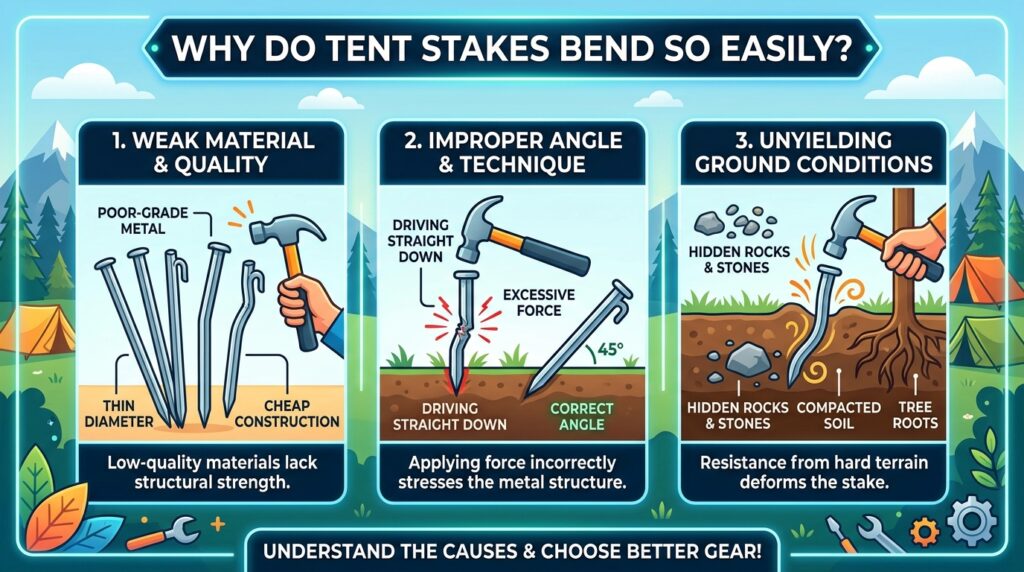
The Ultimate Guide to Tent Anchors: Why Do Tent Stakes Bend So Easily
If you’ve ever been on a camping trip, you know the frustration: you’re trying to set up camp as the sun goes down, you swing your mallet (or use your boot), and ping—your tent stake is now a useless piece of curved metal.
But why does this happen so consistently? Is it poor manufacturing, or are you using the wrong tool for the job? In this comprehensive guide, we break down the science of why tent stakes bend and how to prevent it.
1. The Physics of the “Bend”: Why Stakes Fail
Most people assume a stake bends because the ground is “too hard.” While that’s part of it, the primary reason is lateral stress and point load.
- Compression vs. Shear: Most budget stakes are designed to handle tension (the pull of the tent). They are not designed to handle the high-impact compression of a heavy mallet hitting the top at a slight angle.
- The Fulcrum Effect: Once a stake hits a rock underground, the top of the stake becomes a lever. If you keep pushing, the energy has nowhere to go but sideways, resulting in a permanent deformity.
2. Material Matters: What is Your Stake Made Of?
Not all stakes are created equal. The material is the #1 predictor of whether a stake will survive the weekend.
| Material | Durability | Weight | Best For |
| Steel (Skewer) | Low | Heavy | Soft backyard soil only. |
| Aluminum (7000 Series) | High | Ultra-Light | Backpacking, rocky terrain. |
| Titanium | Very High | Featherweight | Professional trekking. |
| ABS Plastic | Medium | Moderate | Sand and very soft soil. |
| Forged Steel | Extreme | Very Heavy | Car camping, hard-packed earth. |
The “Cheap Steel” Problem
Most entry-level tents come with thin, galvanized steel “shepherd’s hooks.” These have a low yield strength. Once they hit a specific pressure threshold, the molecules in the metal shift permanently.
3. Top 5 Reasons Your Tent Stakes Are Bending
If you find yourself constantly replacing stakes, one of these five culprits is likely to blame:
A. Striking at the Wrong Angle
Many campers drive stakes straight down (90 degrees). The optimal angle is 45 degrees pointing away from the tent. Driving it straight down increases the likelihood of the stake “buckling” under the tension of the rainfly.
B. “The Boot Method”
Using your foot to press a stake into the ground is a recipe for disaster. Your weight is unevenly distributed, and if the stake hits a pebble, your foot will naturally tilt, snapping or bending the metal instantly.
C. Rocky Subsoil
The surface might look like soft grass, but just three inches down, there could be a layer of limestone or packed gravel. When the tip hits an immovable object, the shaft absorbs the impact and bows.
D. Thin Diameter
Standard “hook” stakes are usually only 3mm to 5mm thick. This thin profile has very little structural integrity against lateral force.
E. Weathering and Fatigue
Metal fatigue is real. If a stake has been slightly bent and straightened before, the “neck” of the metal is compromised. It will bend much easier the second time.
You have to use the best tent stakes for rocky ground or heard space, after than your problem will be solved.
4. How to Drive a Stake Without Bending It
Follow these professional tips to ensure your anchors stay straight:
- Clear the Area: Use a stick to poke the ground first to check for hidden rocks.
- Use a Dead Blow Hammer: A rubber mallet or a specialized tent hammer distributes force more evenly than a rock or a standard framing hammer.
- The “Tap-Tap” Technique: Don’t try to drive the stake in with one massive blow. Use frequent, light taps. If you feel resistance, stop. Pull it out and move it two inches to the left or right.
- Use a “Pilot Hole”: In extremely hard ground, use a single heavy-duty steel “rock peg” to create a hole, remove it, and then insert your lighter aluminum stake.
5. Upgrading Your Gear: The Best Stakes for Every Ground Type
If you want to stop bending stakes forever, you need to match your gear to the terrain.
- For Hard/Rocky Ground: Use Threaded Steel Stakes or V-Shaped Aluminum Pegs. The V-shape provides structural “ribs” that make it nearly impossible to bend sideways.
- For Sand or Snow: Use “Snow Flukes” or long, wide plastic stakes with “fins.” These rely on surface area rather than depth.
- The Gold Standard: The MSR Groundhog is widely considered the best all-around stake because of its “Y-beam” design. It is structurally reinforced from three different angles.
6. Frequently Asked Questions (FAQ)
Can I straighten a bent tent stake?
You can, but it will never be as strong. Straightening it creates “stress risers” in the metal. It’s better to carry a few spares than to rely on a compromised peg.
Why do my stakes pull out of the ground?
This usually happens because the ground is too soft or the stake is too short. Switching to a “screw” style or a longer 12-inch stake usually fixes this.
Are plastic tent stakes better than metal?
Only in sand or loose soil. In hard ground, plastic will shatter or “mushroom” at the top when hit with a hammer.
Conclusion: Stop the Bend
Tent stakes bend because of a mismatch between technique and terrain. By upgrading to a Y-beam or forged steel stake and using a 45-degree angle with a rubber mallet, you can avoid the “bent peg” headache.
Pro Tip: Always carry 2-4 more stakes than your tent actually requires. In the world of camping, stakes are the one thing you don’t want to be “short” on.