
If you’ve ever stood in a campsite in the Texas heat or the rocky soil of California, hammer in one hand and a tent stake in the other, you’ve likely hesitated. You know that steel hammer is meant for nails, and that aluminum stake is… well, it’s not a nail.
At besttentstakes.com, we frequently hear from campers who have returned from a trip with a handful of bent, mangled, or “mushroomed” stakes. The culprit? Almost always an improper hammering technique.
In this guide, we will break down exactly why a standard household claw hammer can be the death of your aluminum stakes, how to identify if your stakes are already compromised, and—most importantly—how to secure your shelter without destroying your gear.
The Metallurgy: Why Aluminum Stakes and Claw Hammers Don’t Mix
To understand why a claw hammer causes damage, you have to look at the material properties.
Most high-quality tent stakes are made from 7075-T6 or 6061-T6 aluminum alloys. These are prized in the outdoor industry because they are incredibly lightweight and have an excellent strength-to-weight ratio. However, compared to the hardened tool steel of a claw hammer, aluminum is significantly softer.
The Problem of “Mushrooming”
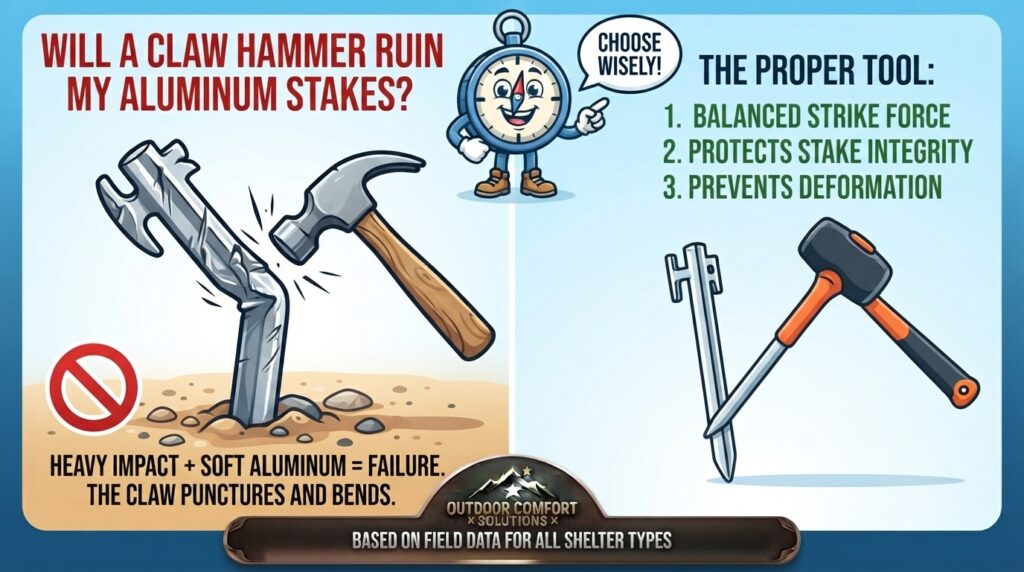
When you strike a metal stake with a steel claw hammer, you are transferring a massive amount of kinetic energy through a small, concentrated point.
- Work Hardening: The repeated impact of the steel hammer causes the aluminum at the head of the stake to deform and spread outward. This is called “mushrooming.”
- Structural Fatigue: Once the top of the stake is deformed, the structural integrity of the entire shaft is compromised. It becomes prone to bending under tension, making your tent setup unstable.
- The “Hook” Hazard: If your stake has a plastic cap or a cord loop, a single misdirected strike from a claw hammer will shatter the plastic, rendering the stake useless.
Regional Impacts: Soil Hardness and Your Stakes
Your risk of damaging your stakes is directly proportional to the terrain you are camping in. Let’s look at how geography dictates your tool choice.
| Region | Typical Ground Conditions | Hammer/Stake Verdict |
| Texas | Baked Clay / Hardpan | Extremely high risk of damage; use a rubber mallet. |
| New York | Loam / Root-heavy | Moderate risk; be careful of hidden rocks. |
| California | Granite / Rocky | High risk; standard aluminum will fail here. |
| Washington | Damp Forest Floor | Low risk; rarely need a hammer at all. |
| San Francisco | Sandy / Loose | Low risk; hammering is unnecessary. |
The Texas Hardpan Reality
In arid climates like Texas, the ground can be as hard as concrete during summer months. Campers often feel they need a claw hammer just to penetrate the crust. If you are in this environment, do not use a claw hammer directly on the stake. Instead, use a “sacrificial” piece of wood or a flat stone as a buffer between the stake and the hammer face.
How to Hammer (or When Not To)
The best way to save your aluminum stakes is to learn when to put the hammer away entirely.
1. The “Step-Press” Method
For most soils—especially the damp, loamy forest floors of Washington or New York—a hammer is completely unnecessary. Use the arch of your foot or the heel of your boot to press the stake into the ground. This applies steady, uniform pressure that is far less likely to cause the stake to bend or warp.
2. The Rubber Mallet Upgrade
If you are car camping and expecting hard ground, invest in a dedicated rubber mallet. The soft face absorbs the shock, distributing the energy of the blow across the entire head of the stake, which prevents mushrooming and protects your gear.
3. The “Pilot Hole” Trick
If you are camping in rocky soil, don’t force your stake. If you hit an unyielding rock, stop. Trying to hammer your way through will only snap your aluminum stake. Instead, use a heavy-duty titanium nail peg to drive a “pilot hole,” remove it, and then slide your standard aluminum stake into the pre-made hole.
10 Frequently Asked Questions (FAQ)
1. Can I use a hammer if I cover the stake head?
Yes. If you must use a claw hammer, place a folded piece of thick fabric or a flat, smooth stone over the head of the stake to distribute the force.
2. How do I know if my stake is ruined?
If the top is “mushroomed” (spread out) or if the shaft has a visible kink or bend, it is time to replace it. A bent stake will never hold as firmly as a straight one.
3. What should I do if a stake is stuck?
Never use the claw end of the hammer to pry it out. You will bend the stake instantly. Instead, use another stake to hook through the loop and pull it straight up.
4. Does the weight of the hammer matter?
Yes. A 16–20 oz claw hammer is far too heavy for a 10–20 gram tent stake. The lighter the hammer, the better.
5. Are all aluminum stakes the same?
No. 7075-T6 aluminum is much more durable than cheaper, generic aluminum found in budget tents.
6. Will my stakes rust if the coating is damaged?
Aluminum doesn’t “rust” like iron, but it can corrode. If you bash off the protective anodized coating with a hammer, the exposed raw aluminum will oxidize over time.
7. Is it okay to hammer in sandy soil?
No. In sand, you should use long, wide-bodied stakes. Hammering a standard stake into sand provides zero holding power.
8. What is the best alternative to a claw hammer?
A rubber mallet is best for car camping. A simple, sturdy rock is best for backpacking.
9. Can I fix a mushroomed stake?
Sometimes you can file down the edges of the “mushroom” with a metal file, but the structural integrity of the head will be permanently weakened.
10. When should I upgrade to titanium?
If you find yourself constantly bending aluminum stakes, it is time to switch to titanium. Titanium nail pegs are designed specifically to withstand the rigors of rocky ground.
Conclusion: Protect Your Investment
Your tent stakes are the unsung heroes of your camping trip. By avoiding the temptation to use a heavy-duty household claw hammer—or by at least using a buffer to protect your gear—you can significantly extend the lifespan of your stakes.
Remember, the goal is not just to get the stake in the ground, but to keep your shelter secure for the duration of your trip. If you are tired of bent aluminum and want a more durable solution for your next adventure in California or the plains of Texas, check out our selection of reinforced stakes at besttentstakes.com.