
We have all been there: the final morning of a perfect trip. You have packed your sleeping bag, rolled up your rainfly, and now you are faced with the most frustrating part of the entire camping experience—the “impossible” tent stake. Whether it is buried in the sun-baked clay of Texas, wedged between granite slabs in California, or frozen solid in the high country of Washington, a stuck stake can ruin your exit strategy.
At besttentstakes.com, we know that improper removal is the number one cause of bent, broken, and mangled tent stakes. Many campers resort to brute force, pulling on the guy-lines or using the claw of a household hammer, only to destroy their equipment in the process.
In this comprehensive guide, we will teach you the professional techniques for removing even the most stubborn stakes without damaging your gear.
Why Stakes Get Stuck (And Why You Should Care)
Stakes get stuck for three primary reasons:
- Friction: Over time, dirt, sand, and moisture settle around the stake, creating a vacuum-like bond with the soil.
- Mechanical Interference: You may have driven the stake through a dense root system or between rocks that are now acting like a “pinch point.”
- Deformation: If you hammered the stake in at an angle, the shaft itself may be slightly bent, making it impossible to pull out along the path it entered.
The Golden Rule: Never pull on the tent’s guy-line, loop, or fabric to extract a stake. This puts immense, localized stress on your tent’s stitching, which can lead to tears, ripped-out grommets, and permanent damage to your shelter.
The Pro Techniques: How to Remove a Stuck Stake
When your fingers just aren’t enough, use these methods in order of increasing force.
1. The “Wiggle and Rotate” Method
Before reaching for tools, try the manual method. Grip the stake head firmly—if it is a flat-top stake, use a glove for better grip. Rotate the stake back and forth (clockwise and counter-clockwise) while pulling upward. This rotation breaks the friction bond between the metal and the soil.
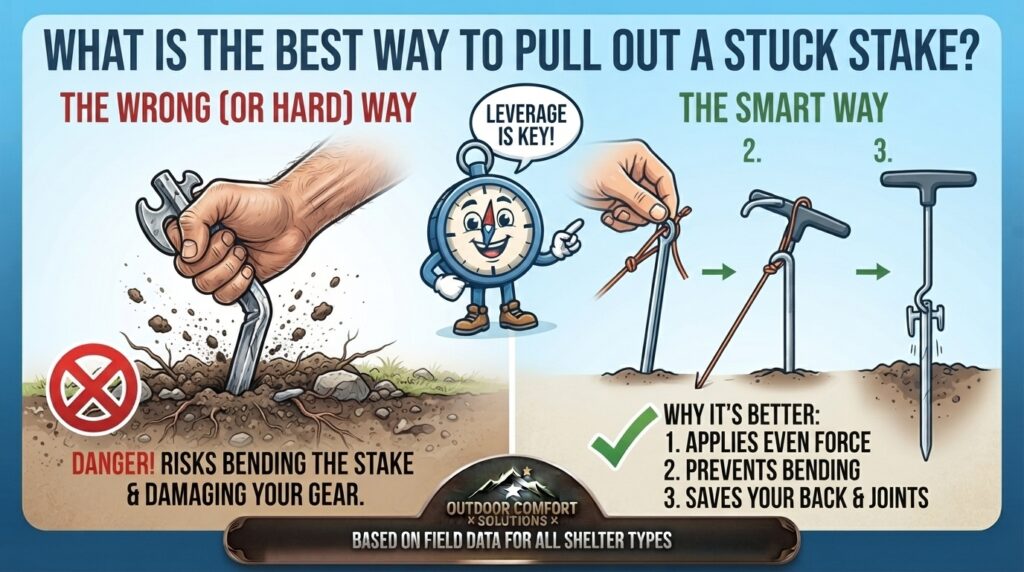
2. The “Stake-on-Stake” Technique (Highly Recommended)
This is the single most effective, damage-free method.
- Take a spare tent stake.
- Hook the spare stake through the pull-loop or under the notch of the stuck stake.
- Use the spare stake as a handle to pull straight up.
- Why it works: This creates a perfect vertical axis of force, which is the path of least resistance. It eliminates the leverage damage that comes from prying.
3. The Lever Method (With Caution)
If the stake is deeply embedded, you may need leverage. Place a sturdy rock or a piece of wood near the base of the stake to act as a fulcrum. Use a spare stake as your lever. Do not use the claw of a metal hammer for this, as the steel claw is too small and will crush or snap the stake.
Regional Challenges: Where You Are Matters
| Region | Primary Obstacle | Recommended Removal |
| Texas | Hard-packed clay (suction) | Water soak + Stake-on-Stake |
| New York | Deep roots | Rotate and clear soil |
| California | Granite/Rocks | Rock-tap (vibration) |
| Washington | Damp/Wet loam | Steady vertical pull |
| San Francisco | Deep sand | Digging/Exposing the stake |
- Texas Tip: If the ground is like concrete, pour a small amount of water around the base of the stake. Let it sit for 5 minutes. The water will break the suction of the clay, allowing the stake to slide out easily.
- California Tip: If your stake is wedged in granite, don’t pull harder. Use a rock to tap the sides of the stake gently. The vibration will loosen the fine dirt holding the stake in place.
10 Frequently Asked Questions (FAQ)
1. Why shouldn’t I use the claw hammer?
The claw of a hammer is designed to pry nails from wood. It applies extreme pressure to a tiny surface area on the stake. Aluminum stakes are too soft to withstand this and will bend or snap immediately.
2. Can I pull on the tent loops?
Never. You risk tearing the fabric or popping the grommet. Always pull the stake directly, not the tent attached to it.
3. What if the stake is completely buried?
If you can’t find the head, use a small trowel or a sturdy stick to dig a narrow trench around the stake until you can get a grip on the top.
4. Does the shape of the stake affect removal?
Yes. Y-stakes have more surface area and can be harder to pull out than smooth nail pegs. Expect to use more “wiggle” for Y-stakes.
5. What if the pull-cord breaks?
If the cord breaks, use the “Stake-on-Stake” method by hooking the remaining notch or the head of the stake directly.
6. Is it better to pull at an angle?
No. Always pull in the exact opposite direction the stake was driven in. Prying at an angle is the fastest way to bend your gear.
7. What if the stake is frozen in the ground?
Pour a little warm water (not boiling) around the stake to melt the ice bond.
8. Are titanium stakes easier to pull out?
Generally, yes. Titanium doesn’t bond as strongly to soil or ice as aluminum does, making it easier to extract.
9. How do I clean my stakes after pulling them?
Use a stiff-bristled brush to remove dried mud. If they are metal, ensure they are dry before putting them in your stuff sack to prevent oxidation.
10. Can a “stuck” stake be a sign of a bad setup?
Yes. If you had to hammer your stake in so deep that it is impossible to remove, you might be using the wrong type of stake for the soil.
Pro Tips for Easier Extraction
- Leave a loop: Always attach a small loop of reflective cord to the head of your stakes. It gives you something to grab and makes them easier to find.
- The “Half-Depth” Rule: You don’t always need to drive a stake to the hilt. In soft ground, driving it 75% of the way is often enough for security and makes removal 100% easier.
- Mark Your Territory: If you are camping in tall grass, mark the location of your stakes with a small stone so you don’t lose them when it’s time to pack up.
Conclusion
Mastering the art of stake removal is the mark of a seasoned camper. By swapping the destructive “claw hammer pry” for the Stake-on-Stake method, you protect your gear and ensure that your high-quality stakes last for hundreds of trips. Remember to adapt your technique to the local soil—soaking the clay in Texas, vibrating the granite in California, or gently twisting in the forests of New York.
At besttentstakes.com, we believe your gear should be as tough as your adventures. Whether you need stakes designed for easy removal or heavy-duty anchors for extreme terrain, we have the tools to keep you grounded.