
For many beginners, the process of setting up a tent ends the moment the stake is hidden from view. There is a common assumption that a stake driven entirely into the dirt—flush with the surface—is the “correct” way to ensure maximum stability. However, at besttentstakes.com, we frequently find that this “bury it deep” mentality is a leading cause of damaged gear, tripping hazards, and incredibly frustrating pack-ups.
So, should you hammer your stakes all the way into the ground? The answer is nuanced, depending on your soil type, the stake design, and the local climate. This guide will help you master the balance between security and accessibility.
The “Flush” Myth: Why Driving It All the Way Down Isn’t Always Best
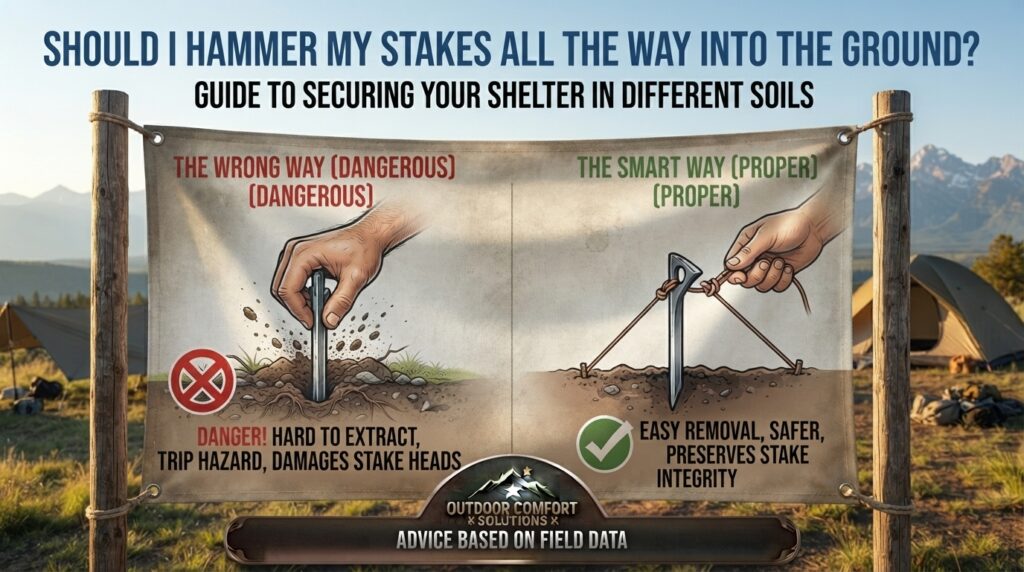
The primary purpose of a tent stake is to hold your guy-line at the optimal angle to keep the tent body taut. While deep embedment provides high pulling resistance, driving the stake until the head is flush with the ground creates several problems:
- Extraction Difficulty: If there is no loop or head exposed to grab onto, you are forced to dig or pry, which drastically increases the likelihood of bending your stake.
- Increased Risk of Damage: When the head is flush, you are more likely to strike your tent’s guy-line, fabric, or cordage with your mallet or rock during the setup process.
- Safety/Tripping Hazard: A stake driven perfectly flush is nearly invisible. It becomes a major tripping hazard, which can lead to injury and, ironically, pull the stake out and rip your tent in the process.
Regional Staking Strategies: How Geography Dictates Depth
Not all soil is created equal. The optimal depth for your stake changes dramatically depending on whether you are in the loose sands of San Francisco or the dense, rocky terrain of California.
| Region | Soil Composition | Optimal Stake Depth |
| Texas | Baked Clay / Hardpan | 80-90% (Keep head exposed) |
| New York | Loam / Forest Floor | 75% (Ideal balance) |
| California | Granite / Rocky | Only as deep as it goes without hitting a rock |
| Washington | Damp / Soft Soil | 90-100% (Need full depth for friction) |
| San Francisco | Sand / Coastal | 100% (Use long sand-specific stakes) |
The “Friction vs. Resistance” Balance
- In Soft Soil (Washington): You often need the full length of the stake to create enough surface area for friction. Here, driving it to the hilt is often necessary to keep the tent from sliding.
- In Hard Ground (Texas/California): The soil itself provides the resistance. You do not need to drive the stake deep; you just need to drive it enough to “seat” it so it doesn’t wobble.
The Golden Rule: The 90-Degree Angle
Regardless of how deep you go, the angle is more important than the depth.
The best way to secure your tent is to drive the stake into the ground at a 45 to 60-degree angle pointing away from the tent. This creates a 90-degree angle between the guy-line and the stake. This leverage position is mechanically superior. Even if the stake is only 75% in the ground, it will hold significantly better than a stake driven 100% in at the wrong angle.
10 Frequently Asked Questions (FAQ)
1. Does driving it all the way in make it stronger?
Only in very soft or sandy soil where you need the extra surface area to prevent pull-out. In firm soil, the extra depth adds negligible holding power while making removal significantly harder.
2. Is a flush-driven stake a tripping hazard?
Absolutely. Always leave at least 1-2 inches of the stake (or the cord loop) visible. If you are camping in a high-traffic area, mark your stakes with reflective tape.
3. What if my stake head is buried and I can’t find it?
Use a small garden trowel or a sturdy stick to clear the topsoil. Never pull on the tent’s webbing to find the stake; you will rip your tent.
4. Should I leave the loop out?
Yes. The pull-loop or the notch at the top of the stake is designed to be the attachment point for your guy-line. It should always remain accessible.
5. Can I hammer the head into the ground?
Only if you are using a rubber mallet and your stake is made of high-quality titanium or heavy-duty aluminum. Using a claw hammer on a flush stake will likely damage the stake head.
6. Do I need to bury the whole stake in sandy soil?
Yes. Sand has very low friction. You want the maximum length buried to create as much “drag” as possible.
7. What is the biggest mistake people make when staking?
Driving the stake vertically (at 90 degrees to the ground) instead of angling it away from the tent.
8. Is it easier to remove a flush stake?
No, it is much harder. Leaving an inch of the stake exposed gives you something to grab or hook another stake into for removal.
9. What if I hit a rock 2 inches down?
Stop. Do not force the stake deeper. A stake that is only partially driven but clear of rocks is more secure than a stake that has been forced and bent against a subterranean boulder.
10. Do different stake types require different depths?
Yes. “Nail pegs” are designed to go deep, while “snow/sand stakes” are designed to be buried horizontally, which is a completely different technique.
Pro Tips for the Perfect Pitch
- The “Wobble” Test: Once you have driven your stake to your preferred depth, give the top a firm tug. If it wobbles or moves, it needs to be driven a bit deeper or repositioned to a more solid spot.
- Avoid the “Over-Drive”: If you find yourself having to use all your strength to get a stake in, stop. You are likely dealing with hidden roots or rocks. Relocate by a few inches.
- Cord Loops are Key: Always have a reflective, high-visibility loop on the head of your stake. It serves as a visual marker to prevent tripping and provides a secure point for removal.
Conclusion
The “bury it completely” approach is a common pitfall that does more harm than good for most campers. For the vast majority of terrains, driving your stakes to about 75-90% depth, while maintaining a strict 90-degree tension angle, is the secret to a secure, stable, and frustration-free campsite.
By keeping a small portion of the stake head exposed, you ensure easy removal, prevent tripping, and protect your tent fabric from unnecessary strain.
At besttentstakes.com, we provide the high-performance stakes you need to handle any soil condition with confidence. Whether you’re setting up on the soft forest floors of Washington or the rocky slopes of California, we have the gear to keep your shelter perfectly grounded.