
Every camper has been there: you arrive at the site, the sun is starting to dip below the horizon, and you realize the ground is hard, baked, or filled with hidden river rock. You reach for your tent stake, try to push it in with your boot, and nothing happens. You look around, see your heavy-duty claw hammer in your trunk, and wonder: Is it okay to use this?
At besttentstakes.com, we frequently field questions about gear maintenance and campsite setup. While a standard household claw hammer seems like the most logical tool for the job, the answer is nuanced. Using the wrong tool can lead to damaged equipment, ruined stakes, or worse—a torn tent.
In this guide, we will explore the risks, the benefits, and the best alternatives for getting your tent secured, whether you are camping on the rocky ridges of California, the hardpan of Texas, or the damp loam of Washington.
The Risks of Using a Household Claw Hammer
A claw hammer is designed for driving nails into wood, a task that requires force, precision, and a specific kind of impact. Tent stakes, however, operate under entirely different physical constraints.
1. Material Damage
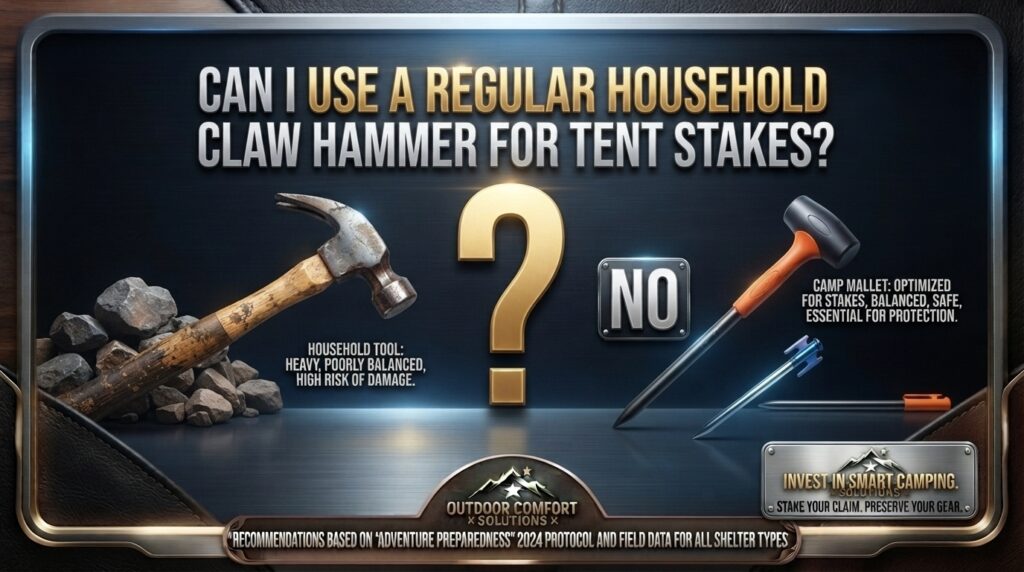
Most household hammers are made of hardened steel with a flat, often textured face designed to grip a nail head. If you use a steel claw hammer on a standard aluminum tent stake, the force of the blow can easily deform the top of the stake. This is especially true for hollow-tube or thin aluminum stakes, which can flatten or “mushroom,” making them difficult to pull out or pack away.
2. Excessive Force (The “Overkill” Factor)
Claw hammers are heavy, often ranging from 16 to 20 ounces. When you swing a heavy tool at a small piece of metal, you risk driving the stake deeper than necessary, or worse, hitting a subterranean rock and snapping the stake entirely. Once an aluminum stake is bent or snapped below the surface, it is almost impossible to remove without digging up a large chunk of your campsite.
3. The “Claw” Liability
The back of a claw hammer is designed to pry nails out of wood. If you use it to pry a tent stake out of the ground, you are applying intense, concentrated force to a single point on the stake’s head. This can snap the plastic loop or the metal neck of the stake instantly, leaving you with a useless piece of bent aluminum.
Terrain-Specific Staking: Why Your Hammer Choice Matters
The geography of your campsite significantly changes how much force you need to drive a stake.
| Region | Soil Type | Hammer Recommendation |
| Texas | Baked Clay / Hardpan | Rubber Mallet or specialized tent hammer |
| New York | Forest Loam / Roots | Push with foot; clear roots by hand |
| California | Granite / Rocky | Titanium Nail Peg + Dedicated Tent Hammer |
| Washington | Damp / Soft Soil | Standard peg; use your heel |
| San Francisco | Sandy/Loose | Long sand-stake; avoid hammering |
The Texas Hardpan Problem
In places like Texas, the ground can be as hard as concrete. If you are camping in an area with dry clay, a claw hammer might actually be necessary because a rubber mallet will simply bounce off. If you must use a heavy hammer in these conditions, use a piece of wood between the hammer and the stake to distribute the force and protect the stake head.
Better Alternatives for the Modern Camper
If you are looking to protect your gear and keep your pack light, consider these alternatives to the bulky household claw hammer:
- The Rubber Mallet: The gold standard for car camping. It provides enough weight to drive a stake into hard earth without the destructive impact force of a steel hammer.
- The Rock (The “Nature’s Hammer”): For backpackers, a solid, fist-sized rock is the most versatile tool. It is free, effective, and you don’t have to carry it.
- The Specialized Tent Hammer: Often made of lightweight aluminum with a hook on the back for pulling stakes, these are designed specifically for the geometry of tent stakes.
- Your Foot/Boot: For 90% of campsites, a firm push with a sturdy hiking boot is sufficient. If you can’t push it in with your foot, the ground is either too hard (requires a better stake) or you have hit a rock (move the stake).
10 Frequently Asked Questions (FAQ)
1. Will a claw hammer ruin my aluminum stakes?
Yes, high-impact force from a steel hammer face can flatten or “mushroom” the head of an aluminum stake, making it harder to use in the future.
2. What is the best way to pull out a stuck stake?
Do not use the claw end of your hammer. Instead, take a spare stake, hook it into the loop or notch of the stuck stake, and pull upward.
3. Should I hammer my stakes all the way into the ground?
For maximum stability, you should drive the stake in until only the hook or the loop is exposed. This prevents the stake from becoming a tripping hazard.
4. Can I use a hammer on titanium stakes?
Yes, titanium is much more durable than aluminum. However, still try to strike vertically to avoid bending the stake.
5. What if I hit a rock while hammering?
Stop immediately. If you keep hammering, you will bend the stake. Move the stake a few inches to the left or right to find a clear path.
6. Are there specific stakes meant for hammering?
Yes, “Nail Pegs” are specifically designed to be driven into hard ground with a hammer. Y-stakes and V-stakes are better suited for softer soil and should be handled with more care.
7. How do I protect my stakes when using a heavy hammer?
Place a flat stone or a thick piece of folded cloth over the head of the stake before striking it.
8. Is a rubber mallet worth the extra weight?
If you are car camping, absolutely. It saves your gear and makes setup much quieter. For backpacking, stick to using a rock.
9. Why does my stake bend when I hit it?
You are likely hitting it off-axis (not straight down) or the stake is made of a lower-grade aluminum that isn’t designed for hard soil.
10. Does soil type affect my choice of hammer?
Yes. Soft, wet soil requires no hammer at all. Hard, baked, or rocky soil requires a durable stake and a method to apply significant, focused force (like a mallet or a rock).
Pro Tips for Effortless Staking
- The 90-Degree Rule: Always drive your stake into the ground at an angle pointing away from the tent. This creates maximum resistance against the pull of the rainfly.
- Double Staking: In extremely high-wind scenarios, use a second stake behind the first to create a “load-sharing” anchor.
- Go Bright: Use stakes with high-visibility heads. If you are using a hammer, it is easy to lose track of stakes in tall grass.
- Clear the Area: Before you hammer, clear the surface of small rocks or debris so you have a flat, stable area to start your stake.
Conclusion
While you can use a regular household claw hammer for tent stakes in an emergency, it is rarely the best tool for the job. Its weight and design are often overkill, leading to bent, mushroomed, or snapped stakes. For most campers, a rubber mallet for car camping or a simple, sturdy rock for backpacking is a much safer, more effective solution.
If you find that your current stakes require a heavy-duty steel hammer just to get into the ground, it might be time to upgrade your gear. At besttentstakes.com, we offer high-strength titanium and reinforced aluminum stakes designed to handle the toughest terrain without the need for a carpenter’s toolkit.